SPY, IVV, QQQ Absorb $8.7B While SOXX Bleeds
Institutions rotated hard within tech on August 14 — piling into broad equity ETFs while dumping $1.56B from semiconductor funds SOXX and SMH.
Key Points
- SPY, IVV, and QQQ together absorbed $8.68 billion in a single session while SOXX and SMH shed a combined $1.56 billion in redemptions.
- Institutions are rotating within tech — not out of it — trimming semiconductor exposure while loading broad-index vehicles that dilute chip-stock concentration risk.
- Watch SOXX at the $220 level and the August 27 PCE release as the next trigger for either a reversal or acceleration of this rotation.
A single trading session this week produced $15.3 billion in net ETF inflows — one of the heaviest one-day creation prints of 2026 — but the composition of those flows tells a more surgical story than the headline number suggests. Semiconductor ETFs were gutted while large-cap index funds gorged, a split that signals institutional positioning for a world where AI enthusiasm endures but chip-stock valuations need a haircut.
Where the $15 Billion Actually Went
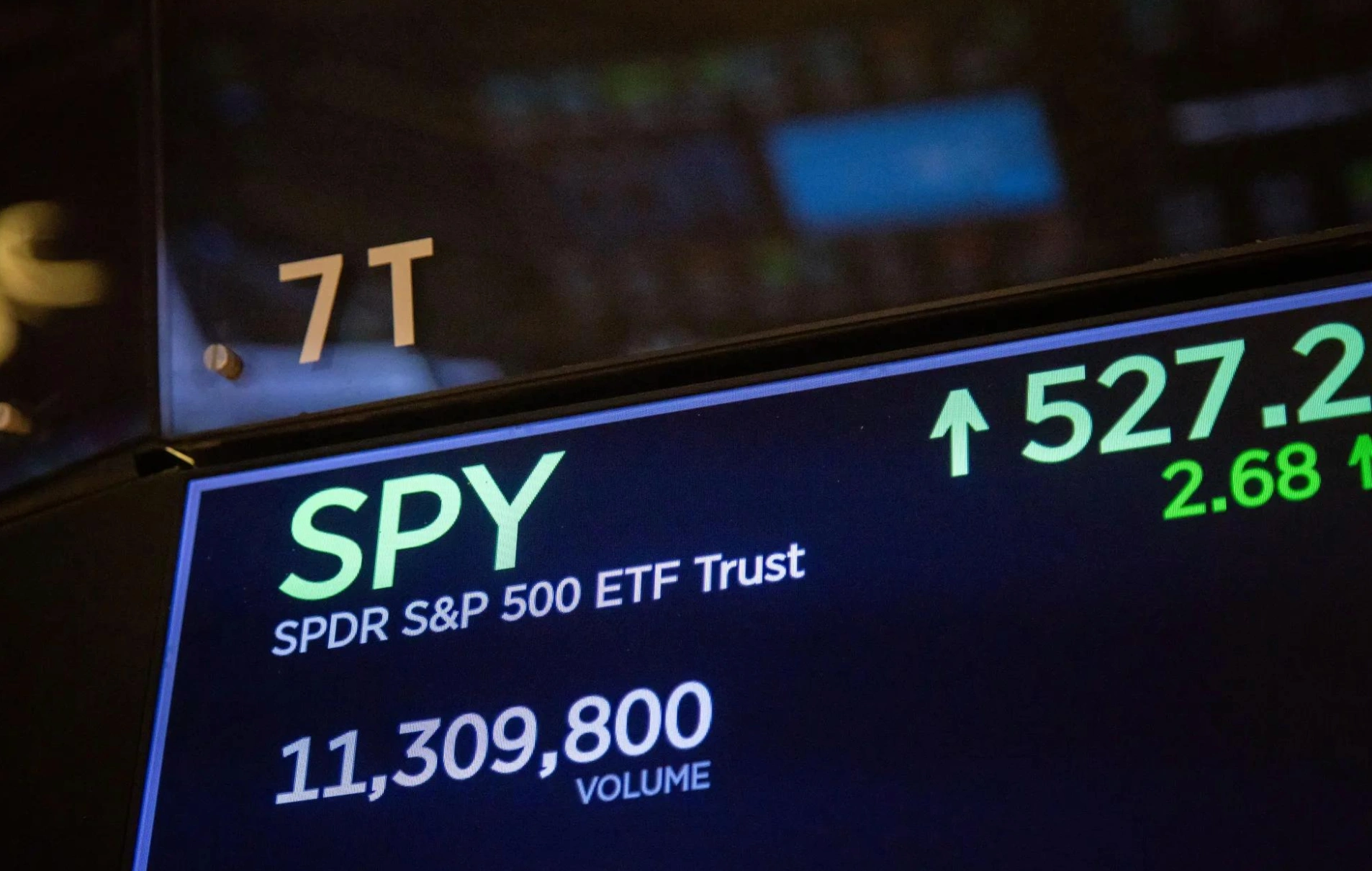
SPY led all U.S.-listed ETFs with $4.13 billion in net creations in a single session, followed by IVV at $2.71 billion and QQQ at $1.84 billion. Combined, those three funds absorbed $8.68 billion — more than half the day's total ETF net issuance — in what amounts to a coordinated institutional bet on broad U.S. equity exposure rather than any single sector or theme. DIA added $891.3 million and XLI, the Industrial Select Sector SPDR, gathered $764.1 million, reinforcing the breadth of the buying. GLD rounded out the top creations list at nearly $637 million, an important secondary signal given the macro context.
The industrial allocation deserves more attention than it typically gets. XLI pulling in $764 million on a day dominated by tech-index buying suggests portfolio managers are hedging their equity duration with cyclical exposure that benefits from onshoring, infrastructure spending, and a labor market still holding at 4.1% unemployment. That's not a defensive posture — it's a reflation trade dressed up inside an equity rally. The 10-year Treasury yield sitting at 4.68% as of August 12 provides the macro frame: the bond market is not pricing in imminent rate cuts, so equity buyers are gravitating toward earnings power over rate-sensitive growth.
The week ending August 5 showed ETF net issuance of $43.70 billion, with total combined long-term mutual fund and ETF inflows at $27.28 billion per ICI data. Equity funds drew $8.52 billion that week, down from $17.19 billion the prior week, but the directional signal remains positive. World equity funds outpaced domestic by nearly five to one — $7.02 billion versus $1.51 billion — suggesting global diversification is running alongside the U.S. large-cap accumulation, not replacing it.
The Semiconductor Unwind Is Deliberate
SOXX recorded $1.16 billion in redemptions — the second-largest outflow across all ETFs in that session — while SMH shed an additional $402.9 million. Together, $1.56 billion left the two largest semiconductor-focused ETFs in a single day. That is not noise. That is a coordinated institutional decision to reduce concentrated chip exposure at a moment when broad tech indices — QQQ gained 0.2% on the day — are still in favor.
The divergence is the message. QQQ absorbing $1.84 billion while SOXX bleeds $1.16 billion means institutional money managers are comfortable owning the Nasdaq 100's semiconductor weight passively — roughly 8-9% of QQQ is in semiconductor names — but are unwilling to hold a pure-play chip vehicle at current valuations. SOXX's top holdings, including Broadcom, NVIDIA, and AMD, have run hard on AI capex narratives. When the index-level vehicle gets bought and the sector-specific vehicle gets sold simultaneously, the trade being expressed is mean-reversion risk management: take the AI tailwind through a diversified wrapper, not through a concentrated bet.
The macro backdrop reinforces the trim. With the Fed funds effective rate at 3.63% and the new Fed Chair Kevin Warsh having held rates unchanged through two consecutive meetings while markets now lean toward a potential hike, the discount rate environment is not friendly to high-multiple semiconductor names trading at 30-40x forward earnings. The 10-year at 4.68% versus the 2-year at 4.20% produces a positively sloped curve of 48 basis points — historically associated with economic expansion but also with tightening financial conditions that compress tech multiples over time. Semiconductor stocks sit at the pointy end of that duration risk.
Gold, Bitcoin, and the Parallel Safe-Haven Bid
GLD's $637 million single-session inflow didn't make the headlines that SPY did, but it is arguably the most important secondary data point in this week's flow report. Gold ETF buying at that scale, concurrent with massive equity accumulation, suggests institutional managers are not treating this as a risk-on-only session. They are building in protection. Bitcoin ETFs recorded their strongest weekly inflows since mid-April 2026 at $853.54 million, with BlackRock's IBIT continuing to dominate the spot Bitcoin ETF landscape — a parallel safe-haven or inflation-hedge bid running through digital assets that reinforces the GLD signal.
The fixed income picture adds another layer. Ultrashort bond ETFs have absorbed $72.1 billion year-to-date, reflecting persistent demand for yield without duration risk. Intermediate strategies have drawn roughly $80 billion. But the notable shift is at the long end: long-duration ETFs, which took in only about $2 billion through the first half of 2026, posted their best single month of the year with $4 billion-plus in August inflows. TLT inflow data flagged in the August 10 flow report showed a surge that is consistent with a small but growing cohort of investors positioning for a growth scare or eventual rate pivot — even as the base case remains rates-higher-for-longer.
The gold and long-bond bids together represent a macro hedge being layered underneath what is otherwise an aggressive equity accumulation day. The $15.3 billion headline is bullish. The $637 million to GLD and $4 billion month to long-duration bond ETFs running alongside it says sophisticated money is not fully trusting the rally.
According to ETF.com flow data, total U.S. ETF assets stand at $16.22 trillion, and the single-day $15.3 billion creation represents 0.09% of that base — a meaningful but not extreme surge. Year-to-date 2026 inflows have crossed $1 trillion, with July alone contributing $191 billion toward a running annual total near $1.3 trillion. The pace implies 2026 could set a record for annual ETF inflows, which would validate the structural shift from active mutual funds into passive and semi-active exchange-traded vehicles.
Traders should watch SOXX around the $220 level as the technical floor that institutional sellers will test against. If SOXX stabilizes there while QQQ continues to attract creations, the rotation-within-tech thesis holds. If SOXX breaks below that level on sustained redemptions, the next destination for that capital is likely XLI and XLV — cyclicals and healthcare — rather than a return to semiconductor overweights. The August 27 PCE inflation release is the next scheduled macro catalyst that could either validate the current positioning or force a rapid reshuffling of these flow dynamics.
The Weekly Investor
Daily market analysis for active traders. Free.