Kroger Q2: EPS Beat Can't Hide the $12B Market Share Bleed
Kroger beats EPS but misses revenue as $12B in consumer spending migrates to Amazon, Walmart, and Costco. What Greg Foran's first print means for KR.
Key Points
- Kroger beat the $1.05 adjusted EPS consensus but missed the $34.68 billion revenue target, with margin compression adding a second strike against the revenue line.
- Greg Foran's debut print exposes a structural wound: Kroger customers have redirected more than $12 billion in consumer packaged goods spending to Amazon, Walmart, and Costco over the past year.
- The October investor update is the next hard catalyst — management must deliver a credible financial framework and savings acceleration timeline or analysts with already-trimmed price targets will cut again.
Kroger's first earnings report under CEO Greg Foran landed Friday with a familiar shape: adjusted EPS cleared the $1.05 Wall Street consensus, full-year guidance got a modest lift to $5.10–$5.30 in adjusted EPS, and yet none of it was enough to paper over a revenue miss against the $34.68 billion target and the margin compression that accompanied it. The stock's reaction stayed inside the 5.5–6.3% band that options markets had priced ahead of the print — measured, not panicked, but not vindicated either.
Foran's Inheritance
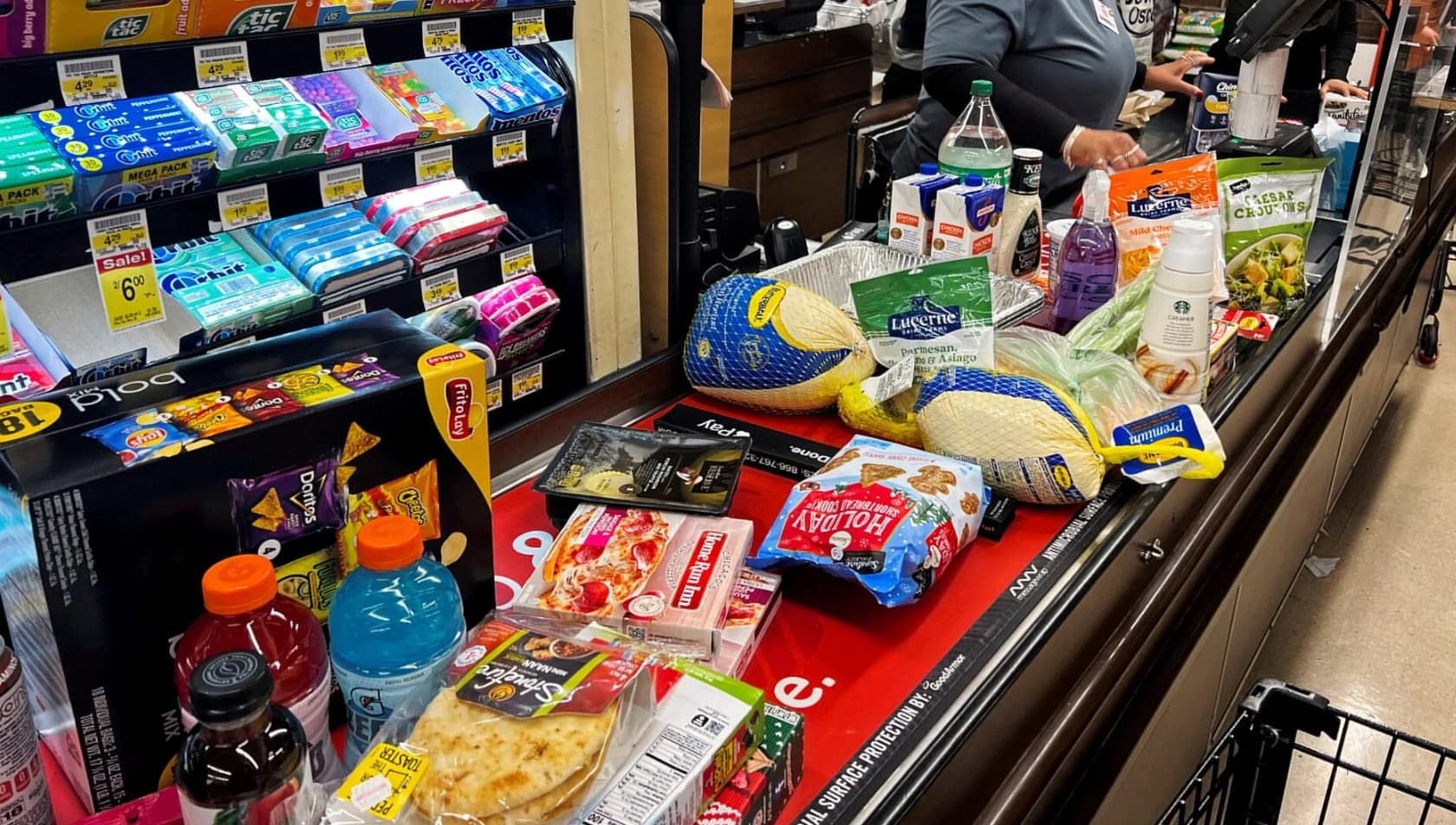
Greg Foran walked into a structurally compromised business. Kroger's first outside CEO hire in more than a century arrived with a mandate to reverse a market share slide that has been running long enough to show up in nine figures of lost revenue, and this quarter's print confirms the problem has not turned. Customers have shifted more than $12 billion in consumer packaged goods spending away from Kroger to Amazon, Walmart, and Costco over the past twelve months. Roughly $1 billion of that loss traces directly to Walmart and Amazon, two competitors operating with logistics and pricing infrastructure that Kroger cannot replicate on the same capital budget.
The revenue miss is the clearest evidence that Foran has not yet found the lever that reverses the traffic trend. A grocer's top line is a direct read on how often customers are choosing its stores, and missing a $34.68 billion target — in an inflationary grocery environment where average ticket sizes should be providing some natural lift — signals that trip frequency and basket size are both under pressure. Margin compression on top of that miss means Kroger is not yet trading lost volume for better profitability. It is losing on both lines simultaneously.
That said, raising full-year adjusted FIFO operating profit guidance to a $5.0–$5.2 billion range alongside a higher EPS range is not noise. It tells you that somewhere in the cost structure, the new management team is finding savings. The question analysts are asking — and Foran has not yet fully answered — is whether those savings are structural and repeatable or the result of one-time operational cuts that pull forward efficiency without building long-run competitive capacity. That distinction is precisely what the October investor update needs to resolve.
The Analyst Math
Three of the sell-side desks that matter most to institutional KR positioning had already trimmed their views before Friday's bell, and none of those cuts look premature in light of what was reported. Deutsche Bank cut its price target to $68 from $79, a $11 reduction that signals deteriorating conviction on the top-line recovery timeline. Citigroup's Paul Lejuez went further — dropping his target to $57 from $61 and adding a 30-day downside catalyst watch on a Neutral rating, which is analyst language for "we see a specific near-term risk and we're telling you formally." A 30-day catalyst watch is not boilerplate. It means Lejuez has a thesis about what could go wrong in the next four weeks and he wants it on the record.
Evercore's Michael Montani is the only one of the three holding an Outperform rating, and even he trimmed to $75 from $78 — a small cut that reads less like a loss of conviction and more like a mechanical adjustment to a lower revenue base. The spread between $57 and $75 across three well-resourced desks is unusually wide for a grocery name, and it reflects genuine disagreement about whether Foran's leadership premium deserves to be priced in now or only after a demonstrated quarter of market share stabilization. That debate will not get resolved by today's print. It gets resolved in October.
The options market's 5.5–6.3% implied move ahead of the report was notable for its precision — the actual price action stayed within that band, suggesting the market had correctly priced the asymmetry of a mixed result. Neither the EPS beat nor the revenue miss was large enough to break the range, which means institutional players who leaned on volatility plays around the print did not get the outsized move they needed to generate significant returns. That itself is informational: the smart money going into Friday was not expecting a blowout in either direction, and they were right.
What Traders Watch Next
The October investor update is now the single most important date on the KR calendar. Management has telegraphed that it will use that session to lay out a longer financial framework and an explicit timeline for savings acceleration. Those two deliverables are doing a lot of work. A longer financial framework means targets that extend beyond the current fiscal year — the kind of multi-year earnings trajectory that institutional portfolio managers need to justify a position rebuild after a prolonged slide. Savings acceleration means Foran has found the cost structure and is ready to show his hand on how fast he can improve unit economics.
If Foran arrives in October with specific, quantified milestones and a credible path to stabilizing market share loss — not reversing it, just stabilizing it — the stock has room to recover toward the $75 range that Evercore is holding. If the October session is thin on detail and heavy on strategic language without numbers, Citigroup's $57 target becomes the gravity center and the 30-day catalyst watch turns into a downgrade. The distance between those two outcomes is about six weeks and one management presentation.
Traders should also watch Walmart and Costco's next data points as a proxy for whether grocery market share migration is accelerating or plateauing. If Walmart's comparable sales figures in the grocery segment keep printing above 4%, Kroger's recovery math gets harder regardless of what Foran says in October. The structural competitor advantage — Walmart's logistics density, Costco's membership model, Amazon's Prime flywheel — does not compress in one or two quarters. Foran's job is not to outrun those advantages but to reduce the rate at which Kroger is losing ground to them while the new management team builds its own structural response. Friday's mixed print confirms that work has started. It does not confirm it is working.
The Weekly Investor
Daily market analysis for active traders. Free.