
IonQ Surges 12% on Quantum Error Correction Breakthrough
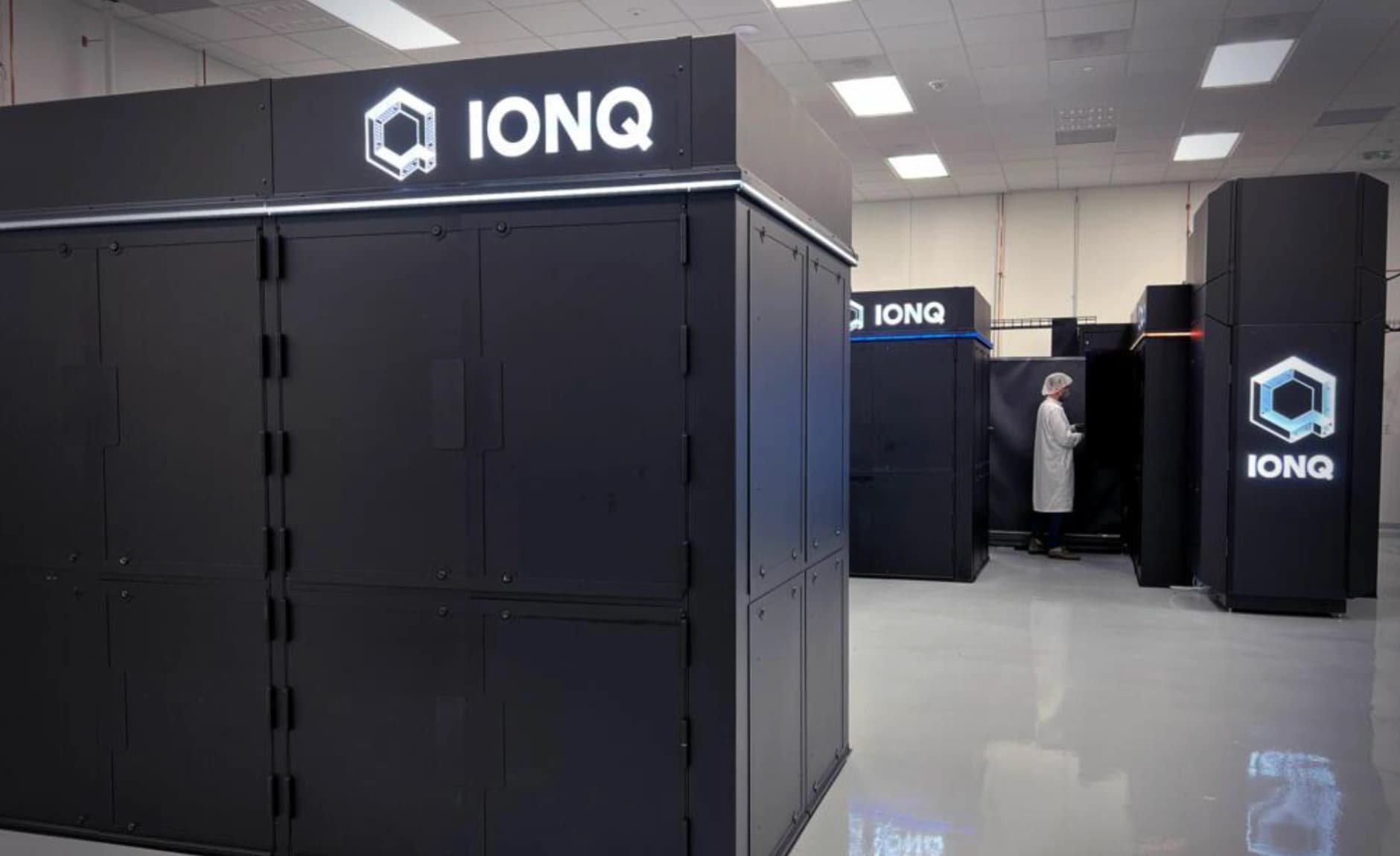
IonQ jumped ~12% premarket after demonstrating real-time quantum error correction on a standard CPU — a milestone that changes the hardware calculus for quantum computing.
Key Points
- IonQ shares jumped approximately 12% in premarket trading Friday after the company demonstrated a real-time quantum error correction decoder running on a standard CPU — eliminating a key hardware barrier that has bottlenecked practical quantum deployment.
- The milestone is technically significant because error correction at this level has historically required custom, cryogenically cooled classical co-processors, and moving that function to a standard CPU dramatically lowers the cost and complexity of near-term quantum systems.
- Traders should watch whether Friday's open holds the premarket gain — if IONQ clears and closes above prior resistance, momentum buyers will target the next technical level; a fade below the open would signal profit-taking from short-term traders who front-ran the news overnight.
IonQ's Friday premarket move of approximately 12% was triggered by something harder to dismiss than a partnership announcement or a government contract: the company demonstrated an end-to-end, real-time quantum error correction decoder executing on a conventional CPU. That is a specific, falsifiable technical result — not a roadmap slide — and it hits directly at the central engineering problem that has separated quantum computing's theoretical promise from its commercial reality for the better part of two decades.
Why This Milestone Moves the Stock
Quantum error correction is not a peripheral feature of quantum computing. It is the foundational requirement. Quantum bits — qubits — are inherently fragile; they lose coherence through interaction with their environment in a process called decoherence, and without active, real-time error correction, quantum calculations collapse into noise before they can deliver useful results. The field has known this since the 1990s. The obstacle has always been implementation: running effective error correction fast enough to keep pace with qubit operations has required exotic classical co-processing hardware operating at cryogenic temperatures alongside the quantum processor itself — hardware that is expensive, power-intensive, and difficult to scale.
IonQ's demonstration changes that calculus. By showing that a real-time error correction decoder can run on a standard CPU — commodity hardware that costs hundreds of dollars rather than hundreds of thousands — the company has materially lowered the engineering complexity and capital cost of deploying functional quantum systems. This is not an incremental improvement on an existing approach. It is an architectural shift that, if it holds up under peer scrutiny, makes IonQ's trapped-ion platform more immediately deployable in cloud and enterprise settings than the prior hardware stack suggested. The 12% premarket move is the market repricing the timeline to commercial viability, not the long-term valuation of quantum computing as an industry.
The Anatomy of a Momentum Trade
IONQ has been one of the most volatile names in the quantum computing space throughout 2026, oscillating sharply on any news with the word "quantum" attached to it. That volatility cuts both ways, and experienced traders approaching Friday's open need to distinguish between a durable re-rating and a momentum flush. The critical question is whether the 12% premarket gain reflects genuine institutional accumulation or retail and algorithmic front-running of a headline. Premarket moves in speculative technology names — especially those with elevated short interest — routinely overshoot the fundamental signal and then retrace sharply in the first 30–60 minutes of regular session trading as overnight positions are liquidated into the open.
What would make this move different from prior IonQ squeezes is the specificity of the underlying catalyst. Earlier 2026 moves in IONQ — and in peer names like Rigetti Computing and Quantum Computing Inc. — were driven by partnership announcements, government funding awards, and vague roadmap updates that advanced no concrete technical marker. A demonstrated, end-to-end error correction decoder running on a standard CPU is a concrete technical marker. It can be replicated, challenged, and validated by independent researchers, which gives institutional buyers a defensible entry thesis that partnership announcements do not. If the result holds under scrutiny in the days following this demonstration, the stock's base case valuation assumptions shift — and that is a different kind of catalyst than what quantum stocks have been trading on for most of the past two years.
What Traders Watch Into the Weekend
The immediate technical setup is the open versus the premarket high. If IONQ opens within 2–3% of its premarket peak and holds that level through the first hour, it suggests real buying interest rather than a gap-and-fade. Prior resistance from the last significant consolidation zone is the first target for momentum buyers; a clean close above it on Friday — with volume — would set up a continuation trade into next week as additional analyst commentary hits on the implications of the error correction demonstration. Conversely, a failure to hold the open in the first hour, on elevated volume, is the classic signature of a retail-driven gap that institutions are selling into. That scenario would put the stock back at its pre-announcement trading range before the week is out.
The broader context matters too. Quantum computing as a sector has been building a multi-year narrative that consistently outpaces verifiable milestones — which is precisely why a verifiable milestone carries more weight when it arrives. If peer-reviewed confirmation of IonQ's error correction result follows in October, the repricing could extend well beyond Friday's single-session move. The date to watch is whether IonQ files any supplementary technical disclosure with the SEC in the coming weeks, which would indicate the company is prepared to stand behind the demonstration under regulatory scrutiny. Absent that, traders should treat this as a high-conviction short-term momentum trade with a stop below Friday's opening print, not a fundamental re-rating that can be held through the next earnings cycle without reassessment.
The Weekly Investor
Daily market analysis for active traders. Free.