
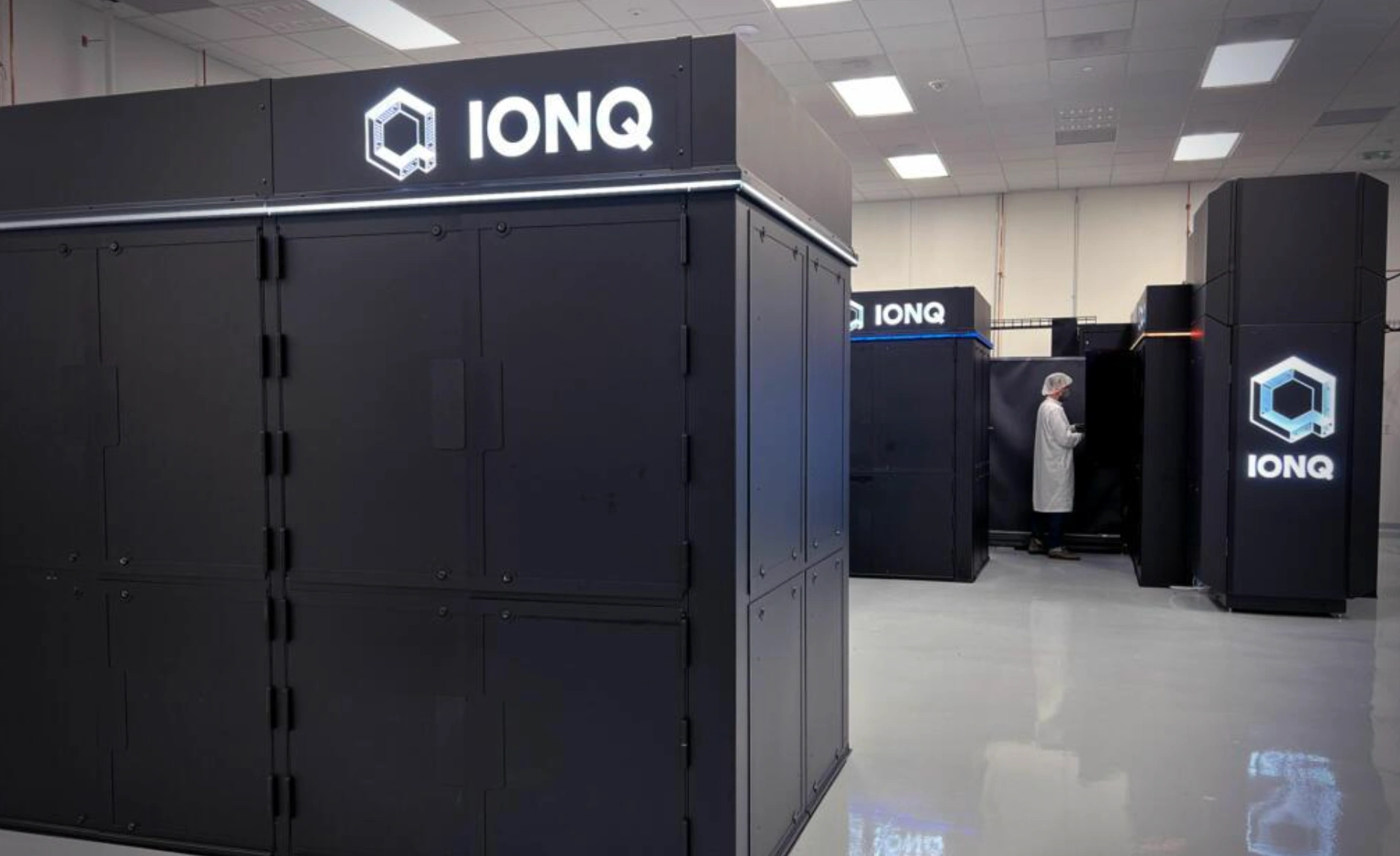
IonQ Surges 12% on Quantum Error Correction Breakthrough
IonQ jumped 12% premarket after demonstrating real-time quantum error correction on a standard CPU — a hardware-agnostic leap that rewrites its addressable market.
Key Points
- IonQ shares surged approximately 12% premarket after the company demonstrated a real-time quantum error correction decoder running on a standard CPU — eliminating the need for dedicated quantum hardware infrastructure.
- The hardware-agnostic nature of the breakthrough is the key catalyst: it dramatically expands IonQ's addressable market beyond the narrow base of dedicated quantum infrastructure buyers to any enterprise running commodity compute.
- Traders should watch whether the 12% premarket gap holds through the open, as quantum computing stocks have a well-established pattern of violent intraday reversals on technical news that the market initially misprices.
IonQ added roughly 12% in premarket trading Wednesday after demonstrating something the quantum computing industry has been chasing for years: a real-time quantum error correction decoder that runs on a standard CPU. No exotic hardware. No dedicated quantum co-processor. A standard central processing unit handling error correction in real time — and that single architectural fact is why this morning's move is not just another quantum hype cycle.
Why This Breakthrough Is Different
Quantum error correction has been the field's central engineering problem for more than two decades. Quantum bits — qubits — are inherently fragile. They decohere. They flip. They introduce errors at rates that make useful computation at scale essentially impossible without a correction layer running fast enough to catch and fix mistakes before they cascade. The traditional assumption has been that error correction itself would require specialized hardware: dedicated co-processors, cryogenic systems, or at minimum purpose-built classical chips operating at speeds and latencies that commodity infrastructure couldn't match.
IonQ's demonstration this morning directly challenges that assumption. By running an end-to-end error correction decoder on a standard CPU in real time, the company has shown that the correction layer — historically one of the most hardware-intensive components of a functional quantum system — can be offloaded to infrastructure that enterprises already own and operate. The implications compound quickly. If error correction doesn't require exotic hardware, the cost structure of deploying quantum-adjacent systems drops by an order of magnitude. The buyer base expands from a few dozen well-capitalized research institutions and hyperscalers to any enterprise with a server rack and a problem worth solving.
That addressable market expansion is what the 12% premarket move is pricing in, at least in part. IonQ has historically traded on narrative and promise more than near-term revenue, which makes the company's stock unusually sensitive to credibility events — moments where theoretical capability becomes demonstrated reality. A real-time decoder on commodity hardware is a credibility event. The market is treating it as one.
The Broader Tech Tape This Morning
IonQ's move doesn't exist in isolation. Wednesday's pre-market tape is running hot across several technology names, and the underlying thesis connecting them is accelerating AI and compute demand. AMD crossed $1 trillion in market capitalization Wednesday as Meta's Muse AI app topped the US free iPhone app chart, feeding the narrative that AI agents — which require continuous, low-latency inference across vast model parameters — will structurally increase demand for both GPU and CPU compute for years. A $1 trillion AMD is a statement about where the market believes the compute build-out cycle is headed.
Microsoft added to the momentum, rising premarket after cutting Copilot enterprise subscription prices by up to 50%. The move looks aggressive on its face, but it follows a recognizable playbook: compress unit economics to accelerate adoption, build switching costs through workflow integration, then reprice once the install base is locked. The 50% cut is a land-grab against OpenAI's direct enterprise push, and it signals that MSFT is willing to sacrifice near-term margin to defend the Copilot franchise. Super Micro Computer gained 1% premarket as AI infrastructure demand continued to provide a steady bid, and Amazon traded in a tight consolidation range near $256 — a stock that looks like it's coiling ahead of a catalyst rather than one that's lost momentum.
IonQ fits neatly into this tape. The company is not yet an AI play in the traditional sense, but the boundary between quantum computing and AI infrastructure is blurring in real time. Quantum systems optimized for specific machine learning tasks — optimization problems, molecular simulation, certain classes of linear algebra — are increasingly being positioned as accelerators within larger AI pipelines, not replacements for classical compute. A hardware-agnostic error correction layer makes that integration story significantly more credible. It means the quantum component can potentially plug into an existing AI infrastructure stack without requiring a facility redesign.
The Trade Setup and What to Watch
The 12% premarket gap is the starting point, not the conclusion. Quantum computing stocks have a documented pattern of opening sharply higher on technical announcements, attracting momentum buyers through the first 30 to 60 minutes, and then experiencing brutal intraday reversals as profit-taking overwhelms retail enthusiasm. The stocks that hold their gaps tend to be the ones where institutional buyers — not just retail momentum — show up in size. The first 15 minutes of order flow after the open will be the tell. Heavy volume on an uptick, particularly if dark pool prints confirm institutional accumulation, suggests the move has legs. Light volume on a gap that immediately starts fading is the exit signal.
The analyst community's existing price targets on IonQ will also come into focus quickly. A 12% premarket surge can move a stock from a discount to its consensus price target to trading at or above it in a single session, at which point the risk-reward for new buyers deteriorates sharply. Traders entering IonQ Wednesday morning need to know exactly where the consensus target sits before sizing a position, because the gap open could be a gift or a trap depending on that single data point.
The macro tape adds one more variable. Crude oil's 3.54% drop to $89.10 this morning is providing a risk-on tailwind across the broader equity complex, and Bitcoin trading near $86,286 suggests appetite for speculative assets remains intact. That environment is favorable for a name like IonQ, which trades more like a high-beta technology option than a traditional enterprise software company. But risk-on environments also reverse fast — particularly when they're driven by geopolitical headlines like US-Iran diplomacy signals, which are among the least reliable catalysts in the market. Check the full earnings calendar for today for additional potential cross-asset catalysts that could shift the tape before the close.
The specific level to watch for IONQ into Thursday: whether the stock can establish and hold a higher low on the daily chart after today's session closes. A gap that opens 12% higher and closes flat or slightly positive — creating a new support level — is constructive. A gap that partially fills and closes below the pre-announcement close is a technical failure, and in quantum computing stocks, technical failures after euphoria gaps have historically been followed by multi-week drawdowns of 20% to 35%. Wednesday's close is the data point that tells traders whether this morning was a genuine re-rating or simply a vol event.
The Weekly Investor
Daily market analysis for active traders. Free.