Bloom Energy Surges 8.3% as AI Power Demand Reshapes the Trade
Bloom Energy led the S&P 500 on September 28, surging 8.3% amid AI data center power demand — up 32.3% in a month. Here's what traders need to know.
Key Points
- Bloom Energy surged 8.3% on September 28 to lead the entire S&P 500, extending a one-month gain to +32.3% against an index that rose just 0.5% on the day.
- The catalyst is structural, not speculative: AI data center buildouts are generating unprecedented demand for on-site, reliable power generation — and Bloom's solid-oxide fuel cell technology is increasingly the answer operators reach for.
- Watch for whether institutional accumulation accelerates into quarter-end on September 30, and whether Bloom's management offers any forward bookings commentary that could cement or crack the 338x trailing earnings valuation.
Bloom Energy jumped 8.3% on Monday to lead every stock in the S&P 500, capping a one-month run of +32.3% that has made it the most explosive large-cap energy trade of the quarter. The gain came on a day the index itself managed only a 0.5% return, meaning Bloom outperformed the broad market by more than 15 times — not a rounding error, not noise. This is a stock in the middle of a full-scale institutional rethink.
The AI Power Thesis Is Doing the Heavy Lifting
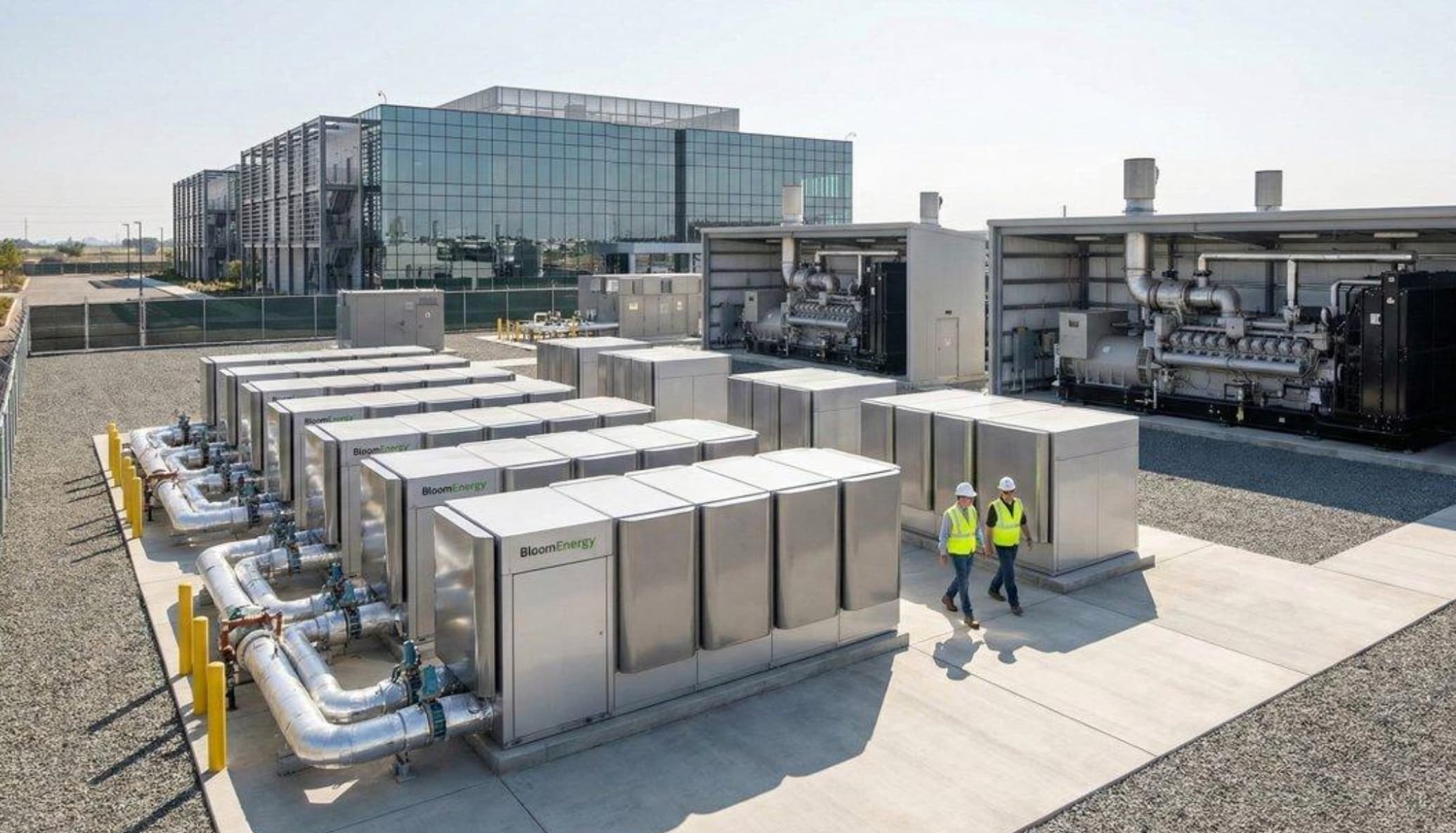
The story behind Bloom Energy's vertical move is not complicated, but it is easy to underestimate. The AI infrastructure buildout — driven by hyperscalers racing to deploy more GPU compute than the electrical grid was ever designed to support — has collided directly with a hard physical constraint: reliable, high-density power at the point of need. Traditional utility hookups involve multi-year permitting timelines. Diesel generators are politically and logistically untenable at scale. That leaves distributed power generation technology in the spotlight, and Bloom's solid-oxide fuel cells, which generate electricity on-site from natural gas or hydrogen without combustion, are among the most mature and scalable solutions commercially available today.
The company's revenue grew 91.0% over the last twelve months — a number that needs no decoration. That kind of top-line acceleration in an industrial technology company is rare under any conditions. In the current environment, where data center operators are signing multi-decade power purchase agreements and quietly lobbying state regulators to fast-track infrastructure approvals, Bloom's order pipeline has quietly become one of the most strategically valuable in the energy sector. The company has existing relationships with major technology customers, and its modular deployment model — scalable from kilowatts to megawatts without grid connection — maps perfectly onto the data center siting problem that is now costing hyperscalers billions in delayed project timelines.
What makes Monday's move particularly meaningful is the company it kept on the tape. Dell Technologies gained 5.95% on the same session, continuing its AI server demand story. Datadog added 5.28%. Akamai jumped 5.01% on the back of its $11.6 billion cloud deal with Anthropic. The cohort of stocks moving together — infrastructure hardware, cloud delivery, distributed power — is not coincidence. It reflects a sustained institutional rotation into the physical and software scaffolding of AI deployment, and Bloom is increasingly being positioned as the power layer in that stack.
Valuation Is the Risk Traders Cannot Ignore
The 338x trailing earnings multiple is the number every short-seller in the building knows by heart, and it deserves serious engagement rather than dismissal. At that level, Bloom is not being priced as an industrial company. It is not being priced as a utility. It is being priced as a growth technology platform, which means the market has already borrowed years of future earnings and front-loaded them into today's share price. Any quarterly result that misses revenue expectations, any guidance that shows bookings softening, any competitor announcement from a fuel cell or small modular reactor developer with a lower cost-per-kilowatt pitch, can trigger a violent derating.
The bear case is not that the AI power demand thesis is wrong — it is almost certainly right directionally. The bear case is that Bloom is not the only company that can address it, that natural gas fuel cells carry a regulatory and ESG overhang as the energy transition accelerates, and that at 338x earnings, the market has priced in perfection across every quarter for the foreseeable future. Short interest in the name is meaningful, and any stall in the momentum — a down day in the Nasdaq, a weak Micron print later this week, a risk-off macro shock — could compress that multiple quickly and painfully.
That said, momentum strategies live and die by continuation, not by mean-reversion timing, and traders who have been long Bloom for the past month have collected 32.3% in returns that no valuation argument could have shorted away. The discipline question for active traders is not whether the stock is expensive — it obviously is — but whether the institutional buying pressure that has driven this run is approaching exhaustion or is still in its early innings.
What Traders Watch Into Quarter-End
Monday's broader market session added a layer of interpretive complexity to Bloom's move. With the S&P 500 up just 0.5% and futures having pointed higher from the open, the context is one of general risk appetite rather than a pure sector catalyst. That raises the question every trader on a quarter-end Monday has to answer: is this institutional accumulation with conviction, or is this window dressing — portfolio managers marking up winners before September 30 so that quarterly statements show the right names?
The honest answer is that the distinction may not matter much in the next 48 hours. Window dressing and genuine accumulation produce the same price action in the short term. What matters is what happens on October 1, when the quarter turns and the calendar pressure evaporates. Stocks that were dressed up without fundamental support tend to give back gains sharply in the first week of October as the buying program ends. Stocks with real underlying demand — and Bloom's 91% revenue growth suggests real underlying demand — tend to consolidate at higher levels and resume their uptrend.
The specific level to watch is the area around $42 to $44, which represents the zone where Bloom traded before this month's acceleration phase began. A pullback to that range on elevated volume in the first week of October would constitute a tradeable re-entry for trend-followers and would signal that institutional buyers are using the reset to add rather than exit. A break below $40 on heavy volume would be a different signal entirely — one that suggests the quarter-end bid was the primary driver. Micron's earnings print, due later this week, will set the tone for the entire semiconductor and AI infrastructure complex, and its guidance commentary on data center capex will either provide a fundamental floor for names like Bloom or remove the macro tailwind that has been lifting the entire cohort. Mark October 1 open and Micron's guidance call as the two events that will answer the window-dressing question with actual data.
The Weekly Investor
Daily market analysis for active traders. Free.