Bloom Energy Falls 15% Before Q2 Earnings Tuesday
Bloom Energy stock drops 14.91% ahead of Q2 2026 earnings, erasing part of its 248% H1 gain as traders de-risk before Tuesday's report.
Key Points
- Bloom Energy stock fell 14.91% Monday to $184.89, compounding a 7% drop earlier this week tied to a $1.70 billion Nebius AI data center fuel cell deployment announcement.
- The selloff is a textbook pre-earnings de-risking event after BE surged 248.4% in the first half of 2026, leaving the stock priced for perfection into a 290% EPS growth expectation.
- Traders should watch Tuesday's after-close Q2 report against consensus of $0.39 EPS and $766.88 million revenue — any miss on revenue guidance will accelerate the unwind.
Bloom Energy is down 14.91% to $184.89 Monday, a $32.41 single-session wipeout that ranks as the largest single-stock decline on the tape today and arrives less than 24 hours before the company reports Q2 2026 results after Tuesday's close — the kind of pre-earnings flush that either creates a buy-the-print setup or signals that the smart money knows something the consensus doesn't.
A 248% Run Meets a Reality Check
The first number any trader needs before sizing a position in BE is 248.4%. That is how much the stock gained in the first half of 2026 alone, a run driven by surging demand for fuel cell power solutions at AI data centers, a series of high-profile contract announcements, and a market narrative that positioned Bloom as one of the purest picks on the intersection of clean energy infrastructure and AI compute power growth. That kind of H1 appreciation compresses the margin for error to nearly zero heading into earnings, and Monday's 14.91% drop is the market's way of acknowledging that the risk-reward has shifted.
The week's losses actually started earlier. Bloom announced a $1.70 billion fuel cell deployment agreement for a Nebius AI cloud data center and highlighted an expanded power deal with Brookfield — exactly the kind of contract wins that should send an energy infrastructure stock higher. Instead, shares fell 7.0% on that announcement. When a company reports transformational contract news and the stock sells off, it is one of the clearest signals in trading that positioning is overextended and that the news flow had already been priced in by investors who accumulated shares during the H1 run. Monday's additional 14.91% decline compounds that dynamic into a two-day loss that has now erased a significant portion of recent gains.
What the Consensus Is Pricing for Tuesday
The Zacks consensus for Q2 2026 sits at $0.39 EPS on revenues of $766.88 million. The EPS projection represents a 290% jump from the year-ago quarter — a number so large it reflects not just operational improvement but a fundamental business model inflection. Revenue consensus implies 91.13% year-over-year growth, and separately, the market is expecting BE's revenue to grow 108% on a year-over-year basis this quarter when measured against Q2 2025's specific comparable, improving dramatically from the 19.5% growth recorded in that same quarter the prior year.
The setup is not without precedent. Last quarter, Bloom beat analysts' revenue expectations by reporting $751.1 million, up 130% year-over-year, with beats on both EPS and EBITDA estimates. That Q1 beat is part of what drove the H1 2026 stock performance and set the elevated expectations embedded in Tuesday's consensus. The critical variable is not whether Bloom beats the $766.88 million revenue number — it may well do so — but what management says about the trajectory of bookings, backlog, and the pace of data center contract execution for H2 2026 and into 2027. Revenue guidance, not the backward-looking Q2 print, is what will determine whether this stock finds a floor at current levels or continues lower.
The AI Data Center Energy Trade Under Scrutiny
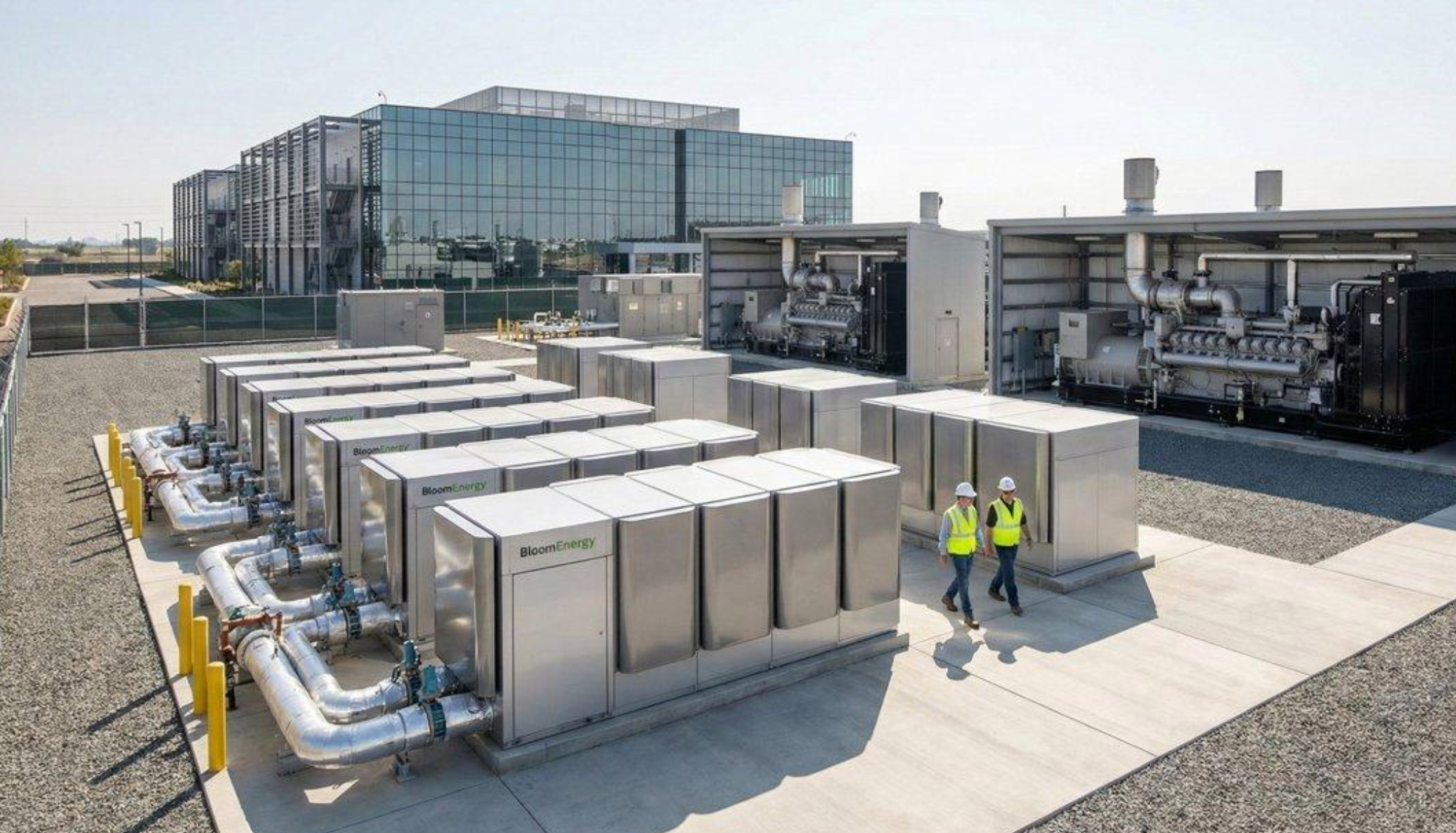
Bloom's thesis rests on a specific and currently powerful macro argument: AI data centers require enormous, reliable, on-site power generation, and fuel cells offer a faster deployment path and higher reliability than grid-connected alternatives in markets where utility infrastructure is constrained. The Nebius deal — $1.70 billion for a single AI cloud operator's deployment — is evidence that this thesis has commercial traction beyond the pilot stage. The Brookfield expansion adds a financial infrastructure dimension to the story, providing capital access that allows Bloom to scale without fully funding deployments from its own balance sheet.
The problem is execution risk at the scale Bloom is now committing to. Going from a company that grew revenues 19.5% in Q2 2025 to one targeting 108% growth in Q2 2026 requires supply chain capacity, manufacturing throughput, and installation velocity that the company has never demonstrated before. Investors who bought the H1 run were largely buying the narrative and the contract announcements; Tuesday's report is the first major test of whether the operational infrastructure to deliver on those contracts actually exists at the required scale. Any commentary suggesting delivery delays, margin compression on large deployments, or working capital strain tied to rapid scaling will be treated harshly by a market that has just watched the stock lose nearly 22% across two sessions.
The broader energy infrastructure context is also relevant. WTI crude is at $80.77 per barrel as of July 17, and natural gas at Henry Hub is running at $2.79 per MMBtu — a price level that keeps fuel cell economics competitive for commercial applications where grid reliability is the primary decision variable rather than pure cost arbitrage. If natural gas prices were significantly higher, fuel cell operating costs would compress margins; at current levels, the economics support Bloom's commercial proposition. The 10-year Treasury yield at 4.71% as of July 23 creates a meaningful discount rate headwind for any long-duration growth stock, and BE — with its valuation built on contracts that will generate cash over 10 to 20-year deployment lifetimes — is not immune to that pressure.
The Level That Decides the Next Move
Tuesday's after-close report is the binary event that resolves the current uncertainty. The downside scenario: BE misses on revenue or guides H2 below Street expectations, in which case the stock, still up dramatically on a year-to-date basis even after this week's declines, likely tests the $160 to $165 range — a level that corresponds to pre-Nebius-announcement pricing and represents roughly another 10% to 13% of downside from Monday's $184.89 close. The upside scenario: BE beats revenue by a margin comparable to last quarter's $751.1 million versus consensus, delivers EPS at or above $0.39, and provides H2 guidance that implies continued triple-digit revenue growth. In that case, the stock likely rebounds sharply toward the $200 to $210 range within 48 hours as short-sellers who drove today's 14.91% decline are forced to cover.
The specific number to anchor the trade is $766.88 million in revenue. A beat of 5% or more — implying Q2 revenue north of $805 million — combined with any upward revision to the full-year outlook would signal that the Nebius and Brookfield deals are executing on schedule and that Bloom's manufacturing capacity is keeping pace with its contract pipeline. Traders who want exposure without the binary earnings risk should note that the volatility in BE over the past two sessions has been extreme enough to warrant waiting for the post-earnings print before establishing or adding to positions. The H1 run created a stock priced for continuous execution; Tuesday night finds out whether that execution is real.
The Weekly Investor
Daily market analysis for active traders. Free.