Alibaba's Zhenwu V900 Chip Sends BABA Up 5%
Alibaba unveils the Zhenwu V900 AI accelerator and a 10-trillion-parameter model at Apsara 2026. BABA surges 5% — and Thursday's Trump-Xi summit could add fuel.
Key Points
- Alibaba unveiled the Zhenwu V900 AI accelerator at the Apsara Conference, claiming triple the performance of its predecessor and scalability to 500,000-unit clusters — sending BABA shares up 5% Tuesday.
- The announcement is the most aggressive single-day AI hardware-and-model reveal from a Chinese tech company in 2026, combining a new chip, a 5-to-10 trillion parameter model target, and a 20-gigawatt data center commitment through 2032.
- Thursday's Trump-Xi summit is the pivotal near-term catalyst — any softening on semiconductor export restrictions could trigger a secondary leg higher in BABA and the broader China AI complex.
Alibaba shares jumped 5% Tuesday after CEO Eddie Wu took the stage at the Apsara Conference in Hangzhou and detonated a three-part AI announcement: a new accelerator chip, a frontier model targeting up to 10 trillion parameters, and a data center buildout commitment that reaches 20 gigawatts by 2032. The scope of the reveal — chip, model, and infrastructure in a single keynote — is the most comprehensive AI stack disclosure any Chinese technology company has made this cycle, and the market priced it accordingly in real time.
The Chip That Started the Move
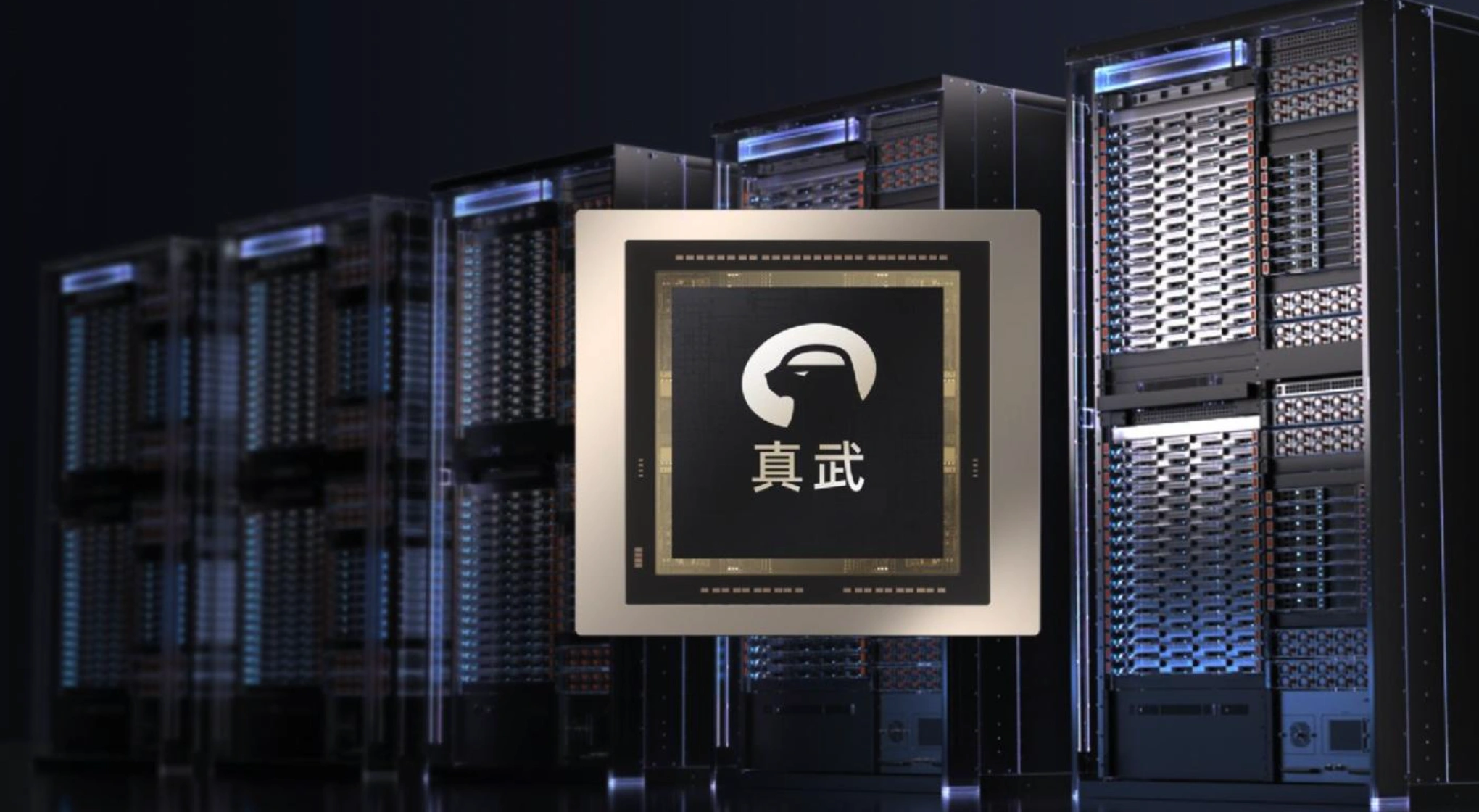
The Zhenwu V900 is the headline asset and the reason BABA moved first and fastest. Wu described the V900 as China's most powerful AI accelerator, claiming it delivers triple the performance of the Zhenwu M890 — itself a chip that, when launched in May 2026, was already claiming a 3x uplift over the earlier Zhenwu 810E. Run the math on that compounding and you get a roughly nine-fold performance improvement in a single calendar year across three chip generations. That is an extraordinary pace if the benchmarks hold under independent scrutiny, and that caveat matters: Alibaba has not yet published third-party validation of the V900's performance claims, and the gap between press-release specs and production-grade results has burned investors in the China chip space before.
What is harder to dispute is the scale architecture. Wu said the V900 can be combined in clusters of up to 500,000 units for frontier model training — a cluster size that would put Alibaba's stated training infrastructure in the same conversation as the largest deployments being built in the United States. For a company operating under U.S. export controls that have progressively cut off access to Nvidia's most advanced H100 and B200 GPUs, the V900 represents Alibaba's answer to a supply chain that Washington has deliberately tried to strangle. Whether the V900 actually closes the performance gap with Nvidia's best silicon is the question every serious investor should be demanding data on before adding meaningfully to the position.
The Model and the Infrastructure Behind It
The chip is the spark, but the model ambition is what frames Alibaba's long-term positioning. Wu announced plans to train a new large language model with between 5 trillion and 10 trillion parameters — a scale that would dwarf today's publicly known frontier models by a wide margin. For reference, GPT-4 was widely estimated at roughly 1.8 trillion parameters; a 10-trillion-parameter model would represent a qualitative leap in training compute requirements, not just a quantitative one. Wu said Alibaba's Qwen team is actively researching model architecture and data optimization to support this ambition, with the stated goal of advancing toward artificial superintelligence.
That ASI framing is deliberate and worth parsing carefully. It is partly competitive signaling aimed at the domestic Chinese market, partly a pitch to global enterprise customers evaluating Alibaba Cloud against AWS and Azure, and partly a genuine strategic declaration that Alibaba intends to be a first-tier player in the AGI race — not a fast-follower. The 20-gigawatt data center commitment through 2032 is the infrastructure that makes the model ambition credible. Twenty gigawatts is a staggering power figure; for context, that is roughly equivalent to the entire electricity consumption of a mid-sized European nation. Alibaba Cloud's willingness to put that number on record publicly signals that the capital commitment behind this strategy is real, not aspirational. According to CNBC, Wu laid out the full scope of the three-pronged announcement at the Apsara Conference, which runs through September 24.
The strategic context sharpens the picture further. Chinese technology companies have been racing to develop domestic alternatives to Nvidia processors since the Biden-era export controls tightened the supply of advanced semiconductors to China, and the Trump administration has shown no appetite for rolling those restrictions back — at least not unilaterally. Alibaba's acceleration curve across three chip generations in roughly 12 months reflects the urgency that export policy has injected into China's domestic semiconductor ambition. The V900 is not just a product launch; it is evidence that the pressure is producing results, even if the magnitude of those results remains to be independently verified.
What Traders Watch Next
The immediate setup for BABA is binary around Thursday. The Trump-Xi summit is the macro event that will either validate or cap the move initiated today. Any signal from that meeting — even informal language suggesting a pause or softening in advanced chip export restrictions — would provide a second catalyst for BABA, as well as for the broader China AI complex. Investors watching the Hong Kong-listed shares at 9988.HK should note that the Hong Kong market will price Thursday's summit headlines before U.S. markets open Friday morning, meaning the first clean read on summit outcomes will come through the HK close.
Beyond the geopolitical event risk, the Apsara Conference itself runs through September 24, and additional technical disclosures on the V900 — particularly any performance benchmarks that go beyond Wu's on-stage claims — could move the stock independently of the summit. Analysts tracking the semiconductor space are focused squarely on whether Alibaba will release comparative benchmark data against Nvidia's H100 or the Huawei Ascend 910C, which has been the de facto domestic reference chip for Chinese AI training workloads.
The technical level to watch on BABA is straightforward: hold today's 5% gain through the Wednesday close and the stock sets up for a clean break higher into Thursday's event. Fail to hold it, and the position becomes a summit-outcome trade with binary risk. Traders who want Thursday optionality without overnight gap risk should consider the options market — BABA's implied volatility will reprice into the summit, and defined-risk structures around the $115 to $125 range offer a way to stay in the trade without unlimited downside exposure. The single most important date on the calendar for this position is Thursday, September 24.
---
The Weekly Investor
Daily market analysis for active traders. Free.