TSMC 2nm Ramp Hits 120K Wafers as $2T Cap Nears
TSMC is accelerating its 2nm ramp to 120,000 wafers per month by end of 2026 as Apple, Nvidia, and AMD lift orders 10–20%, pushing its market cap toward $2 trillion.
Key Points
- TSMC is accelerating 2nm output to approximately 120,000 wafers per month by end of 2026, up from earlier estimates of 90,000–100,000, driven by 10–20% order increases from Apple, Nvidia, AMD, Qualcomm, and MediaTek.
- TSMC controls 72% of the global foundry market and manufactures every major AI accelerator, making its production cadence the single most important supply variable in the AI trade.
- With TSMC's market cap approaching $2 trillion and SOXX up 7.4% last week, the foundry's 2nm ramp timeline is now the structural backbone of the entire AI chip investment thesis.
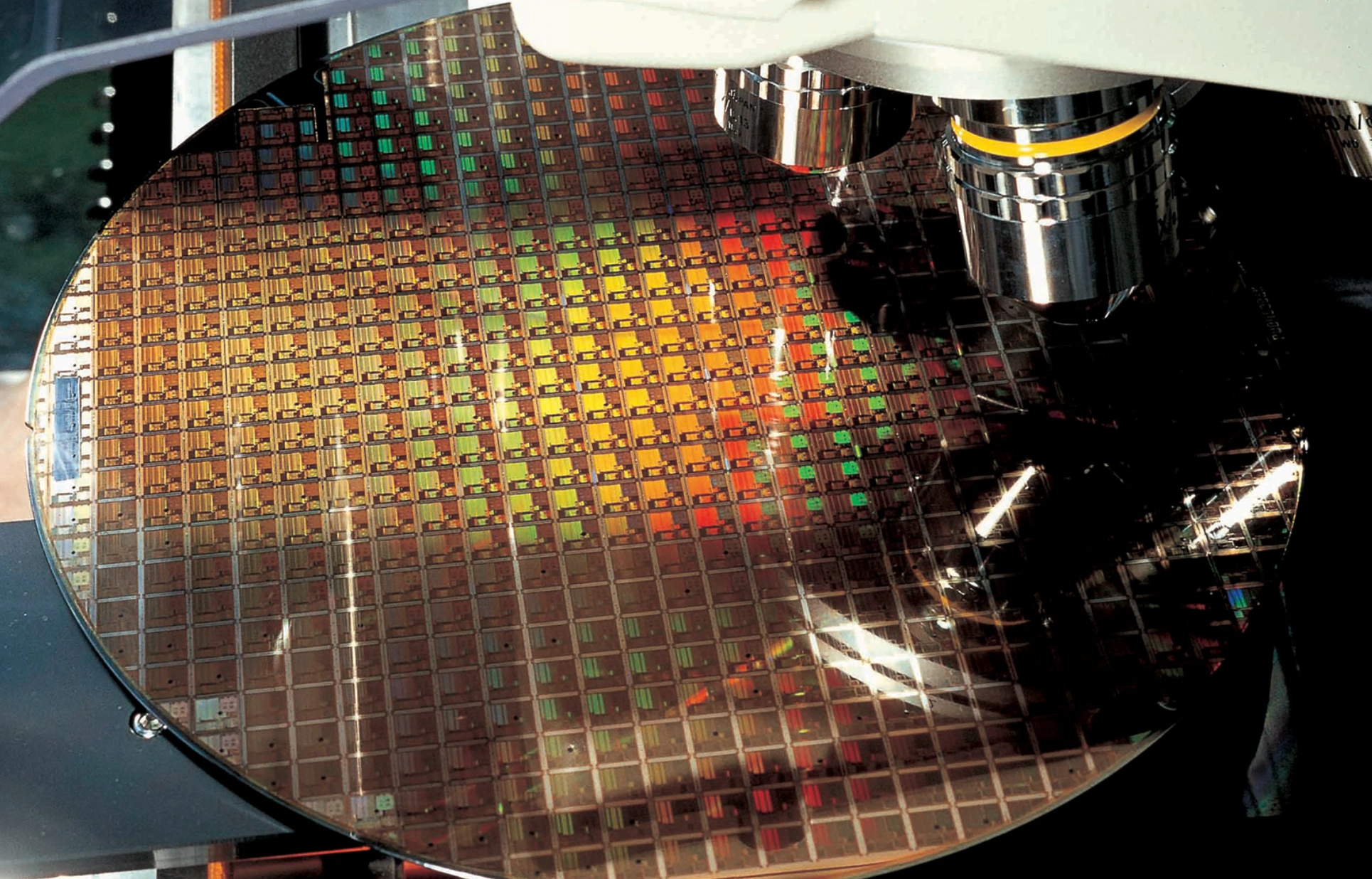
The most important number in the semiconductor supply chain this week is not a stock price — it is 120,000. That is the monthly wafer output TSMC is now targeting for its 2-nanometer node by end of 2026, up sharply from earlier industry estimates of 90,000 to 100,000 wafers per month. The acceleration is demand-driven: Apple, Nvidia, and other major customers have raised their 2nm orders by 10% to 20%, giving the world's dominant foundry enough forward visibility to pull in its production timeline and commit capital to the expanded ramp. For traders positioned in the AI supply chain, this is not an incremental update — it is confirmation that the next generation of AI silicon is arriving faster than the consensus model assumed three months ago.
Why TSMC's 2nm Timeline Moves Every AI Trade
Taiwan Semiconductor holds 72% of the global chip foundry market, a concentration that makes it structurally unlike any other company in the technology supply chain. Unlike chipmakers that design their own products, TSMC is the physical layer beneath the entire AI ecosystem. Nvidia's Blackwell GPUs, Broadcom's custom AI ASICs, Apple's A-series and M-series processors, AMD's MI-series accelerators, and Qualcomm's Snapdragon platforms all run through TSMC's fabs. There is no meaningful alternative at advanced nodes. ASML's extreme ultraviolet lithography machines — which TSMC uses for both its 3nm volume production and its 2nm ramp — are sold to TSMC at a rate that gives the foundry a multi-year lead over Samsung Foundry and Intel Foundry in process maturity. That lead is now widening, not narrowing.
The 2nm node matters specifically because of what it enables for AI workloads. Compared to 3nm, the 2nm process delivers approximately 10% to 15% performance-per-watt improvement in early customer projections, with higher transistor density that allows chip designers to pack more compute into the same die area. For AI accelerators where power delivery and thermal management are already binding constraints in dense data center deployments, that efficiency gain is not marginal — it translates directly into more inference capacity per rack, which is the metric hyperscalers optimize against when they are spending tens of billions of dollars annually on GPU infrastructure. Microsoft, Google, Amazon, and Meta are all expanding their AI data center footprints aggressively in 2026, and the 2nm ramp is the enabling technology for the next generation of custom and merchant silicon that will fill those facilities.
The $2 Trillion Threshold and What It Means
TSMC's market capitalization is approaching the $2 trillion mark, a threshold that would place it alongside Apple, Nvidia, and Microsoft in the ultra-large-cap tier where index rebalancing, passive fund flows, and institutional mandate adjustments create self-reinforcing buying pressure. The approach to that level is not coincidental — it reflects the market's repricing of TSMC from a cyclical semiconductor manufacturer to a critical infrastructure provider for the AI economy. Global semiconductor sales from April 2025 to April 2026 rose 93.9%, from $56.9 billion to $110.5 billion per Semiconductor Industry Association data, and TSMC is the physical node through which the majority of that demand passes.
The SOXQ ETF, which tracks the broader semiconductor index, returned over 58% in the past three months as hyperscalers including Microsoft and Oracle placed massive orders for advanced AI chips. SOXX, the iShares Semiconductor ETF, gained 7.4% in just the past week. Those are not moves generated by short-term trading momentum — they reflect institutional recognition that the AI capital expenditure cycle is durable enough to justify premium multiples on the companies with irreplaceable positions in the supply chain. TSMC, with its combination of process leadership, customer concentration, and geographic irreplaceability, sits at the center of that repricing. Its customers are not interchangeable. Apple alone accounts for a significant share of TSMC's advanced node revenue, and Apple's 2nm order increase signals that the next iPhone and Mac silicon generation will deploy the node at consumer scale — adding volume that AI accelerator orders alone would not generate.
The geopolitical risk profile has not disappeared. TSMC's primary production concentration in Taiwan remains the single largest systemic risk for anyone holding TSM shares or any AI chip stock with TSMC foundry exposure. The company's Arizona fabs, now in production at 4nm and with 2nm expansion planned, reduce but do not eliminate that concentration. Investors have chosen to price that risk as a known and partially mitigated factor rather than an imminent threat, a judgment that has been rewarded over the past three months but that could reprice rapidly on any change in Taiwan Strait conditions.
What Traders Watch Between Now and Year-End
The near-term catalyst sequence for TSM is well defined. Micron reports its fiscal Q4 results Wednesday, and while Micron is a memory company rather than a logic foundry customer, its HBM demand commentary will provide a real-time read on AI data center build rates — the same end market that is driving TSMC's 2nm order acceleration. A strong Micron print with bullish HBM guidance confirms the demand environment that TSMC's customers are signaling with their order increases. A weak print or cautious outlook creates a short-term headwind for TSM shares even though the fundamental supply relationship is unaffected.
OpenAI's DevDay announcements today in San Francisco are the second variable. Any disclosure of new agentic AI infrastructure or expanded model deployment timelines accelerates the demand signal that is already pulling TSMC's 2nm production schedule forward. The feedback loop runs from model capability to deployment demand to chip orders to foundry production — and TSMC sits at the end of that chain, where every upstream acceleration eventually shows up as a wafer start. Micron's Q4 results Wednesday are the most proximate data point for the AI memory and compute demand complex. For TSM specifically, the technical level to monitor is the approach to the $2 trillion market cap mark — a sustained close above that threshold before year-end would represent a structural shift in how the largest pools of institutional capital classify and size TSMC exposure, and the passive rebalancing flows that accompany index inclusion at that scale are not small.
The Weekly Investor
Daily market analysis for active traders. Free.