
ECB's Lane Concedes Demand Destruction — But Hikes Aren't Off
ECB Chief Economist Philip Lane warns surging long-term rates will slow growth more than projected — while European PMIs today flash unexpected strength across Spain, France, and Sweden.
Key Points
- ECB Chief Economist Philip Lane warned today that "notable recent increases in long-term interest rates will slow growth and reduce pass-through by more than projected" — the clearest Frankfurt signal yet that the hiking cycle's own byproducts are becoming a constraint on further tightening.
- Lane's comments land against a backdrop of surging European services PMIs — Spain at 58.3, France confirming its first expansion in nine months at 51.2, and Sweden at 57.4 — suggesting the demand side of the eurozone is holding up better than the ECB's internal projections assumed.
- The tension between Lane's dovish demand-destruction framing and hawkish Nagel's data-dependent stance sets up the ECB's next meeting as a genuine split, with markets currently pricing 2–3 more hikes but oscillating violently after repricing four hikes to fewer in under a week.
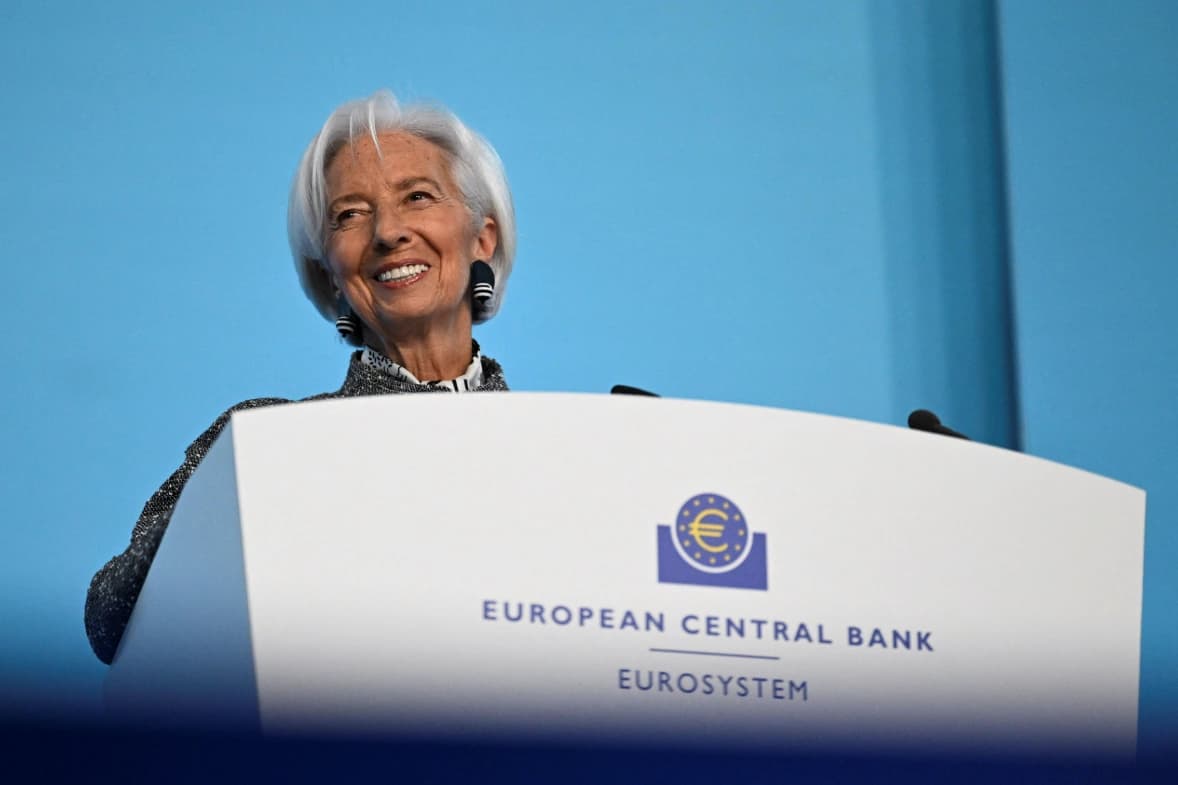
ECB Chief Economist Philip Lane delivered the clearest dovish signal from Frankfurt in weeks this morning, warning that rising long-term interest rates — amplified by AI-driven corporate borrowing demand — are tightening financial conditions beyond the ECB's own projections and will act as a drag on growth and inflation pass-through that the bank had not fully modeled. The statement is a direct concession that the tightening cycle is generating its own headwinds, and it arrives on the same morning that services PMI readings across Spain, France, and Sweden are printing well above estimates — producing one of the sharpest data contradictions European macro traders have had to process in months.
Lane's Admission and What It Actually Means
Speaking in Frankfurt today, Lane urged a "measured" ECB response to what he characterized as a second wave of energy price pressure stemming from the Iran war. His argument is structurally dovish: while the ECB raised its key rate to 2.65% at the September 10 meeting — up 25 basis points from 2.40% — Lane argued that the economy's resilience to the initial energy surge is now being tested by a fresh impulse at exactly the moment when the lagged effects of prior rate hikes are hitting demand most forcefully. He cited high energy costs, reduced fiscal support, and surging market-based borrowing costs as compounding drags on aggregate demand, and specifically flagged AI-related corporate borrowing as adding upward pressure on long-term rates in a way that extends beyond the ECB's conventional policy transmission channels.
That last point deserves more attention than it has received. If AI-driven capital expenditure — financed increasingly through long-duration corporate debt — is structurally pushing long-term rates higher across the eurozone independent of ECB policy, then the ECB's effective tightening is more severe than the 2.65% key rate implies. Lane is essentially arguing that the real rate environment in Europe is tighter than the policy rate alone would suggest, and that additional hikes risk over-tightening into demand that is already softening. For bond traders, this framing is significant: it positions the ECB closer to a conditional pause than the four-hike trajectory that markets were fully pricing as recently as last week.
The hawkish counterpoint came from Bundesbank President Joachim Nagel, who reiterated a data-dependent, meeting-by-meeting approach and noted "no clear signs that inflation has fed through to price and wage setting" — language that cuts both ways. It rules out a wage-price spiral for now, which is dovish on the margin, but it also means Nagel sees no fundamental reason to back off tightening if incoming data remains hot. The ECB's governing council is not a unified body, and the Lane-Nagel dynamic today illustrates a split between a chief economist focused on financial conditions tightening beyond intention and a German hawk anchored to the absence of second-round inflation effects.
The PMI Data Makes Lane's Case Harder
The complication for Lane's demand-destruction narrative is that today's services PMI prints across Europe are not cooperating with a slowdown thesis. Spain's Services PMI came in at 58.3 for September against a 57.0 estimate — its fifth consecutive month of expansion — with the composite at 56.8 against a 55.5 consensus. France, which has spent the better part of 2026 mired in services-sector contraction, confirmed a final Services PMI of 51.2 for September — its first expansion reading in nine months — with the composite at 51.1. Sweden printed 57.4 on services against a 56.0 prior, with the composite at 57.6. Taken together, these are not the numbers of an economy in demand-destruction mode.
The divergence between Lane's forward-looking warnings and the current-activity data creates a specific problem for traders trying to position ahead of the next ECB meeting. If the PMI data continues to run above 55 in the region's largest economies, the ECB's hawks will have the empirical ammunition to push for another hike regardless of Lane's financial-conditions argument. The ECB set its rate at 2.65% in September and markets currently price 2–3 additional hikes over the next year — a range that has itself been violently repriced, from four hikes fully priced just days ago. That kind of volatility in rate expectations reflects genuine uncertainty within the governing council about where the terminal rate sits.
What makes today's Lane statement politically significant within the ECB is its implicit challenge to the four-hike trajectory. By framing long-term rate increases as doing work the ECB hadn't planned on, Lane is building an intellectual foundation for a slower pace of hikes — or a genuine pause — that does not require inflation to fall first. That's a different argument than "inflation is cooling," and it's potentially more durable as a framework if energy prices remain elevated due to the Iran conflict and sovereign spreads stay wide.
What Traders Watch Next
The near-term ECB calendar centers on October 28 for the Bank of England MPC decision — which at a current rate of 3.75% provides a policy-rate reference point for cross-channel comparisons — and October 30 for the Bank of Japan's meeting, where another hike from the current 1.25% is being actively debated after Tokyo core CPI accelerated to 2.7% year-over-year in September, the fastest pace in 10 months. The BOJ dynamic matters for European traders because a continued yen-strengthening cycle driven by BOJ hikes would add to the dollar pressure already visible in the DXY, complicating the ECB's import-price inflation calculus.
For the euro itself, the key near-term variables are the French budget process — which Lane implicitly referenced when citing reduced fiscal support — and any escalation in the Iran-related energy disruption that would validate his second-wave thesis. If Brent crude pushes sustainably above current levels on fresh supply concerns, Lane's "measured response" framing becomes the dominant ECB narrative and further front-loading becomes harder to justify politically. Conversely, if services PMIs across the eurozone print above 56 for a third consecutive month through October, expect Nagel and the German bloc to reassert a hawkish line heading into the ECB's next rate decision. The ECB's 2.65% rate and a DXY holding near current levels are the two reference points to anchor against — any meaningful break in either one shifts the trade.
The Weekly Investor
Daily market analysis for active traders. Free.