
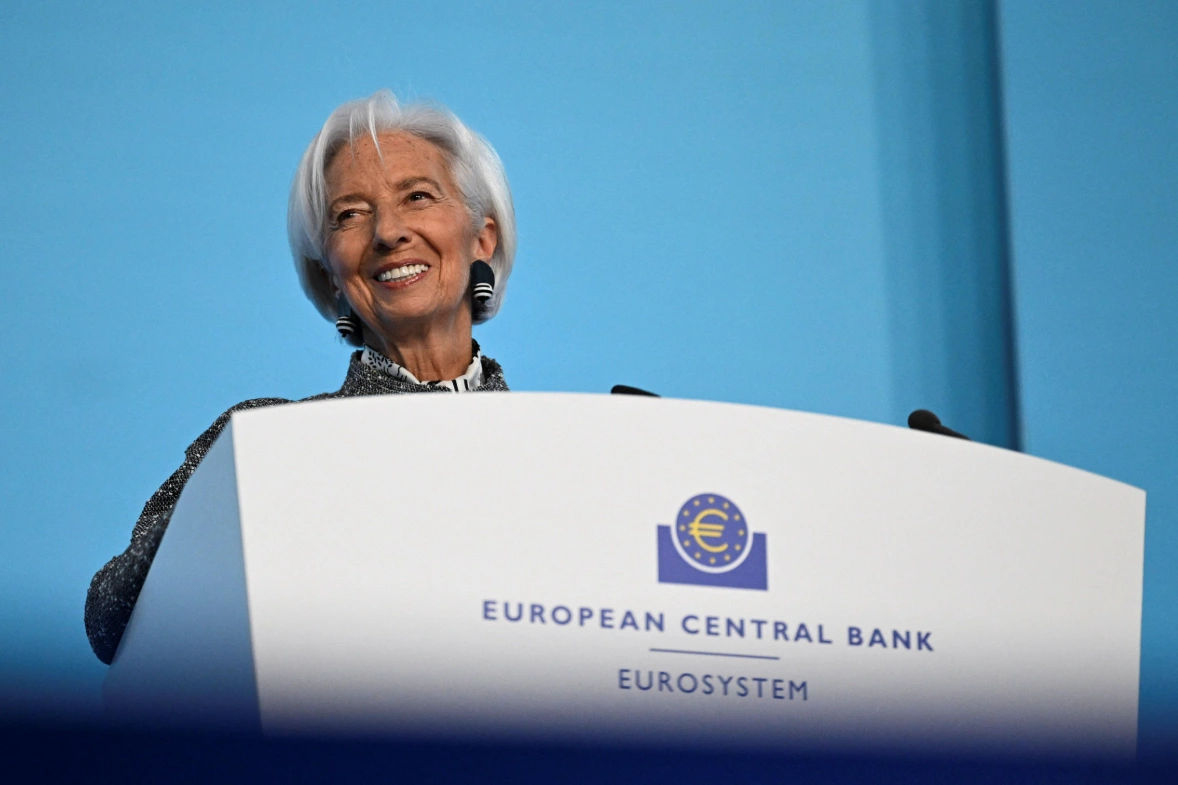
ECB Hikes Again as Euro Inflation Stays Above 3%
The ECB raised rates 25bps on September 10 with eurozone inflation at 3.0% in 2026. Here's what the new projections mean for EUR, bonds, and global policy.
Key Points
- The ECB raised all three key interest rates by 25 basis points on September 10, with new staff projections showing eurozone headline inflation at 3.0% in 2026 and core at 2.5% — both above the 2% target through 2027.
- Upward revisions to the 2027 and 2028 inflation forecasts, even as GDP projections for 2026 and 2027 were revised higher, signal the ECB sees a longer inflation fight than markets had priced.
- With the Fed now at 3.75%-4.00%, the BOJ at 1.0%, and the BOE decision due September 19, the global tightening wave is broadening — and the dollar index is the instrument that ties it all together.
Six days before the Federal Reserve moved, the European Central Bank delivered its own 25-basis-point hike on September 10, pushing rates higher against a backdrop of eurozone headline inflation running at 3.0% for 2026 — fifty percent above the institution's medium-term target. The back-to-back moves from Frankfurt and Washington confirm that the synchronized global easing cycle that traders spent much of 2024 and 2025 positioning for has been replaced by something more complicated: a world where major central banks are tightening again, but at different speeds, for different reasons, with materially different growth outlooks underneath them.
The ECB's Uncomfortable Arithmetic
The ECB's September 10 staff projections are the most detailed window into Frankfurt's thinking, and the numbers are not particularly encouraging for anyone hoping the hiking cycle ends quickly. Headline inflation is projected at 3.0% for 2026, 2.5% for 2027, and 2.1% for 2028 — a trajectory that only clips the 2% target in the final year of the forecast window. The 2026 headline figure was unchanged from June projections, but the 2027 and 2028 revisions went higher, not lower. That upward revision at the tail end of the forecast is the detail traders should anchor on: it means the ECB's own economists do not see inflation converging cleanly to target even as monetary policy tightens. They are modeling a prolonged overshoot.
Core inflation — stripping food and energy — runs at 2.5% in 2026, 2.6% in 2027, and 2.3% in 2028. The 2027 core projection is actually higher than the 2026 print, which is an unusual configuration. It suggests the ECB is modeling services inflation and wage dynamics as persistent, not transitory, with peak core pressure arriving in the middle of the forecast horizon rather than at the beginning. For the Governing Council, this makes a near-term pause difficult to justify on the numbers alone, even if growth is softening. The GDP projection for 2026 was revised upward to 0.9%, and 2027 was bumped to 1.4%, with 2028 at 1.5% — but growth running below 1% this year still constitutes the weakest expansion in the eurozone's post-pandemic recovery. The ECB is tightening into sub-1% growth with inflation stuck above 3%. That is a genuinely uncomfortable position that Frankfurt's communication has consistently soft-pedaled.
Global Divergence Is the Real Trade
The honest macro picture for September 2026 is not a story about any single central bank — it is a story about the near-simultaneous return of tightening across multiple major economies after a brief interval where several appeared to be easing. The Bank of Japan raised its policy rate to 1.00% from 0.75% on June 16, 2026, a move that sent tremors through carry trades globally. Japan's Q2 GDP came in at +0.4% quarter-on-quarter on September 7 — above the 0.3% forecast — while industrial production slipped -0.2% month-on-month on September 14 against a +0.1% consensus. The BoJ is tightening into a mixed data environment, much like its counterparts. The Bank of England decision is scheduled for September 19 — next Thursday — and will complete the picture of where the G4 central banks stand heading into Q4.
What emerges from this configuration is a dollar trade that is more nuanced than the simple "Fed hikes, dollar rips" dynamic that dominated 2022. When the Fed was the only major central bank tightening, dollar strength was near-mechanical. Now the ECB and BoJ are both in hiking mode, which compresses the interest rate differential that drives EUR/USD and USD/JPY at the margin. The dollar index cannot rely on rate differentials alone to sustain a trend — it needs the Fed to be hiking faster and further than peers, which the dot plot released today will either confirm or complicate. If the median Fed dot clusters at 4.25% for year-end while the ECB signals a potential pause after its next meeting, the differential widens again and the dollar finds renewed bid. If both institutions signal they are near the peak, currency markets go back to trading growth differentials — where the U.S. at 1.5% annualized GDP is not obviously superior to the eurozone at 0.9%.
What Traders Watch Next
The Bank of England on September 19 is the next scheduled event that could materially shift the global rates narrative. UK inflation has been among the most persistent in the G7, and a BoE hike next Thursday would extend the synchronized tightening theme into a third consecutive week, reinforcing the message that the low-rate era that dominated from 2020 through 2024 is structurally over rather than temporarily interrupted. The pound's reaction will also feed into the broader dollar basket trade via GBP/USD weighting in the DXY.
For traders with cross-asset exposure, the sequencing of this week's events creates a specific setup. Today's Fed dot plot — the most important single data release of the week — lands against a backdrop where the ECB has already moved and the BoE is six days away. Federal Reserve communications through the October data window will shape whether November 5 is a live meeting or a hold. The retail sales data released this morning — consensus at +0.8% headline versus a prior -0.6% decline — feeds directly into that November calculus by telling the committee whether the U.S. consumer is absorbing the existing rate level or starting to crack. A strong retail print combined with a hawkish dot plot and a BoE hike on September 19 would represent the most overtly tightening global macro backdrop since late 2022, and risk assets priced on duration — long bonds, growth equities, high-multiple tech — would face their most concentrated pressure point of the year. The Yahoo Finance Fed decision tracker has running coverage of today's decision and its market implications. Watch the dollar index around the 104.50 level and the 10-year Bund yield's behavior relative to the 10-year Treasury spread — if that differential compresses further, the global tightening trade is becoming more symmetric, and the dollar's safe-haven bid weakens accordingly going into October.
The Weekly Investor
Daily market analysis for active traders. Free.