TSMC's EMIB Gambit and the Packaging Arms Race
TSMC is building Intel-style EMIB packaging tech, sending INTC up 12%. Here's what the chip supply chain shift means for AI infrastructure trades.
Key Points
- Intel surged approximately 12% and TSMC gained nearly 7% after reports that TSMC is developing an EMIB-style advanced packaging process in partnership with Kinsus Interconnect Technology.
- TSMC's move to replicate Intel's Embedded Multi-die Interconnect Bridge technology signals that CoWoS packaging capacity — currently the primary bottleneck for Nvidia and AMD AI chip production — is reaching its structural ceiling.
- TSMC's 67.7% gross margin and above-40% revenue growth guide confirm that pricing power at the leading edge remains intact, and the packaging race will determine who captures the next leg of AI infrastructure spending.
Intel's stock jumped approximately 12% last week on a story that had nothing to do with Intel's own execution — and everything to do with TSMC validating the technology Intel has spent years defending. Reports that TSMC is developing an advanced chip-packaging process modeled on Intel's Embedded Multi-die Interconnect Bridge, or EMIB, in partnership with Taiwan-based Kinsus Interconnect Technology sent a direct signal to the market: the existing CoWoS packaging infrastructure that handles Nvidia and AMD's most critical AI chips is no longer sufficient for what the industry needs to build next.
Why Packaging Is the New Chokepoint
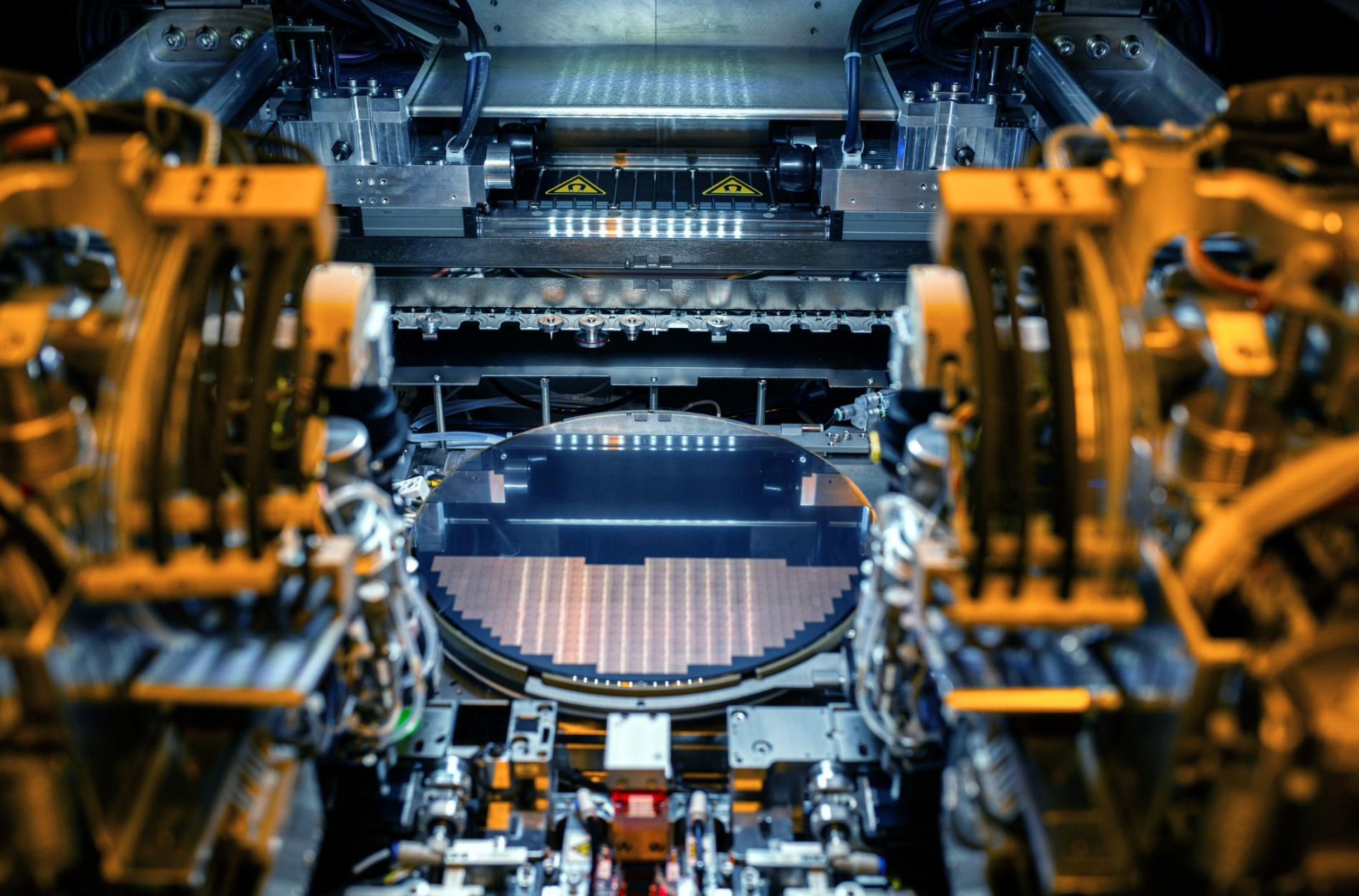
The semiconductor conversation in 2024 and 2025 was dominated by leading-edge node competition — who gets to 3nm, 2nm, and beyond. That race continues, but the bottleneck that is actually constraining AI chip output right now is not lithography. It is packaging. Advanced packaging — the process of integrating multiple chiplets, memory stacks, and interconnects into a single functional unit — has become the critical manufacturing constraint for the AI chips that hyperscalers are willing to pay any price to secure.
TSMC's CoWoS, or Chip-on-Wafer-on-Substrate, is the incumbent technology enabling Nvidia's H100, H200, and Blackwell-series GPUs to connect at the bandwidth densities AI workloads demand. The problem is that CoWoS capacity is finite and has been running at effective maximum utilization for the past 18 months. Nvidia's $62.3B data center revenue in Q4 FY2026 was not constrained by chip design — it was constrained by how fast TSMC could package finished wafers into shippable product. That is the problem TSMC's EMIB initiative is designed to solve, and it is why the market reacted as sharply as it did.
Intel's EMIB technology connects separate silicon dies using a small silicon bridge embedded directly in the package substrate — a process that achieves high interconnect density without requiring the full wafer-level integration that CoWoS demands. Intel has used EMIB in its own Ponte Vecchio and Gaudi GPU architectures, with mixed commercial success, but the underlying IP has always been considered legitimate. TSMC's decision to develop a similar approach, rather than simply expanding CoWoS capacity, tells you something specific: TSMC believes the next generation of AI chip designs will require packaging flexibility that CoWoS alone cannot deliver.
The Intel Validation Trade and Its Limits
The 12% move in INTC last week is a validation trade, not a recovery trade, and that distinction matters for positioning. Intel did not announce a new customer, a new product, or a new fab timeline. The stock moved because TSMC's EMIB imitation implicitly confirmed that Intel's packaging IP has strategic value — value that Intel itself has struggled to monetize commercially. That is a different kind of catalyst than a fundamental earnings inflection.
Intel's own financial trajectory remains challenged. The company has been executing a multi-year restructuring under Pat Gelsinger's foundry strategy, and the market has been skeptical of the timeline and the capital intensity required. A TSMC partnership — even an indirect one built on IP imitation rather than licensing — does not accelerate Intel's revenue recovery. What it does is reduce the probability of INTC's packaging technology becoming commercially irrelevant, which was a genuine tail risk before last week's news. The practical question for traders is whether the 12% move fully prices that reduced tail risk, or whether there is a further leg if TSMC eventually pursues a direct licensing arrangement.
TSMC's own numbers from its most recent quarter are harder to argue with. A 67.7% gross margin versus the company's own guidance is a signal of extraordinary pricing power at the leading edge — TSMC is not discounting to fill capacity, it is commanding premium pricing because no other foundry can produce what its customers need at volume. The above-40% revenue growth guide, layered on top of that margin profile, places TSMC in a category occupied by almost no other industrial-scale manufacturer on earth. Deloitte's 2026 Semiconductor Industry Outlook projects global semiconductor annual sales reaching $975 billion this year — a historic peak — and TSMC is capturing a disproportionate share of the highest-margin segment.
What the Supply Chain Stress Signals for AI Trades
The broader semiconductor supply chain is not uniformly healthy, and traders conflating the AI chip boom with the overall sector will get caught. Reports of a potential Samsung strike introduce meaningful uncertainty into NAND and DRAM supply — memory that feeds into every AI training cluster but that operates on entirely different economics than TSMC's leading-edge logic business. The structural divergence between booming AI data center chips and slow-growth automotive, smartphone, and industrial semiconductor demand is particularly acute for diversified chipmakers like AMD and Intel, which must allocate engineering and manufacturing resources across segments with wildly different margin profiles.
AMD's Q2 earnings tomorrow — August 4 after the close — will function as the demand-side confirmation for everything the TSMC packaging story implies on the supply side. The specific line to watch is data center GPU revenue, particularly commentary on MI300X shipment volumes and early MI400-series customer traction. If AMD management signals that packaging constraints are easing — which the TSMC EMIB development would eventually support — that is a structurally bullish data point for the entire AI chip supply chain, including NVDA heading into its own August 26 report. If AMD instead flags continued packaging-related supply limitations, it confirms that the bottleneck has not been resolved by the TSMC announcement, only acknowledged.
Onto Innovation, which reports Q2 2026 results on August 6, is the under-the-radar read on wafer fab utilization. As a metrology and inspection equipment provider, Onto's order book tracks capacity expansion decisions at leading-edge fabs before those decisions show up in equipment giant earnings. A strong Onto print on August 6 would indicate that TSMC and its peers are actively expanding packaging and wafer capacity — the real-world confirmation that last week's EMIB headline translates into physical capital deployment. That is the signal chain traders should be tracking: TSMC packaging announcement, AMD demand commentary on August 4, Onto Innovation utilization read on August 6, and then NVDA's definitive data center revenue print on August 26. The packaging arms race is the structural thread connecting every one of those catalysts, and Intel's 12% move last week was the market's first price on a race that has only just begun.
The Weekly Investor
Daily market analysis for active traders. Free.