TSMC Q3 Profit Surges 69%: Q4 Guide Sets AI Bar
TSMC Q3 net profit jumped 68.7% to NT$763.1B, crushing consensus. Q4 revenue guide of $52.3B–$54.3B is the new AI infrastructure benchmark.
Key Points
- TSMC Q3 net profit hit NT$763.1 billion, up 68.7% year-over-year, beating the NT$746.34 billion consensus on revenue of NT$1.49 trillion (~$46.36B).
- AI-driven pricing power drove operating margin to 58.7%, above TSMC's own guidance ceiling, while free cash flow more than tripled to NT$476.56 billion from NT$139.38 billion a year ago.
- Q4 revenue guidance of $52.3B–$54.3B — implying 14% sequential growth — sets the new spending floor for the entire AI infrastructure supply chain; watch Nvidia, ASML, and AMD for sympathy moves on the open.
Taiwan Semiconductor posted Q3 net profit of NT$763.1 billion — up 68.7% year-over-year — on revenue of NT$1.49 trillion (~$46.36B), beating LSEG SmartEstimate consensus on both lines and delivering the sixth consecutive record quarter. The print landed above even the revised bar set by TSMC's own October 8 pre-announcement, when the company flagged record sales of ~NT$1.49 trillion, already ahead of its $44.6B–$45.8B guidance range. This morning's full earnings call confirmed what the pre-release only hinted at: the profit machine is accelerating, not plateauing.
The Numbers That Matter
The headline profit beat is significant, but the operating margin figure is the one that should move money. TSMC printed 58.7% operating margin, clearing the upper end of its own guided range of 58%. For a company doing nearly $46 billion in quarterly revenue, sustaining and expanding margin at that level is not a function of cost-cutting — it is direct evidence of pricing power. TSMC's advanced nodes, particularly its 3nm and 2nm processes, remain capacity-constrained against a demand wall that keeps customers paying premium prices without negotiating leverage. When a foundry can set the price and still run full utilization, the margin story writes itself.
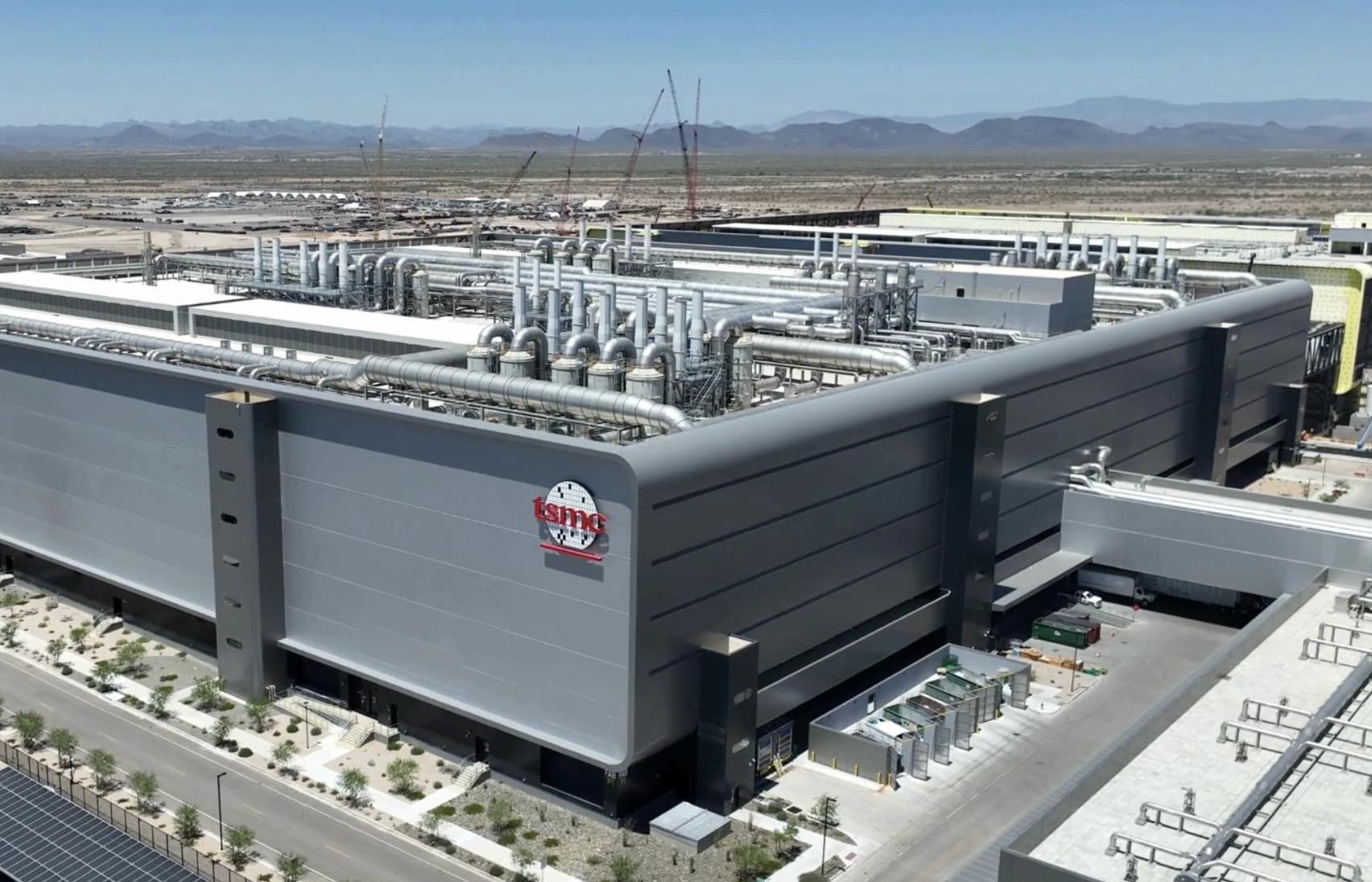
Free cash flow tells the same story with more force. FCF surged to NT$476.56 billion in Q3, up from NT$139.38 billion in the same quarter a year ago — a 242% increase in twelve months. That is not an accounting artifact. TSMC's capital expenditure cycle, which was consuming cash aggressively through 2023 and 2024 as the company built out capacity in Arizona, Japan, and Taiwan, is beginning to pay back at scale. The Arizona Fab 21 Phase 1 ramp, producing 4nm chips, is now contributing to revenue. Phase 2, targeting 2nm production, is on track for 2026–2027 delivery, which means the capex curve has not finished rising — but the existing installed base is now generating cash at a rate that funds the next build without straining the balance sheet.
Why the Q4 Guide Is the Real Trade
TSMC guided Q4 revenue to $52.3B–$54.3B, the midpoint sitting at $53.3B — a 14% sequential jump from Q3's $46.36B. To put that in context: the company is guiding to add roughly $7 billion in quarterly revenue in a single quarter. That is not demand recovery language. That is demand acceleration language, and it has direct implications for every company sitting upstream and downstream of TSMC's fabs.
TSMC's earnings call confirmed that AI-related demand — driven by custom silicon for hyperscalers and GPU orders from Nvidia — remains the primary growth engine. CoWoS advanced packaging, which TSMC supplies exclusively for Nvidia's H-series and B-series GPUs, continues to be a bottleneck, with TSMC expanding capacity but still unable to fully satisfy order backlogs. The company's commentary on CoWoS capacity expansion will be the most watched section of the call transcript for traders in Nvidia and Broadcom specifically.
The Q4 guidance also recalibrates what analysts will be modeling for 2027. If TSMC can sustain a $52–54B quarterly run rate into Q4 2026, full-year 2026 revenue is tracking toward approximately $175–180B — a figure that was considered optimistic by most sell-side desks entering the year. A $53B Q4 print would push consensus 2027 estimates meaningfully higher for not just TSM but the entire semiconductor supply chain: ASML on lithography equipment, Applied Materials and Lam Research on deposition and etch tools, and ASE Technology on advanced packaging assembly.
The Sympathy Trade and What to Watch
TSM ADR was trading at $437.08 in pre-market, down 1.81% as markets priced in a high bar ahead of the print. That pre-market weakness sets up the opening move as a clean tell: if TSM gaps up and holds above $440, the market is confirming that the Q4 guide is being taken seriously. If it fades despite the beat, the read is that Q4 expectations had already been privately upgraded by institutional desks, and the print was sell-the-news. Watch the $445 level as the first meaningful resistance — that represents roughly a 1.8% move from Wednesday's close and aligns with where TSM traded before the October 8 pre-announcement spike.
The sympathy trade is worth executing with discipline rather than reflexively. Nvidia (NVDA) is TSMC's single largest customer by advanced node volume and has the most direct earnings exposure to TSMC's capacity trajectory. Any commentary on CoWoS output expansion or 3nm yield improvement is directly accretive to Nvidia's gross margin picture for 2027. ASML (ASML) is the second-order play — if TSMC is guiding to $52–54B in Q4 and signaling continued capex, ASML's EUV backlog holds. AMD is the third leg: if TSMC's 3nm yields are strong, AMD's MI-series GPU ramp costs come down.
Today's broader earnings slate includes 56 companies reporting, but TSMC is categorically the print of the day — and arguably the most consequential earnings report for understanding 2026's AI capital expenditure cycle. The financials sector results from PNC, BNY, SCHW, and USB will dominate tape activity by midday, but the TSM open sets the tone for the semiconductor complex for the session. Traders in SOXX, the Philadelphia Semiconductor Index ETF, should treat the TSM move in the first 30 minutes as a directional signal before adding exposure. The specific date to circle forward: TSMC's next investor day, expected in Q1 2027, where 2nm pricing and Arizona Phase 2 timelines are likely to be formally disclosed — those two items alone will move the stock 5–8% on the day they land.
The Weekly Investor
Daily market analysis for active traders. Free.