S&P 500 Futures Test All-Time High After AI Revenue Shock
S&P 500 futures climb 0.4% Friday as dip buyers return after OpenAI's $50B revenue miss rattled tech Thursday. Q3 earnings season is the next catalyst.
Key Points
- S&P 500 futures are trading at 7,846.75 Friday morning — within 1 point of the index's all-time high of 7,844.67 set earlier this month.
- Thursday's 1.25% Nasdaq selloff was triggered by an FT report revealing OpenAI's annualized revenue is $50 billion, not the $70 billion widely cited — a $20 billion gap that rattled AI-adjacent longs across the board.
- The next live wire is Q3 earnings season, where consensus forecasts call for 11.6% top-line growth and 30%-plus net earnings expansion across all 11 S&P 500 sectors simultaneously.
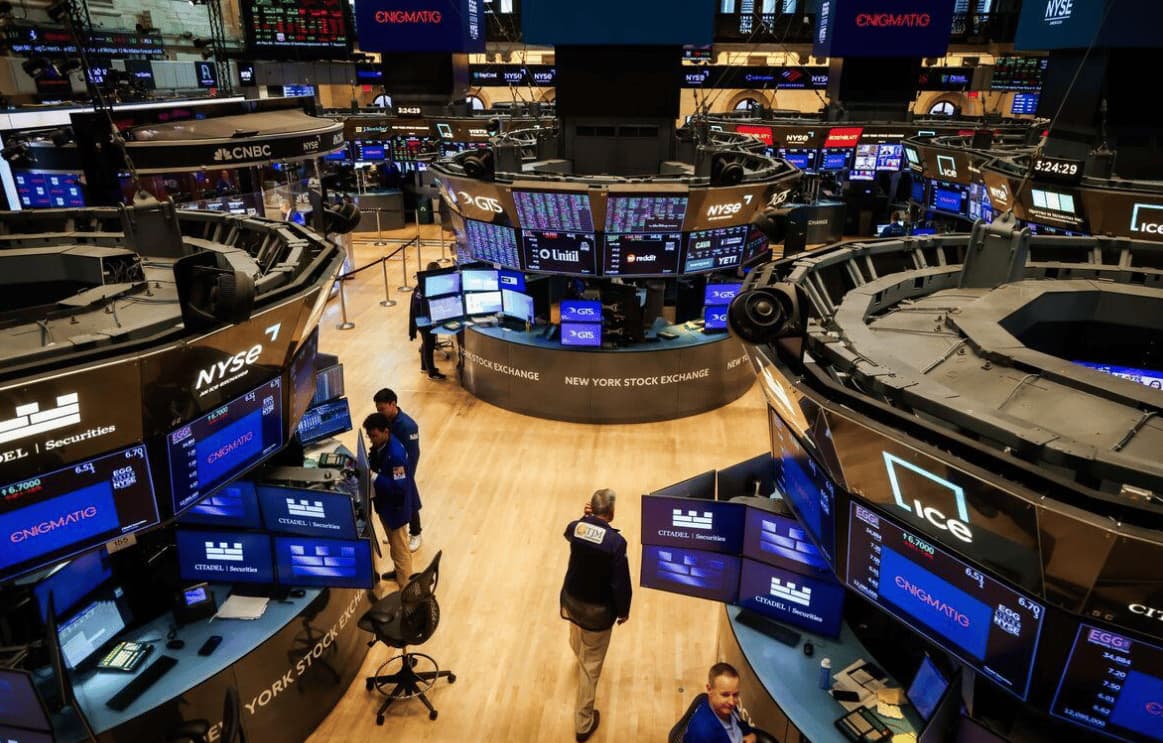
S&P 500 futures are trading at 7,846.75 Friday morning, up 30.50 points or 0.39%, and in doing so are knocking on the door of the index's all-time high of 7,844.67 — set just weeks ago in October 2026. The overnight bounce follows a punishing Thursday session in which the Nasdaq shed 1.25% to close at 27,193.34 and the S&P 500 dropped 0.47% to 7,765.36, both casualties of a single bombshell data point: OpenAI is generating far less revenue than the market believed.
The AI Revenue Gap That Moved Markets
The Financial Times reported Thursday that internal OpenAI documents show annualized revenue of $50 billion — not the $70 billion figure that had circulated widely through analyst notes, media reports, and investor decks. That $20 billion discrepancy is not a rounding error. It is the difference between a company on a hypergrowth trajectory that justifies trillion-dollar ecosystem valuations and one that is, by any honest accounting, still burning toward a finish line it has not yet reached. The market treated it accordingly: the Nasdaq fell 1.25% in its sharpest single-session drop in weeks, with AI-adjacent names bearing the brunt of the selling.
What is notable about Friday's futures action is how quickly institutional money moved to buy that dip. Nasdaq-100 futures are up 0.8% — 242.25 points to 31,211.75 — outpacing both the S&P and Dow by a wide margin. That divergence is a signal, not noise. When the market's most growth-sensitive index leads the overnight bounce after a sentiment-driven selloff, it typically indicates that the selling was positioning-driven rather than a fundamental re-rating. Traders who had overextended AI exposure trimmed Thursday; the buyers who stepped in overnight are making a different bet — that $50 billion in annualized revenue is still $50 billion, and that the broader AI infrastructure trade does not live or die on OpenAI's top line alone.
The Dow, characteristically, barely flinched through any of this — declining just 0.1% Thursday before futures added another 74 points, or 0.14%, Friday morning. Value and dividend names are behaving as shock absorbers, not as drivers. The real action is in the growth complex, and Friday morning's futures confirm that the institutional bias there remains tilted long.
Macro Headwinds That Won't Go Away
The dip buyers have a problem: the macro backdrop has not improved. The 10-year Treasury yield remains above 5.3%, a level that has historically compressed equity multiples and made the risk-free rate a genuine competitor to equity returns. Oil has pushed past $100 per barrel, adding inflationary pressure at exactly the wrong moment — just as the Federal Reserve has been trying to thread the needle between cooling demand and avoiding a hard landing. Both variables are acting as persistent headwinds to any sustained multiple expansion in equities, and neither is showing meaningful signs of retreating.
Yet the options market is not panicking. The VIX sits at 15.22 as of Friday's open, down 1.23% from Thursday's close of 15.41, and well within the 13.38–35.30 range it has traced over the past 52 weeks. At 15, the VIX is pricing roughly 0.94% daily moves in the S&P 500 — a calm posture for a market navigating a 5.3% risk-free rate and triple-digit oil. That said, the CBOE SKEW Index sitting around 141 tells a more nuanced story. SKEW measures the cost of out-of-the-money put protection relative to at-the-money options, and a reading of 141 is elevated — it means investors are quietly paying up for tail-risk insurance even as headline volatility stays subdued. The combination of low VIX and high SKEW is a classic pre-earnings posture: comfortable in the near term, guarded about a potential shock. Prediction markets are backing the bulls for today specifically — Polymarket's "S&P 500 Up or Down on October 9?" contract is pricing a 76% probability of a positive close, with the opening-bell contract at 94% for a higher open.
The energy and yield dynamics also explain two of Friday's most interesting pre-market moves. Crown Castle surged 6.74% and American Tower jumped 5.87% in pre-market trading — infrastructure and tower REITs that have been obliterated by rising yields are getting a relief bounce, likely on any marginal signal of yield stabilization. These are not momentum trades; they are rate-sensitive assets snapping back. The durability of those moves will depend entirely on whether the 10-year holds below 5.3% through the session.
What Earnings Season Has to Deliver
The OpenAI revenue miss is a warning shot fired into the heart of one of this bull market's core narratives: that AI is generating revenue at a pace that justifies the capital expenditure, the infrastructure buildout, and the elevated multiples that have propelled the Nasdaq to its current altitude. Whether that narrative survives intact will be determined not by OpenAI — a private company with no earnings call — but by the publicly traded names that report over the next six weeks.
The setup is historically unusual. Analysts forecast that all 11 S&P 500 sectors will deliver positive year-over-year revenue and profit growth simultaneously in Q3 2026 — a synchronized sweep last achieved in Q2 2021. Consensus top-line growth sits at 11.6%, but the headline number that will do the most work is net earnings growth exceeding 30%. That is not a soft target. The last time the market priced in that kind of earnings acceleration and got it, the S&P 500 spent the following quarter pushing to new highs. The last time the market priced it in and missed, the multiple compression was swift and painful.
The week-to-date scoreboard underscores how much is riding on that delivery. The S&P 500 is up 0.6% for the week — a respectable gain — while the Dow and Nasdaq are essentially flat. The index that matters most, the S&P, is being propped up largely by the expectation that earnings season validates the multiple. At 7,846.75 on the futures, the market is one strong earnings report away from printing a new all-time high above 7,844.67 and one meaningful disappointment away from testing the 7,700 level that served as support through September. The first major reports hit next week. That is the event traders need to be positioned for before Friday's close.
The Weekly Investor
Daily market analysis for active traders. Free.