
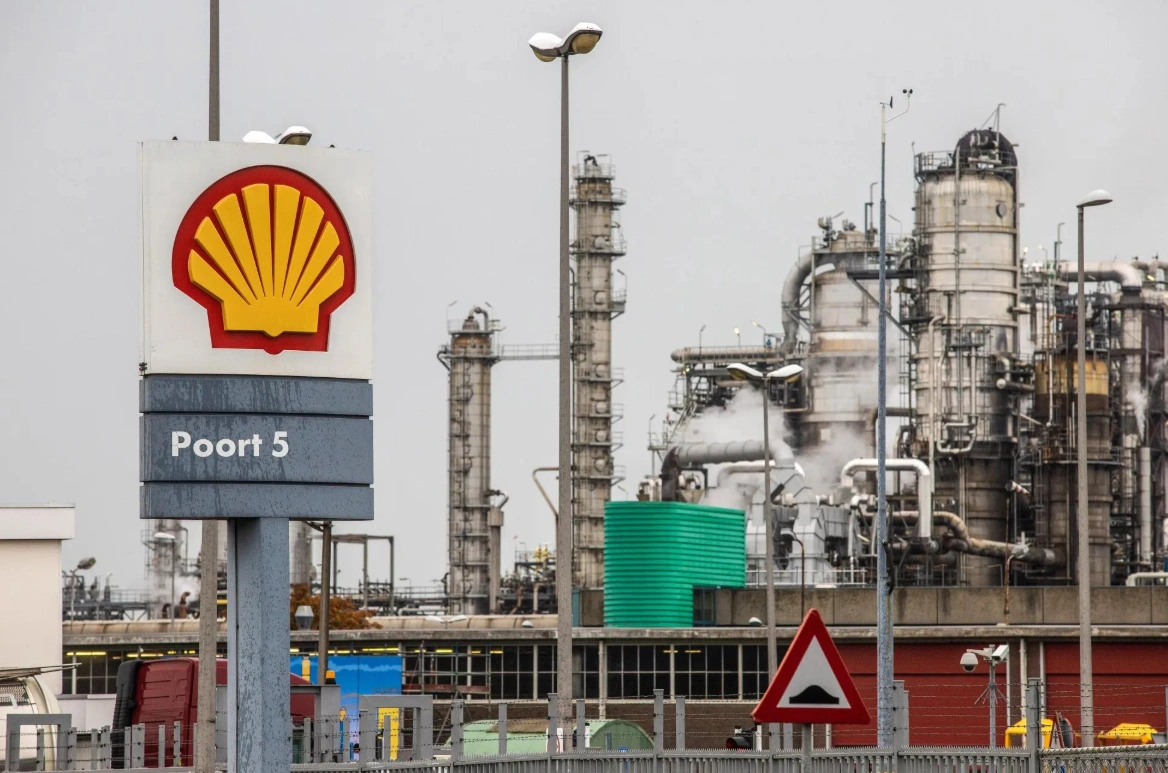
Shell Hits 52-Week High as Oil Supply Shock Bites
Shell stock hit $99.02 Wednesday as Saudi pipeline disruption and Aramco cargo cancellations drove Brent crude to $108 and WTI to $106.53.
Key Points
- Shell shares hit a new 52-week high of $99.02 Wednesday as Brent crude slid only modestly to $108 a barrel after Saudi Arabia's East-West pipeline shutdown and Aramco's cancellation of European cargoes drove WTI to $106.53 Tuesday.
- The supply disruption is Iran-conflict-driven and structural, not demand-side, giving energy equities insulation from the broader rate-hike selloff that knocked the S&P 500 down 0.45% Tuesday.
- Traders should watch whether Brent holds the $107 floor on Thursday — a sustained break above $110 would likely push Shell toward the $102–$105 range and accelerate XLE inflows.
Shell shares hit $99.02 on Wednesday, a fresh 52-week high, as the crude market absorbed its second consecutive day of supply shock headlines — Saudi Arabia's East-West pipeline offline and Aramco pulling European cargo allocations. Brent is easing only fractionally, down 0.68% to $108 a barrel this morning, which tells you the market has not priced in a quick resolution to the Middle East disruption that launched this rally.
The Supply Shock Anatomy
This is not a demand story. The crude move that pushed WTI to $106.53 on Tuesday and kept Brent pinned above $108 today is being driven entirely by supply-side events with a geopolitical origin — the ongoing Iran conflict and its cascading effects on Saudi operational decisions. When Aramco cancels European cargoes, those barrels don't get replaced quickly. European refiners facing reduced spot availability have to compete for alternative supply from West Africa or the U.S. Gulf Coast, and that competition bids up global benchmarks. The East-West pipeline shutdown compounds the problem by limiting Aramco's own logistical flexibility for routing crude to different markets.
The distinction between a demand-driven and supply-driven oil spike matters for how long it lasts and which energy equities benefit most. Demand-driven rallies tend to lift integrated majors and refiners simultaneously but fade faster as high prices eventually suppress consumption. Supply-driven shocks — particularly those tied to geopolitical disruption rather than OPEC quota adjustments — can persist for months and disproportionately benefit upstream producers and integrated majors with large production bases. Shell's asset mix, spanning deepwater production, LNG, and trading operations, is well-positioned for exactly this environment. The company captures margin on both production and the volatility premium that energy traders pay in choppy markets.
Energy vs. the Rate Headwind
The broader market selloff context makes Shell's 52-week high notable for a structural reason: it is one of the few large-cap names posting new highs on a day when the Federal Reserve is hiking rates for the first time in three years. Higher rates are classically a headwind for capital-intensive energy majors — debt costs rise, project financing becomes more expensive, and investors rotate toward short-duration assets. Yet Shell is breaking out, not breaking down. The explanation lies in the magnitude of the crude price move. At $108 on Brent, the cash flow generation for integrated majors overwhelms the marginal increase in financing costs. Shell's balance sheet, which has been a focus of management attention since the post-pandemic restructuring, gives the company the flexibility to absorb a rate move to the 3.75%–4.00% fed funds range without material stress.
CNBC's market coverage noted the energy sector as a standout amid Tuesday's broader decline, with the rate-hike repricing that punished tech and growth names having the opposite effect on commodity producers. When the 10-year Treasury yield touched 5.041% — its highest since 2007 — and the S&P 500 fell 0.45%, XLE was the clearest beneficiary of the defensive rotation into real assets. Energy companies generate revenue in dollars tied directly to commodity prices, which means elevated oil functions as a natural inflation hedge at precisely the moment the Fed is confirming that inflation remains sticky enough to warrant tightening.
The chip sector comparison underscores the divergence. AI-related semiconductor names absorbed a 5% sector rout Monday on slowdown concerns, followed by only a partial Tuesday recovery — AMD up 2%, Qualcomm up 4%, Coherent up nearly 2%. Meanwhile Shell was printing highs. Investors repositioning away from high-multiple, long-duration tech toward cash-flow-positive energy names is a rotation trade with duration, not a one-day tactical move.
What Traders Watch Next
The VIX opened at 17.50 Wednesday with an intraday range of 16.58 to 18.17 — elevated but not panicked. For energy equity traders, a VIX in this range is actually constructive. It signals enough market anxiety to sustain the flight-to-real-assets bid without tipping into the indiscriminate selling that takes down every sector including commodities. The 52-week VIX range of 13.38 to 35.30 puts the current reading in a middle zone where energy names with strong fundamentals tend to outperform on a relative basis.
East West Bancorp's Morgan Stanley upgrade to Overweight with a $160 price target on Wednesday — a financials call in a rate-hike environment — signals that sector-specific fundamental strength is still being rewarded even under macro pressure. The same logic applies to Shell. The stock is not just trading crude; it's trading its own operational leverage to crude at a moment when the supply disruption shows no immediate sign of reversal. Saudi Arabia does not restart pipelines and resume European cargo allocations overnight. These are decisions made within a complex geopolitical negotiation framework that has been running for months.
The specific number to track is Brent at $107 — the intraday low from Tuesday's session. If crude holds above that level on Thursday and into the weekend, the pipeline disruption story has staying power and Shell has room to press toward $102. A close above $100 — just 1% from current levels — would be a psychological and technical trigger likely to attract momentum buyers who have been watching the $99 resistance zone. On the downside, a resolution of the Saudi pipeline issue or unexpected signals from Aramco about resuming European shipments would immediately pressure Brent back toward $100–$102, which would represent a 5%–7% crude pullback and take the bid out from under Shell and the broader energy sector trade. The FOMC press conference at 2:00 PM ET today is a secondary catalyst for crude — a hawkish dot plot that triggers a dollar strengthening move would apply modest downward pressure on oil prices denominated in USD, adding a second variable to Thursday's crude open.
The Weekly Investor
Daily market analysis for active traders. Free.