PepsiCo Beats Q3 but Slashes Full-Year EPS Guidance
PepsiCo beat Q3 EPS by $0.05 and topped revenue estimates, then cut full-year EPS growth guidance to 1%–2% from 4%–6%. Here's what traders need to know.
Key Points
- PepsiCo reported Q3 adjusted EPS of $2.34, beating the $2.29 consensus, but slashed full-year core constant-currency EPS growth guidance to 1%–2% from a prior floor of 4%.
- North American snacks are the fault line: a 15% price cut on Lay's and Doritos propped up volume and share but left Foods North America revenue flat and core operating profit down 12% year-over-year.
- Watch the $8.34–$8.42 full-year EPS range — roughly 1.5%–2.5% below where the Street was modeled — as analysts revise down and the stock's relief rally gets tested against hard math.
PepsiCo posted a clean quarterly beat Thursday morning — $2.34 adjusted EPS versus the $2.29 consensus, $25.27 billion in revenue against a $24.96 billion estimate — then walked up to the podium and cut its full-year outlook anyway. The stock rose more than 1% in premarket trading. Don't let the pop fool you.
The Beat That Doesn't Matter
The quarterly numbers are real but largely beside the point. Net sales rose 5.6% and organic revenue grew 3.1%, both solid prints in a consumer environment where volumes have been grinding lower across the packaged food space. Core operating margin came in at 16.9%, down 35 basis points year-over-year — tight but not alarming at first glance. The problem is what's inside the number. A 4-percentage-point tailwind from tariff refunds propped up core operating profit in the quarter. Strip that out, and the underlying profitability picture is materially weaker than the headline suggests. As reported at CNBC's earnings desk, management acknowledged the refunds explicitly — which means the Street can't pretend they're recurring.
The quarterly beat buys goodwill for about 48 hours. The guidance cut is the story that matters for the next six months. PepsiCo now guides for core constant-currency EPS growth of just 1%–2% for the full fiscal year, compared to its prior guidance floor of 4% — itself already the low end of a 4%–6% original range. Core EPS growth guidance was cut to 2.5%–3.5%, down from a prior floor of 5%. Analysts had consensus 2026 EPS modeled at approximately $8.55, implying roughly 5% growth on 2025's $8.14. The revised guidance implies a range of $8.34–$8.42 — about 1.5%–2.5% below where the Street was sitting. That gap forces a revision cycle, and revision cycles in staples tend to drag longer than traders expect.
The Snack Problem Is Structural
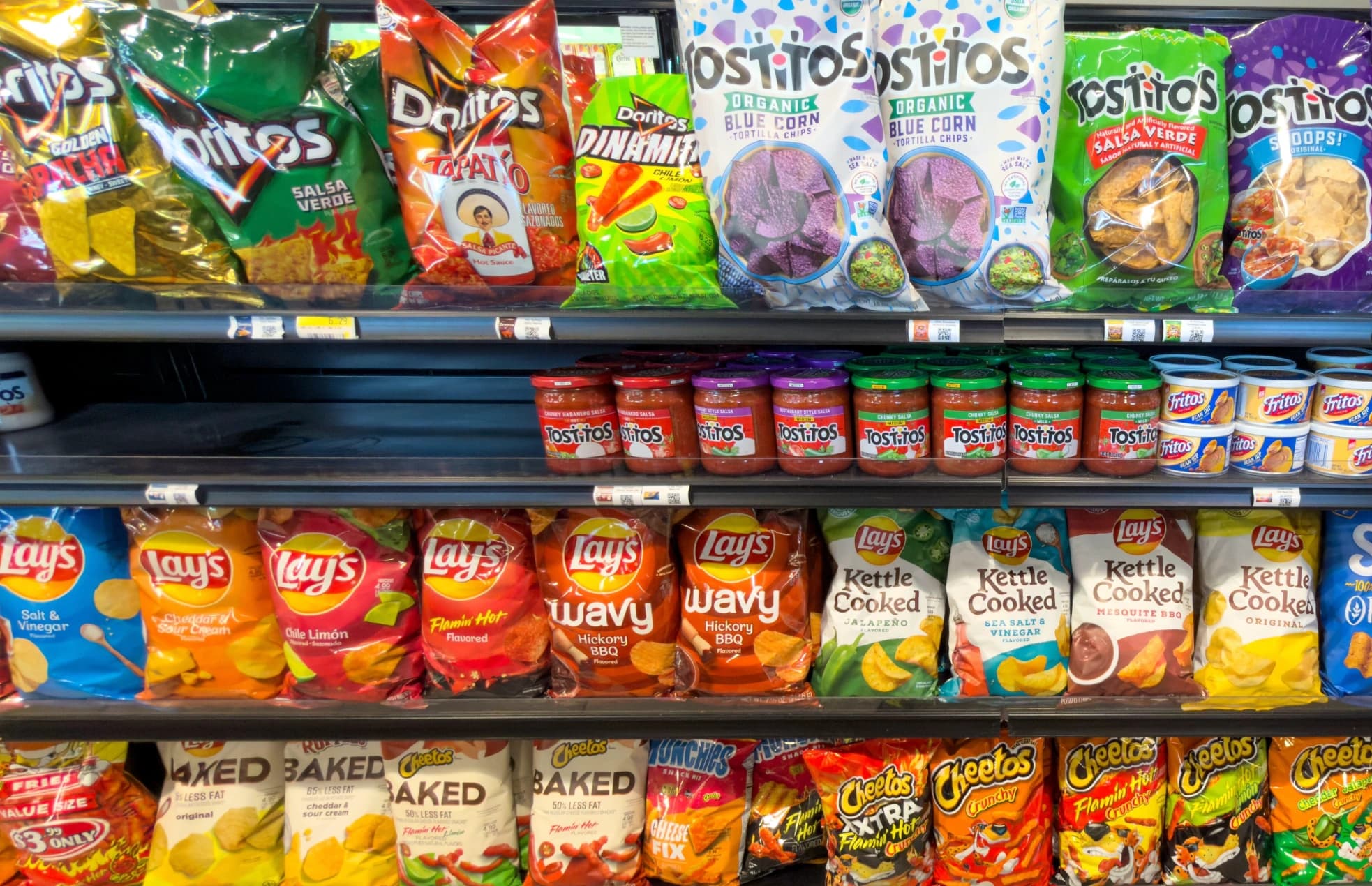
The pressure epicenter is PepsiCo Foods North America, and it's a self-inflicted wound playing out over multiple quarters. In February, PepsiCo cut prices by up to 15% on Lay's, Doritos, and other savory snack brands in an attempt to recover volume that had been bleeding away as consumers traded down or stopped buying at elevated price points. The strategy worked on volume — Q3 showed savory snack volume and market share improving. It didn't work on revenue. PepsiCo Foods North America posted flat revenue for the quarter and core operating profit down 12% year-over-year. That is not a rounding error. It means PepsiCo bought back shelf presence and scanner data at the cost of nearly an eighth of its snack division's profitability.
The deeper issue is that management has essentially confirmed the pricing power it spent a decade building in North American salty snacks is not fully recoverable at current consumer confidence levels. When a company with Frito-Lay's distribution muscle and brand portfolio has to cut 15% to defend volume, the implied price elasticity is worse than the bull case assumed. The full-year organic revenue growth forecast was narrowed to approximately 3%, versus a prior 2%–4% range — which sounds like a tightening rather than a cut, but the midpoint is unchanged and the top end came down. Net revenue growth guidance moved up to ~6%, from 4%–6%, padded by currency and acquisition contributions. That's financial engineering, not operational recovery. Shareholder returns of $8.9 billion remain intact, and the dividend is safe — but that's a floor, not a catalyst.
What Traders Should Watch Next
The short-term setup is tricky. PepsiCo's premarket pop of more than 1% reflects relief that the quarter wasn't a disaster and that organic growth held at 3%. The stock had already been under significant pressure in 2026, and at roughly 17–18 times forward earnings — near the lowest P/E multiple in five years according to TIKR data — some valuation support exists. Contrarian staples buyers will point to that multiple. The counterargument is that the "E" in that P/E ratio is now moving down, not up, and cheap-on-forward-earnings is a trap when the forward earnings number itself is being revised lower across the analyst community in real time.
The filing on SEC EDGAR confirms the guidance language in full — worth reading for anyone trading the stock into year-end. The key variable to monitor is whether Frito-Lay volume gains in Q4 are sufficient to offset the margin compression from lower pricing, and whether PepsiCo can begin walking back promotional intensity without losing the share it just recovered. That won't be clear until the Q4 print, which arrives in early February 2027. Between now and then, any broader risk-off move in consumer staples — already a defensive sector fighting for allocations against higher-yielding alternatives — would likely pressure PEP back toward the $160–$165 range that served as support earlier in 2026. The relief rally is a gift for holders looking to trim; for new buyers, the next meaningful entry depends on whether the revision cycle is one cut or two. History suggests it's rarely just one.
The Weekly Investor
Daily market analysis for active traders. Free.