NVDA's $12.9B Hugging Face Bet Reshapes AI Landscape
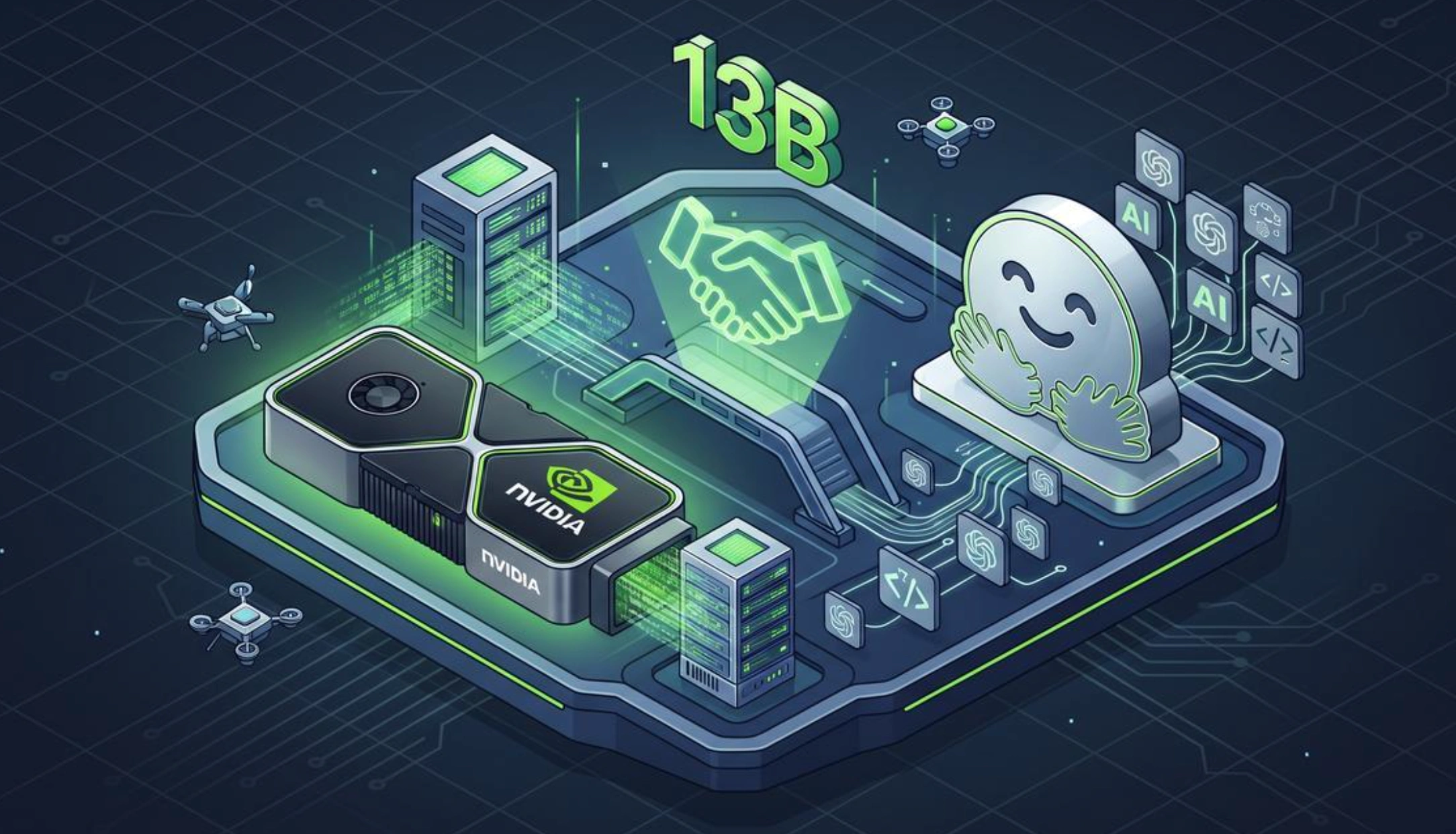
Nvidia's $12.9B Hugging Face acquisition and $99B investment portfolio signal a structural shift in AI strategy. Here's what traders need to watch now.
Key Points
- Nvidia's equity investment portfolio has grown more than tenfold to $99B over the past year, anchored by a ~$12.9B agreement to acquire Hugging Face.
- The deal wave — combined with 83.4% year-over-year revenue growth in FY2027 Q2 and surging GB300 demand — signals Nvidia is transitioning from chipmaker to full-stack AI infrastructure conglomerate.
- Traders should watch the $189.45 level as a consolidation floor; analyst price targets range from $220 to $400, leaving the upside case entirely dependent on execution across its expanding deal portfolio.
Nvidia shares are up 1.16% to $189.45 on Monday as Wall Street continues digesting the most aggressive M&A and investment sprint in the company's history — a ~$12.9B agreement to acquire Hugging Face, a multi-billion dollar investment in Thinking Machines Lab, and a portfolio that has ballooned more than tenfold to $99 billion over the past twelve months. The question traders are now asking isn't whether Jensen Huang is spending; it's whether the architecture he's building has a ceiling.
The Deals Behind the Number
The Hugging Face acquisition is the headline, but it's the portfolio scale that reframes the thesis. Nvidia's $99B investment footprint — up from roughly $9B a year ago — spans AI model infrastructure, robotics, and cloud compute, positioning the company less like a GPU vendor and more like a sovereign wealth fund with a chip fab attached. The Thinking Machines Lab investment, though the precise figure hasn't been officially confirmed, adds another node to what is becoming a vertically integrated AI stack: silicon at the bottom, models in the middle, and increasingly the platforms those models run on at the top.
Hugging Face is not a vanity acquisition. It is the dominant open-source model repository on the planet — the GitHub of AI — with tens of thousands of models hosted and millions of developers as daily active users. Owning Hugging Face gives Nvidia something no GPU roadmap can deliver: distribution. Every developer who pulls a model from Hugging Face's hub is now, in effect, a touchpoint for Nvidia's ecosystem. The strategic logic mirrors what Microsoft did when it paid $7.5B for GitHub in 2018. That deal looked expensive for about 18 months. Then it didn't.
The Figure/Nscale GPU deployment adds a physical AI and robotics dimension that Nvidia has been telegraphing for two years. Physical AI — robots, autonomous systems, industrial automation — requires dense inference compute at the edge. Nvidia's GB300 chips, which are already generating measurable demand signals (a Crusoe-Perplexity AI deal is the most recent forward indicator), are designed precisely for that workload. The robotics bet is long-dated, but the GB300 demand signal is immediate and tradeable.
83.4% Growth — and the Problem With Being Too Good
Nvidia's FY2027 Q2 print showed revenue growth of 83.4% year-over-year, a figure that would be career-defining for most technology executives and is, for Nvidia, increasingly the baseline expectation. That's both the opportunity and the trap. When a company grows at 83%, the market prices in continuation. Any deceleration — from export controls, supply constraints, a softening in hyperscaler capex, or competitive displacement — registers as a crisis rather than a normal cyclical pause.
The analyst community is not aligned on what the stock is worth here. Price targets run from $220 to $400, a spread of $180 on a $189 stock — an unusually wide band that reflects genuine disagreement about which of Nvidia's growth vectors will dominate over the next 18 months. The bulls at $400 are pricing in a world where GB300 demand accelerates, Hugging Face becomes a platform revenue generator, and physical AI scales faster than anyone currently models. The bears at $220 are pricing in export control escalation, margin compression from the investment portfolio's drag, and the eventual arrival of credible silicon alternatives.
Dell's AI-server demand read-through last week reinforced the near-term bull case. Dell's numbers are a direct proxy for Nvidia GPU shipments into enterprise and hyperscaler accounts — when Dell says AI server demand is robust, it means Nvidia's order book is full. That read-through, combined with the broader Buy-rated analyst commentary circulating after last week's earnings, explains why NVDA is holding its ground even as AMD drops 1.94%, TSM falls 2.24%, and MRVL leads decliners at -4.22% today.
The CFO Sale and What It Doesn't Mean
Nvidia's CFO sold $7.65 million in common stock on September 18 — a data point that will fuel retail concern but almost certainly shouldn't. Insider sales at Nvidia's price level, from executives who have held equity for years, are routine liquidity events governed by pre-scheduled 10b5-1 trading plans. The signal value is low. The noise value is high. Traders who front-run insider sales at megacap AI names have a consistently poor track record.
What matters more than the CFO's sale is the regulatory environment crystallizing around the company. California Governor Gavin Newsom signed an executive order on September 18 specifically flagging Nvidia alongside Apple and Google in what has been described as an "AI kill switch" order. The federal government, through a December 2025 executive order establishing a national AI policy framework, has already directed federal authorities to challenge state AI laws as potentially preempted or unconstitutional. That federal-state collision course is not priced into NVDA with any precision — because nobody knows how it resolves or how long it takes.
The DOJ's AI task force, operational since January 2026, will likely accelerate scrutiny following Newsom's order. For a company that just agreed to acquire the world's largest open-source AI platform, the antitrust optics are not trivial. Hugging Face's market position in model distribution is arguably dominant. Whether that dominance, once inside Nvidia's corporate structure, attracts regulatory attention is a question that will follow this deal through its closing process. Traders holding NVDA into year-end should treat regulatory risk as a non-zero variable — not the base case, but not ignorable either.
The immediate technical level to watch is $189.45, today's price and effectively the post-earnings consolidation floor. A move above $200 on volume would signal the market is ready to reprice the M&A portfolio as accretive rather than speculative. A break below $180 — a level not tested since before last week's earnings — would suggest institutional investors are trimming into strength rather than adding. The next hard catalyst is any update on the Hugging Face deal timeline or a formal announcement on the Thinking Machines Lab investment size, either of which could arrive without warning out of TechCrunch Disrupt this week.
The Weekly Investor
Daily market analysis for active traders. Free.