Intel's Apple Deal and TSMC's 53% Revenue Print
Intel surges 15% on an Apple chip manufacturing deal while TSMC posts 53% August revenue growth. The foundry war is reshaping the AI supply chain now.
Key Points
- Intel surged approximately 15% after the Wall Street Journal reported Apple will use Intel to manufacture chips for some of its devices — the most significant foundry credibility signal INTC has received in years.
- TSMC fell 1.5% on the same Apple-Intel news, making explicit what the market already suspected: every point of foundry share Intel captures comes directly off TSMC's most lucrative customer account.
- Thursday's Trump-Xi summit and any movement on advanced chip export controls remain the dominant macro variable for NVDA and the entire semiconductor complex through end of week.
TSMC reported August revenue of NT$514.81 billion — a 53.3% year-over-year surge — and it barely moved the stock, because the market had already priced the AI infrastructure buildout into its multiple. What did move the semiconductor complex this week was a Wall Street Journal report that Apple and Intel have closed a chip manufacturing deal after more than a year of negotiations, sending Intel up roughly 15% and cutting TSMC by 1.5% in a single session. The foundry war just got a real combatant.
TSMC's Numbers Are Priced In — The Risk Is Intel
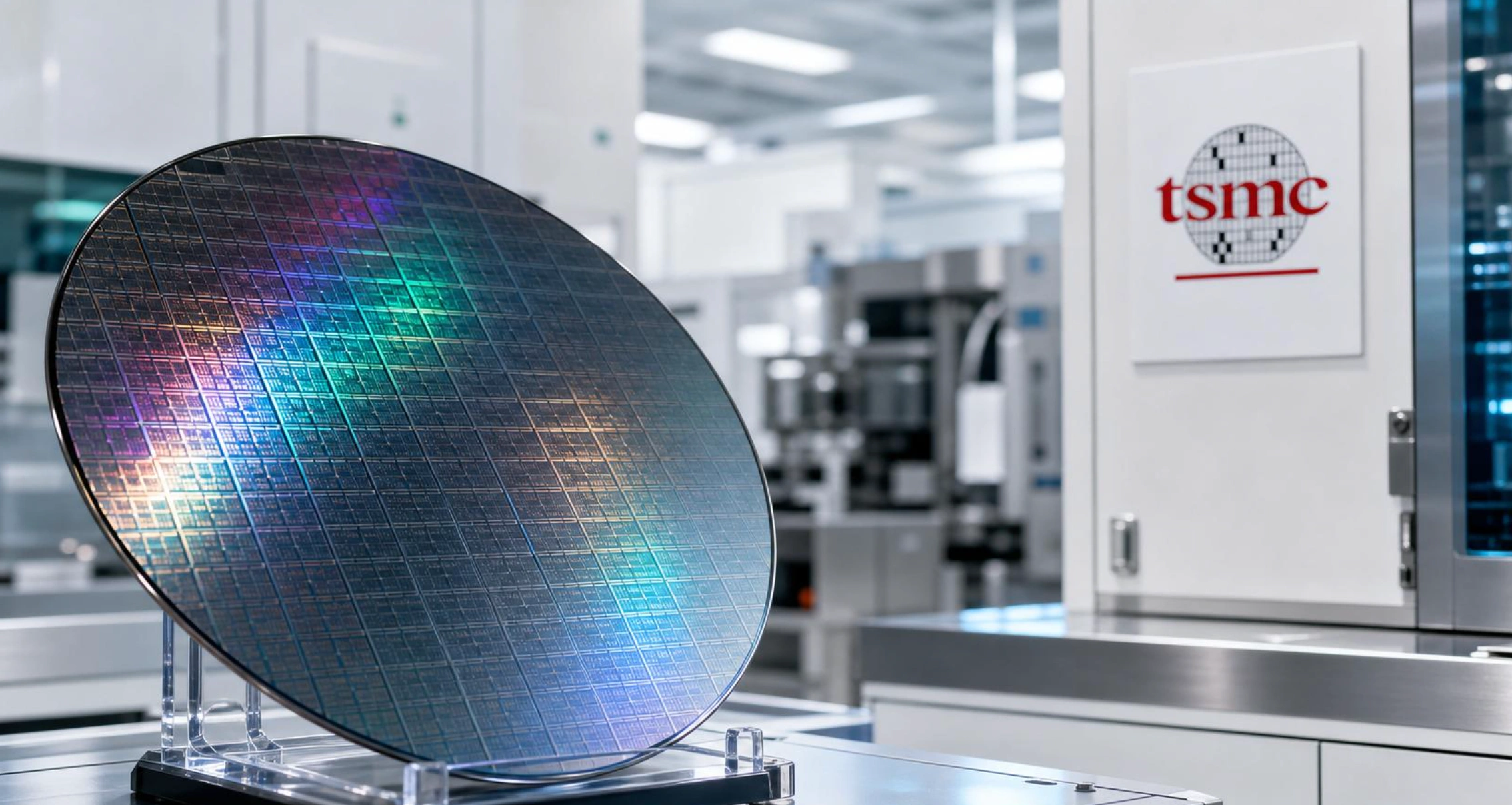
TSMC's August revenue print is the cleanest real-time gauge of AI hardware demand anywhere in public markets. NT$514.81 billion, up 53.3% year-over-year, confirms that the AI infrastructure spending cycle has not decelerated into the second half of 2026. The company is guiding full-year revenue growth above 40%, which at its current revenue run rate implies an annual top line well north of NT$4 trillion. Those are generational numbers for a foundry business, and they reflect the simple structural reality that TSMC controls 72% of the global chip foundry market and every major AI accelerator — from Nvidia's Blackwell GPUs to Broadcom's custom ASICs — runs through its fabs in Taiwan.
The supply constraint story has not changed either. TSMC's CoWoS advanced packaging capacity is nearly doubling in 2026, yet lead times remain in the 52-to-78-week range. The binding constraint is not raw wafer capacity; it is the packaging bottleneck that determines how quickly finished AI chips can be delivered to hyperscaler customers who have already paid for them. That structural mismatch keeps TSMC's pricing power intact and makes its revenue line a reliable leading indicator for the entire AI hardware chain — including Nvidia, Broadcom, Marvell, and every fabless designer that depends on TSMC's nodes. The 3-nanometer process is in volume production, and the 2-nanometer ramp is underway, meaning TSMC is simultaneously defending its technology lead and absorbing the capital expenditure of a node transition. Full-year 2026 capex will be among the highest in the company's history.
Intel's Apple Deal Changes the Foundry Calculus
The Intel-Apple deal is a different kind of story — not a confirmation of existing trends but a genuine discontinuity. Intel stock soared approximately 15% on the news and was tracking toward a fourth consecutive record high, which by itself signals how starved the market has been for evidence that Intel's foundry turnaround is real rather than aspirational. For years, Intel Foundry Services has been a business unit with a strategy and a roadmap but a conspicuous absence of marquee external customers willing to bet their most critical silicon on Intel's manufacturing capabilities. Apple is not just a marquee customer — it is the single most demanding chip customer on the planet, with tolerances for yield, schedule, and performance that no foundry can fake its way through.
The specific devices Apple will use Intel to manufacture have not been disclosed, which matters for sizing the opportunity. If Intel is manufacturing chips for peripheral or lower-margin Apple products, the revenue impact is meaningful but not transformative. If the deal eventually touches iPhone application processors — currently exclusive to TSMC's most advanced nodes — the implications for both companies' competitive positioning would be seismic. The market is currently pricing the ambiguity, which is why Intel's 15% move is large but not hysterical. There is a credibility premium being assigned, not a fully modeled revenue stream. TSMC's 1.5% decline on the same day is the market's way of acknowledging that the Apple account, long treated as permanently locked in at TSMC, now has at least a partial question mark over it.
Memory Divergence and the NVDA Summit Trade
The memory market is running a parallel story that is less visible but equally important for AI infrastructure investors. SK Hynix is aggressively ramping its 1c DRAM node — the most advanced DRAM process in volume production — with a clear focus on AI inference applications where memory bandwidth is the binding performance constraint. Samsung, meanwhile, is still working through yield problems on HBM4, the next generation of high-bandwidth memory that sits directly on AI accelerators as a performance-critical component. The divergence is not academic: if Samsung cannot resolve its HBM4 yield issues at scale, SK Hynix maintains pricing power and supply priority with Nvidia and other accelerator makers well into 2027. That dynamic has direct implications for the cost structure of every AI training and inference cluster being built by hyperscalers right now.
Nvidia's near-term trajectory is almost entirely a function of geopolitics rather than fundamentals, which is an unusual position for a company with its earnings profile. The Trump-Xi summit Thursday is the event that determines whether Nvidia's China export ceiling rises, holds, or tightens further. The current restrictions effectively block Nvidia from selling its most advanced Blackwell GPUs into China — a market that, before the export control regime tightened, represented a significant and high-margin revenue stream. Any formal or informal signal from Thursday's summit indicating a willingness to revisit those restrictions would be a direct positive catalyst for NVDA. Any hardening of the restrictions — or new categories of controlled technology — would reinforce the ceiling. Semiconductor analysts tracking the policy landscape are recommending traders position before Wednesday's close to avoid being caught by overnight gap risk on Friday's open.
The forward-looking trade for the semiconductor complex this week is structured around one date and one event. Thursday, September 24 — the Trump-Xi summit — is the single most important price discovery moment for NVDA, BABA, and the broader chip sector between now and end of quarter. For Intel specifically, the follow-through trade after the initial 15% surge depends on whether the company provides any additional clarity on the Apple deal's scope before the next earnings cycle. TSMC's extraordinary revenue trajectory confirms the demand environment remains intact — but in a week when Intel is reclaiming foundry relevance and geopolitical risk is repricing daily, the most important number is not in any earnings release. It comes out of a bilateral meeting room on Thursday.
The Weekly Investor
Daily market analysis for active traders. Free.