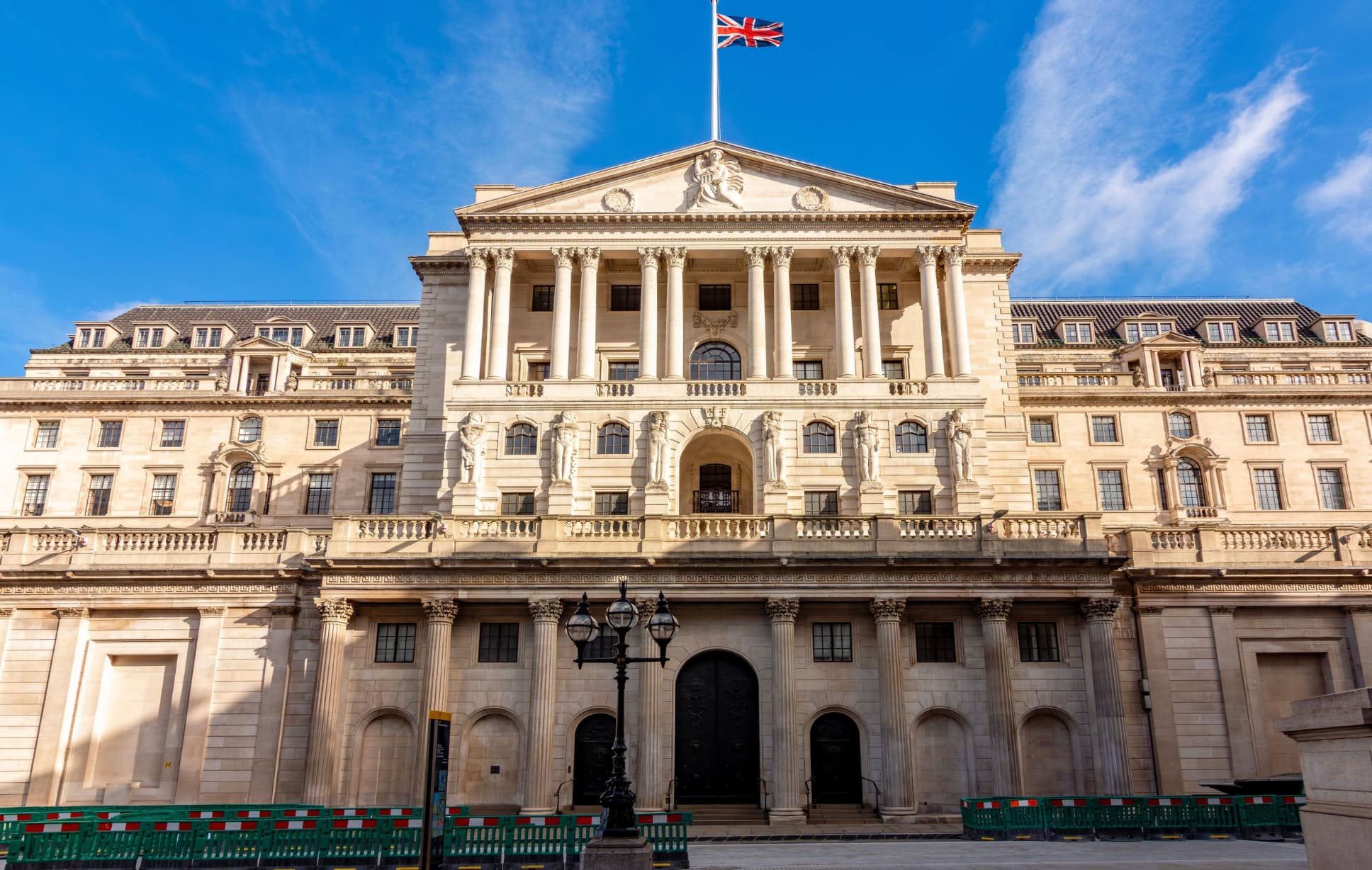
BoE Holds at 3.75%, BoJ Set to Hike Friday to 1.25%
Bank of England holds rates at 3.75% as GBP/USD trades near 1.3400. Bank of Japan expected to hike 25 bps to 1.25% Friday — a 30-year high.
Key Points
- The Bank of England is expected to hold its benchmark rate at 3.75% Thursday, but the MPC vote split and forward guidance language will determine near-term GBP/USD direction from the current 1.3400 handle.
- The Bank of Japan is widely expected to raise rates 25 basis points to 1.25% on Friday — its highest level in three decades — and USD/JPY is already seeing selling pressure in European trading Thursday as markets pre-position.
- Traders should watch the BoJ vote margin and statement language Friday for any signal that the hiking cycle could extend beyond 1.25%, which would be the primary catalyst for a sustained USD/JPY breakdown.
The global rate-hike cycle that most analysts called dead in early 2025 is alive across three major economies simultaneously. The Bank of England holds its September decision Thursday with rates at 3.75% and GBP/USD hovering near 1.3400 after snapping a three-day losing streak. Twelve hours later, the Bank of Japan is expected to move rates to 1.25% — a level not seen in 30 years. Sandwiched between them: a Federal Reserve that just hiked to 4.00% and an ECB sitting at 2.65% after its own 25-basis-point move last week.
The BoE Hold That Isn't Actually Quiet
A hold at 3.75% from the Monetary Policy Committee is consensus, fully priced into sterling markets, and on its own should generate minimal volatility. That makes the MPC vote split and the accompanying statement the only things worth trading Thursday. The critical question is whether any dissenting members push for a cut — and if so, how many. A 7-2 or 6-3 split in favor of holding, with two or three members dissenting toward a cut, would signal the MPC is moving toward easing earlier than current market pricing implies and would pressure GBP/USD below the 1.3400 level that has provided near-term support.
The BoE's position is analytically distinct from the Fed's. Where Warsh is tightening into 3.4% CPI with a 4.1% unemployment rate and positive — if modest — GDP growth, the BoE is holding into a UK economy that has faced more pronounced pressure from elevated energy costs and persistent wage-driven inflation. The ECB's second hike in as many months, announced last week at 2.65%, complicates the picture further: a more aggressive ECB relative to the BoE creates EUR/GBP cross-rate dynamics that could squeeze UK importers and add a secondary inflation channel even as the MPC tries to stay on hold. EUR/USD itself is trading near a seven-week low around 1.1450 Thursday morning, reflecting the market's digestion of the ECB's hawkish pivot alongside the Fed's renewed tightening.
For GBP/USD specifically, the 1.3400 level is the line. A clean hold with neutral-to-hawkish language from Governor Bailey keeps sterling supported in the 1.3380–1.3450 range through the London close. A dovish surprise — more dissenters than expected, or explicit language about the proximity of rate cuts — breaks 1.3380 and opens a test of 1.3300. The base case is neither: a clean, uneventful hold that passes the session with modest movement, leaving GBP directionality to be set by Friday's BoJ decision and any residual USD strength from Thursday's U.S. data releases.
Japan's Moment: 1.25% and a 30-Year Milestone
The Bank of Japan's expected 25-basis-point hike Friday to 1.25% is not a routine policy adjustment. It is a structural regime shift that has been building since the BoJ abandoned its yield curve control framework in 2024. At 1.25%, Japanese rates would sit at their highest since the mid-1990s — a period before the deflation trap that defined two decades of near-zero and negative rate policy. Governor Ueda has repeatedly signaled that the BoJ will continue normalizing as long as the 2% inflation target remains durably in reach, and the second hike of 2026 confirms the committee believes that threshold has been crossed.
USD/JPY is already reflecting pre-positioning. Selling pressure in European trading Thursday morning — ahead of the actual BoJ decision — indicates that institutional desks are not waiting for Friday's confirmation to reduce long-dollar/short-yen exposure. The directional trade is clear: a confirmed 1.25% hike moves USD/JPY lower, with the pace and magnitude of the move determined entirely by the statement language around future hikes. If the BoJ signals another move is possible in 2026's remaining meetings — there is one scheduled for October and one for December — USD/JPY faces a sustained breakdown. If the language is more cautious, flagging 1.25% as a natural pause point for data assessment, the initial yen strength gets faded and USD/JPY stabilizes.
The carry trade arithmetic is shifting in ways that matter beyond the spot rate. For more than a year, the yen's near-zero rate made it the default funding currency for global carry trades — investors borrow cheap yen, deploy into higher-yielding assets. At 1.25%, the cost of that funding has risen meaningfully, and at 4.00% on the dollar side, the rate differential still heavily favors USD. But the direction of travel is what carry-trade desks monitor: every BoJ hike narrows the spread and incrementally increases the cost of maintaining short-yen exposure. The positioning unwind, when it comes, tends to be sharp and non-linear because carry trades are structurally crowded. Thursday's pre-positioning move in USD/JPY may be the early edge of that unwind.
The Divergence Trade and What Breaks It
Four major central banks — the Fed, BoE, ECB, and BoJ — are all in tightening or hold-at-elevated-levels mode simultaneously. That is an unusual configuration historically, and it narrows the set of obvious divergence trades that have defined FX markets for the past two years. The FOMC's unanimous September hike sits at the top of the rate ladder at 4.00% and climbing. The ECB at 2.65% is the most recent mover and still has the most uncertain forward path, given that its tightening cycle has been explicitly linked to geopolitical pressures from the Iran war. The BoE at 3.75% is effectively in a wait-and-see stance. The BoJ at a prospective 1.25% is the furthest from neutral in normalization terms, having traveled from negative rates.
The ECB dimension deserves specific attention for EUR/USD traders. The central bank reiterated after last week's 25-basis-point hike that it would not pre-commit to further steps — language that usually signals a conditional pause rather than a definitive stop. With EUR/USD near 1.1450, the seven-week low reflects a market that is pricing the Fed's resumed tightening as more durable than the ECB's. If next week's eurozone inflation data prints above expectations, that assessment gets challenged and EUR/USD could recover toward 1.1550. If it disappoints, the 1.1400 level becomes the next technical target.
The key date for the global central bank picture is Friday, September 18. A BoJ hike to 1.25%, confirmed with a majority vote and accompanied by language acknowledging future normalization remains data-dependent, would complete a week in which three of the world's four most-watched central banks have either acted or signaled imminent action. Watch USD/JPY at the 142.00 level — a clean break below that handle on Friday's decision would confirm the directional trade and open a move toward 140.50 over the following two weeks. That is the number that matters most heading into the Tokyo open Thursday night.
The Weekly Investor
Daily market analysis for active traders. Free.