ASML Q3 EPS Crushes Estimates by 21% — TSMC Due Tomorrow
ASML's Q3 EPS of $14.65 demolished the $12.13 consensus by 20.8%. Full-year guidance raised to €44–45B. TSMC reports tomorrow.
Key Points
- ASML Q3 EPS of $14.65 beat the $12.13 consensus by 20.8%, while full-year 2026 net sales guidance was raised to €44–45B from an initial €36–40B.
- Profit surged over 20% on cost discipline and product mix even as revenue only modestly beat, and ASML flagged AI adoption across an "expanding applications space" as the structural demand driver.
- TSMC reports Thursday, October 15 — a second consecutive beat would confirm AI-driven chip demand is accelerating into year-end, a critical read for the entire semiconductor supply chain.
ASML's Q3 earnings landed Wednesday morning with an EPS print of $14.65 against a $12.13 analyst consensus — a 20.8% upside surprise that dwarfs the company's own recent history of 7%-to-18% beats. Revenue of €11.7 billion ($13.21 billion) edged just above the $13.16 billion consensus, but the profit story is what moves positions today: net income reached €5.0 billion on a gross margin of 57.5%, and the Dutch lithography monopolist promptly raised its full-year 2026 net sales guidance to €44–45 billion — up from €36–40 billion at the start of the year. That is a revision of roughly €7 billion at the midpoint, made in three quarters.
The Print That Rewrote the Year
The magnitude of the full-year guidance revision is the story that will echo through Thursday's TSMC report and beyond. ASML entered 2026 guiding €36–40 billion in net sales for the full year. It now guides €44–45 billion, with Q4 alone expected to deliver €14.2–€15.2 billion at approximately 57% gross margin. That Q4 midpoint of €14.7 billion would be the company's largest quarterly revenue in its history. For context, ASML's entire 2022 revenue was €21.2 billion. The company is now guiding to nearly that figure in a single quarter.
What drove the earnings beat wasn't a volume surge — revenue only cleared consensus by roughly $50 million — it was margin execution. Gross margin of 57.5% reflects a favorable mix of High-NA EUV systems and service revenue, both of which carry structurally higher margins than older DUV tools. ASML has consistently expanded margin as its product mix shifts toward the most advanced lithography nodes, and the Q3 result confirms that dynamic is accelerating rather than plateauing. The company explicitly attributed demand strength to "AI adoption across an expanding applications space," a phrase that signals the tailwind is broadening beyond hyperscaler GPU clusters into enterprise and edge deployment.
High-NA EUV and the Photomask Breakthrough
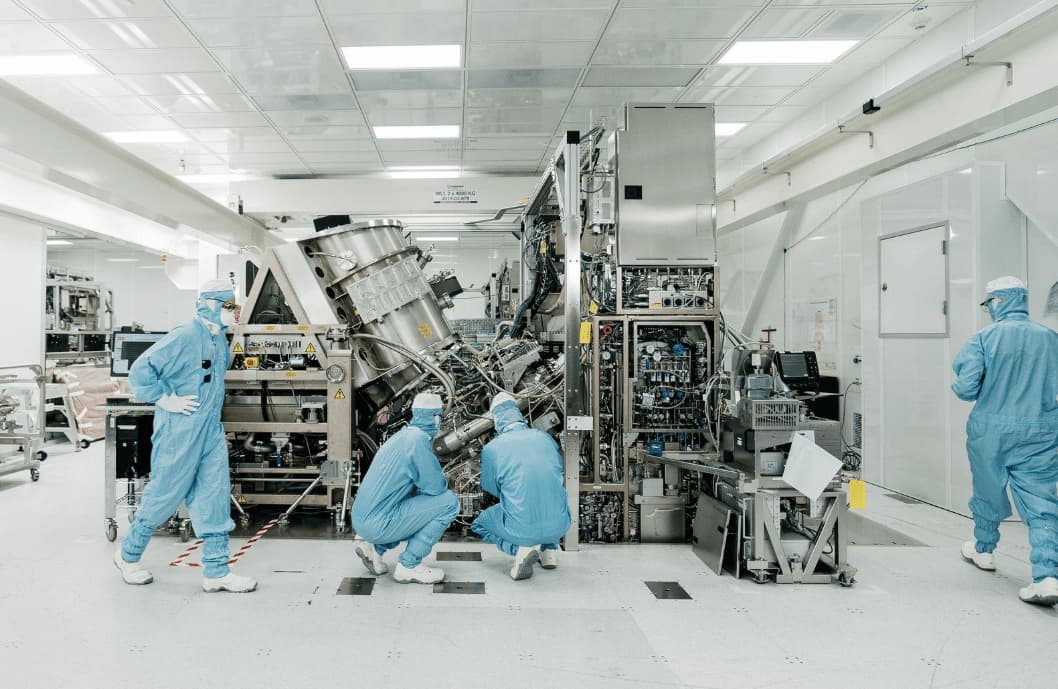
Separate from earnings, ASML and TSMC announced a joint initiative Wednesday to pioneer the semiconductor industry's transition to 12-inch photomasks for High-NA EUV lithography. The technical claim is a greater-than-40% productivity increase for dual-mask exposure — a threshold that, if achieved at volume, would materially shift the economics of cutting-edge chip manufacturing. High-NA EUV is the technology that enables sub-2nm manufacturing, and the photomask transition is a prerequisite for commercializing those nodes at scale.
The timing of this announcement — on the same day as ASML's earnings beat and one day before TSMC reports — is not accidental. Both companies are telegraphing a coordinated roadmap to customers and investors. For semiconductor supply chain participants, the 12-inch photomask transition has ripple effects in advanced packaging, mask inspection equipment, and materials sourcing. Companies exposed to photomask infrastructure, pellicle manufacturing, and mask inspection — including players like Entegris and Lasertec — warrant scrutiny in the days following this announcement. The productivity claim also directly challenges the economics of multi-patterning workarounds that Intel and Samsung have relied upon, and strengthens TSMC's node leadership case ahead of tomorrow's print.
ASML also used Wednesday's release to flag a concern that should not be buried in the beat: the company warned that "major innovations" are needed to address AI's power consumption and cost challenges. This is the first time ASML has foregrounded power economics as a constraint on its own demand outlook. It is a candid acknowledgment that AI infrastructure buildout has a ceiling defined by energy availability and data center power density — not just wafer demand.
Valuation, TSMC Preview, and What Traders Watch Next
ASML's stock trades at $1,717.76 as of Wednesday. GF Value pegs intrinsic value at $1,277.79, implying 34.4% overvaluation at current prices. The trailing P/E of 54.8x compares to a five-year median of 39.25x. That premium has been a persistent feature of ASML's valuation since 2023, justified by its monopoly position in EUV lithography — no other company manufactures the machines required to print chips below 7nm. But at 54.8x trailing earnings and with an earnings beat of this magnitude already priced into a stock sitting near all-time highs, the risk-reward calculus for new long positions is not straightforward. ASML has beaten EPS in each of the last four quarters by margins ranging from 7% to 18%; this quarter's 20.8% beat is the largest of that streak.
The immediate catalyst forward is TSMC's Q3 report on Thursday, October 15. TSMC manufactures approximately 73% of the world's processors and an estimated 90% of the most advanced processors — it is the single most important fundamental data point for the chip sector. TSMC's EPS consensus has risen 5.3% over the past 90 days, a more modest revision than ASML's 26.3% upward drift, but the base expectations are already elevated. TSMC has beaten EPS in each of the last four quarters by 7% to 13%. A beat in that range tomorrow would confirm that AI-driven wafer demand is translating into real revenue at the foundry level — not just order backlogs — and would likely lift the entire semiconductor supply chain, from equipment makers to materials suppliers.
The bear case for tomorrow centers on TSMC's CoWoS advanced packaging capacity, which remains the binding constraint on AI chip shipments. If TSMC signals that CoWoS supply is still gating NVIDIA and AMD AI accelerator output, the forward revenue ramp could be more back-half-2027 than near-term. Watch TSMC's Q4 guidance range and any language around advanced packaging capacity additions. The specific number to track: TSMC's 3nm and 2nm revenue contribution as a percentage of total wafer revenue. If it exceeds 20% in Q3, that is a structural inflection signal for the High-NA EUV transition ASML and TSMC announced this morning. TSMC prints before the U.S. open on Thursday, October 15 — position accordingly before Wednesday's close.
The Weekly Investor
Daily market analysis for active traders. Free.