AMD, Intel, SOXX: Last Week's Chip Rally Explained
AMD surged 8% on 57% data center growth, Intel squeezed 10% higher, and SOXX jumped 6% in a session. Here's what it means ahead of AMAT Thursday.
Key Points
- AMD posted 57% year-over-year data center revenue growth, driving an 8% single-session rally on August 4, while Intel surged 10% on short covering after a 24% monthly decline — and the SOXX semiconductor ETF posted a 6% single-day gain, an unusually large move for a non-leveraged fund.
- The rallies are being driven by a structural AI infrastructure build cycle, but AMD's 171x price-to-earnings ratio versus Nvidia's 31x creates a valuation overhang that leaves chip stocks acutely exposed to any macro deterioration.
- Applied Materials reports Thursday after the close with consensus calling for $9.01 billion in revenue — up 23.4% year-over-year — and the print will serve as the definitive equipment-spending read for the remainder of the 2026 semiconductor build cycle.
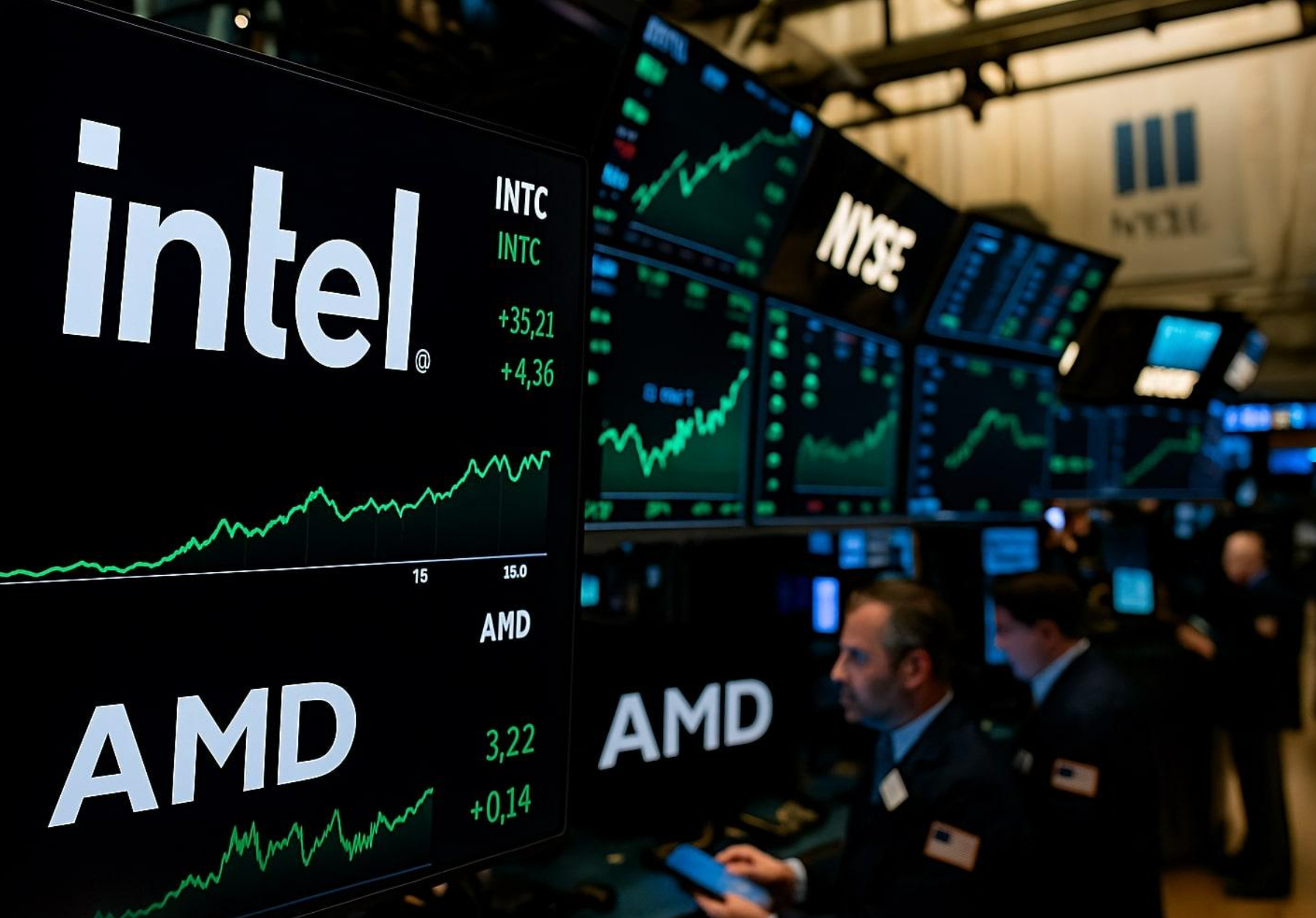
The SOXX semiconductor ETF jumped 6% in a single session last week, its largest single-day move since the early 2024 AI re-rating, as AMD's 57% year-over-year data center revenue growth triggered an 8% rally in AMD shares on August 4 and Intel squeezed 10% higher on short covering after a brutal 24% monthly decline. The moves are real and they are significant — but the valuation math underneath them is not uniformly constructive, and Thursday's Applied Materials print will tell traders whether the equipment spending that supports the entire build cycle is holding pace with the demand narrative.
What the AMD Number Actually Means
AMD's data center segment growing 57% year-over-year is not a rounding error or a soft beat — it is confirmation that the MI300X GPU line has achieved meaningful enterprise penetration in a market that many analysts assumed Nvidia had permanently closed off. The specific revenue figure matters because it validates a two-vendor competitive dynamic in AI accelerators: hyperscalers are not running a single-source supply chain, and AMD is winning real workloads at real scale. That is the read-through that moved the stock 8% in a single session, not a headline beat against a sandbagged estimate.
The broader chip complex moved in lockstep, with Intel surging 10% on short covering after a 24% monthly slide. Intel's move is categorically different from AMD's — it is a short-squeeze in a name where sentiment had become structurally negative following a prolonged period of execution disappointments, not a fundamental re-rating. Intel reacquired Apollo Fab 34 in April 2026 for $14.2 billion, funded by $7.7 billion in cash and $6.5 billion in new debt, and its Q2 2026 guidance called for $13.8–$14.8 billion in revenue at a 39.0% non-GAAP gross margin and $0.20 non-GAAP EPS. Those are not the numbers of a company turning the corner — they are the numbers of a company stabilizing. A 10% squeeze off a 24% hole leaves Intel still down double digits on the month, and traders should not mistake short-covering velocity for fundamental recovery.
The SOXX 6% single-session move is the number that puts last week in context. Single-day gains of that magnitude in a non-leveraged, diversified semiconductor ETF happen at major inflection points — either the beginning of a sustained re-rating or the climax of a relief rally that fades when the next catalyst disappoints. The ETF's composition means that AMD and Nvidia gains are amplified through the index, but so are any reversals. With AMD trading at 171x earnings versus Nvidia at 31x, the valuation dispersion within the index creates a fragile internal structure: AMD can absorb bad news far less efficiently than Nvidia can at current multiples.
The Memory Crunch Is Repricing the Entire Stack
The single input cost story dominating every AI infrastructure earnings call this cycle is memory — specifically high-bandwidth memory, the specialized DRAM that AI GPUs require in large quantities and that only a handful of vendors, primarily SK Hynix, Micron, and Samsung, can supply at the required specifications and volumes. Demand for HBM has outpaced capacity additions, and the pricing consequences are being felt simultaneously across every company in the AI stack. Tesla CEO Elon Musk described memory pricing as "insane," and Amazon CEO Andy Jassy said the "inflated price" of memory chips drove his company's capex guidance higher. These are not small companies making noise about commodity inputs — they are the largest buyers in the world, and they are both flagging the same supplier pricing dynamic in the same earnings cycle.
The memory crunch has a second-order effect that is less discussed but equally important for chip stock positioning: it is compressing margins at the system level even as chip volumes grow. A GPU cluster that costs 20% more to build than it did 12 months ago because HBM pricing has reset higher is a cluster that generates lower returns on invested capital, regardless of how strong the top-line revenue looks. This margin compression at the infrastructure layer flows directly into the CapEx overhang visible at companies like CoreWeave, where the gap between contracted revenue and capital required to deliver it is widening, not narrowing.
Advanced packaging is the other physical chokepoint in the supply chain. TSMC's CoWoS process — the Chip-on-Wafer-Substrate packaging technology that bonds HBM to GPU dies at the density required for AI workloads — is capacity-constrained, and TSMC CEO C.C. Wei has been explicit that even aggressive build programs in the U.S., Japan, and Germany are "far from enough" to meet current demand. TSMC controls 72% of the global foundry market, making its packaging capacity not a niche technical issue but a binding constraint on how fast the AI infrastructure build can physically proceed. The constraint does not resolve with money — it resolves with time, as new CoWoS lines require 18–24 months from investment decision to productive output.
AMAT Thursday Is the Equipment Cycle's Report Card
Applied Materials reports fiscal Q3 earnings Thursday after the close, and the consensus is demanding: $9.01 billion in revenue, up 23.4% year-over-year, with EPS of $3.39, up 36.7% year-over-year. Analysts specifically expect quarter-over-quarter revenue growth above 13%, driven by equipment spending tied to DRAM capacity expansion for HBM, advanced logic investment at TSMC and Intel, and advanced packaging tool demand. AMAT is the primary equipment supplier to the foundries and memory makers building the physical infrastructure of the AI cycle — its revenue is a direct measure of how much capital is being committed to new production capacity, as opposed to how much is being talked about on earnings calls.
The read-through from an AMAT beat would be significant and specific. It would confirm that TSMC, SK Hynix, Micron, and Intel are not just verbally committing to capacity expansion — they are actually placing equipment orders and taking delivery, which leads actual wafer output by 12–18 months. That lead-time structure makes AMAT's order book one of the most reliable forward indicators in the semiconductor supply chain. A miss or a guidance cut, by contrast, would signal that customers are pausing or deferring tool orders, which historically precedes a broader capex deceleration within two to three quarters.
The macro backdrop adds a specific complication to Thursday's print. The 10-year Treasury yield is sitting at 4.69% as of August 6, and with CPI still running at 3.5% year-over-year and core CPI at 2.6%, the Fed Funds Rate at 3.63% is unlikely to move lower aggressively in the near term. Semiconductor equipment is a capital-intensive, long-cycle business: higher-for-longer rates increase the hurdle rate for foundry capacity investments and can slow the pace of new tool orders even when end demand for chips is strong. Watch whether AMAT's management addresses this explicitly on Thursday's call — any commentary on customer order pacing or push-outs in the context of financing costs would be the most actionable new information in the print. The key level to watch into the number is AMAT's $210 technical support; a revenue print above $9.2 billion with maintained full-year guidance opens the path back toward the $240 range last visited in June.
The Weekly Investor
Daily market analysis for active traders. Free.