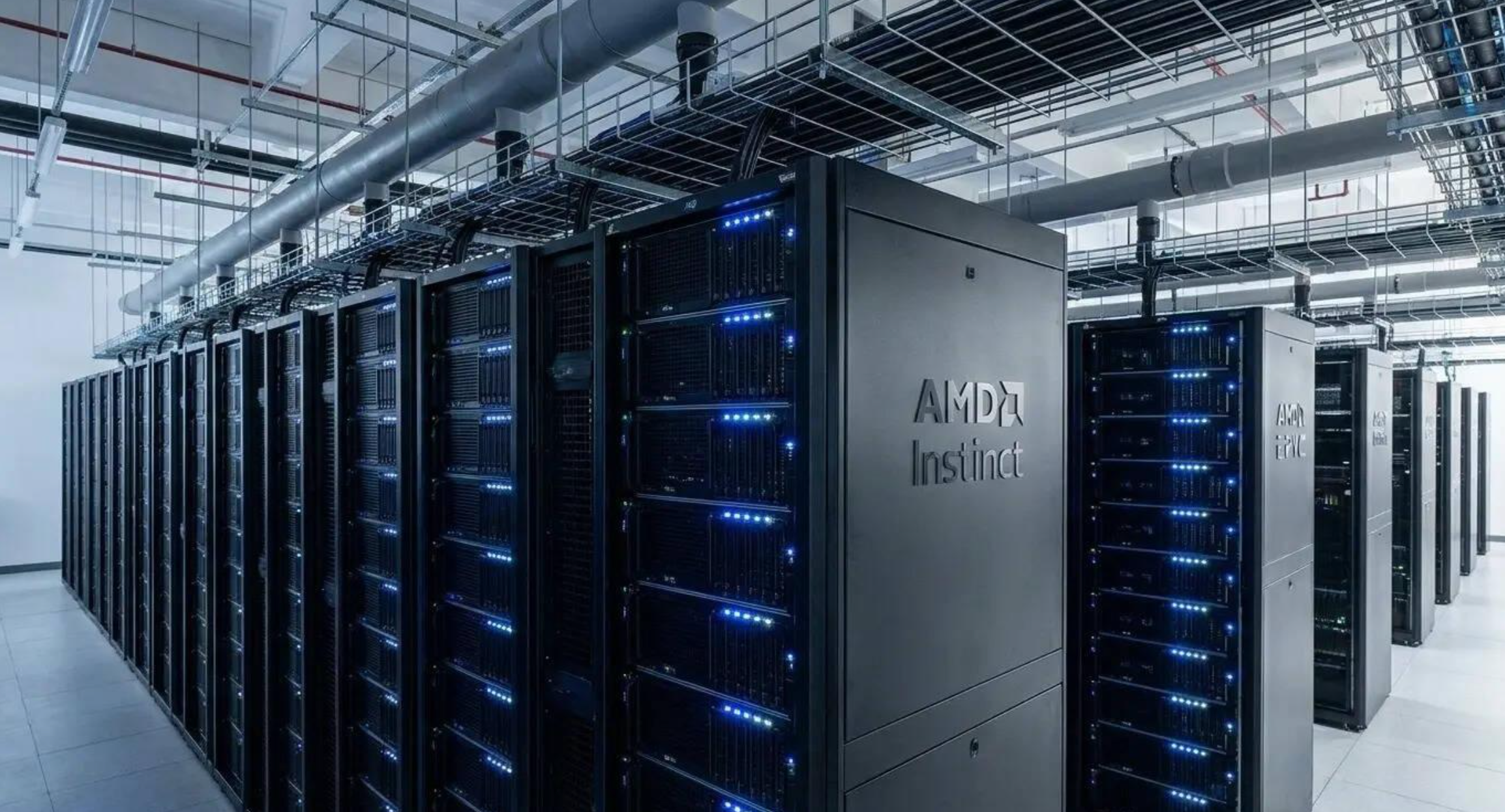
AMD Helios Rack Targets NVDA's Core at $15B GPU Forecast
AMD's Helios AI rack system takes direct aim at Nvidia's Grace Blackwell. With 114% GPU revenue growth forecast, here's the competitive math.
Key Points
- AMD's Helios AI rack system — announced at this week's Advancing AI event — is the first rack-scale competitive product directly targeting Nvidia's Grace Blackwell and Vera Rubin platforms, arriving as AMD forecasts GPU revenue of $15 billion for full-year 2026, up 114% year-over-year.
- AMD's data center segment posted $5.8 billion in Q1 2026 revenue, up 57% year-over-year, giving the company real financial runway to fund the rack-level infrastructure push that moves the competitive conversation from individual GPUs to full-system deployments.
- The pivotal number to watch is AMD's Q2 data center revenue, due on earnings — any sequential acceleration toward a $7 billion quarterly run rate would validate the Helios demand thesis and likely force a re-rating of AMD's forward multiple, which still sits well below Nvidia's 43x.
AMD delivered its most consequential competitive product announcement in three years this week, unveiling the Helios AI rack system at its Advancing AI event and targeting the exact rack-scale deployment model that has allowed Nvidia to lock hyperscaler and neocloud customers into end-to-end infrastructure relationships worth billions in annual recurring revenue. The strategic logic is straightforward and the financial stakes are not small: AMD is forecasting $15 billion in GPU revenue for 2026 — up 114% year-over-year — and Helios is the product that either validates or breaks that forecast depending on whether hyperscalers actually deploy it at scale in the back half of the year.
What Helios Actually Means Competitively
The shift from selling individual GPUs to selling integrated rack systems is not a product decision — it is a go-to-market and customer relationship decision with multi-year revenue implications. Nvidia understood this before anyone else. Grace Blackwell and the forthcoming Vera Rubin platform are not simply chips; they are complete compute systems that include networking, memory architecture, cooling infrastructure, and software stack integration, all optimized to work together and all creating switching costs that make ripping out an installed base extraordinarily painful and expensive. When a hyperscaler buys a Nvidia rack system, they are not buying silicon — they are buying an AI factory, and every quarter that factory runs, it deepens the dependency.
AMD's Helios enters this market with a specific thesis: that hyperscalers and neoclouds are sufficiently frustrated with Nvidia's supply constraints, pricing power, and ecosystem lock-in to actively support a credible alternative, even if it requires meaningful integration work. That thesis is not speculative — it is supported by documented behavior. Microsoft has publicly committed to AMD MI-series GPU deployments across Azure. Meta has disclosed AMD GPU purchases for its AI training infrastructure. Google has its own TPU line but continues to evaluate third-party silicon for specific workloads. The hyperscalers have every financial incentive to ensure AMD stays competitive, because the alternative is a single-vendor market where Nvidia can price without reference to competition.
The Helios rack's technical specifications — which AMD detailed at the Advancing AI event — center on the MI400 series GPU architecture, interconnected via AMD's Infinity Fabric at bandwidths designed to match or exceed Nvidia's NVLink for specific all-to-all communication patterns that dominate large language model training. Jefferies flagged ahead of the event that the CPU announcements accompanying Helios could expand AMD's total addressable market meaningfully, targeting server configurations that currently default to Intel Xeon or Nvidia's Grace CPU. If AMD can capture even 15 percentage points of additional server CPU market share in AI-optimized rack configurations, that represents a revenue opportunity that does not appear in current GPU-centric analyst models.
The Financial Runway and the Valuation Gap
AMD's ability to fund a serious rack-scale competitive push is not in question the way it was three years ago. The company reported $5.8 billion in data center revenue in Q1 2026 — up 57% year-over-year — generating the gross profit dollars needed to sustain aggressive R&D and go-to-market investment simultaneously. The 150% year-to-date stock gain through July reflects the market's belated recognition that AMD's data center trajectory is structural, not cyclical. But the valuation gap relative to Nvidia remains wide, and closing it requires AMD to demonstrate rack-level win rates, not just GPU shipment volumes.
Nvidia trades at approximately 43x forward earnings and 21.5x EV/Sales, with a Morgan Stanley price target of $288 and analyst consensus implying 21% upside from current levels. AMD's forward multiple sits materially below those figures, which the bull case argues is unjustified given AMD's 114% GPU revenue growth forecast and the structural demand dynamics Deloitte projects will push global semiconductor sales to a historic $975 billion peak in 2026. The counterargument is that Nvidia's premium reflects software moat — the CUDA ecosystem, NIM inference microservices, and the enterprise software stack that makes swapping out Nvidia GPUs technically painful regardless of hardware performance parity. Helios does not solve the CUDA problem directly, and AMD's ROCm software platform, while improved, still lags CUDA in developer tooling, library support, and enterprise deployment documentation.
Goldman Sachs estimates that four hyperscalers will collectively spend $725 billion on AI infrastructure in 2026 — a 77% year-over-year increase. AMD does not need to win the majority of that spending to justify its current valuation trajectory. It needs to win enough to sustain $6-to-$7 billion quarterly data center revenue run rates through the back half of 2026 while demonstrating that Helios is generating pipeline, not just press releases. The Senate's antitrust scrutiny of Nvidia — flagged by senators examining AI market concentration alongside their review of Meta's Scale AI investment and Google's Windsurf licensing deal — creates a secondary tailwind: regulatory pressure on Nvidia's market position makes hyperscalers more eager to demonstrate AMD sourcing to antitrust regulators, independent of pure performance considerations.
The Specific Levels and Dates That Matter
AMD's next earnings call will be the first real data point on whether Helios is generating actual purchase orders or serving primarily as a competitive signaling tool. The Q2 data center revenue figure is the single most important number: consensus is modeling approximately $6.2 billion, which would represent roughly 7% sequential growth from Q1's $5.8 billion. A print above $6.8 billion — implying 17% sequential growth — would force upward revisions to the full-year $15 billion GPU forecast and likely accelerate the multiple re-rating. A print below $5.8 billion, meaning flat or negative sequential data center growth, would raise serious questions about whether Helios is arriving too late to capture the current AI infrastructure spending cycle before hyperscalers lock in their H2 2026 purchasing commitments with Nvidia.
The competitive calendar beyond earnings is equally dense. Nvidia's Vera Rubin platform is expected to see initial customer deployments in Q4 2026, which means AMD has a finite window — roughly two quarters — to establish Helios as a proven alternative before the next generation of Nvidia silicon resets the performance benchmark again. TSMC's disclosure of a revenue growth outlook above 40% for 2026 confirms that wafer supply is available to support AMD's production ramp, removing the supply-side constraint that limited AMD's ability to capitalize on previous Nvidia shortfalls. The Samsung strike risk flagged in recent supply chain reporting is a Nvidia risk as much as an AMD risk — Samsung manufactures HBM memory that both companies depend on for high-bandwidth memory in AI accelerators, and any supply disruption there hits the entire GPU market simultaneously. Watch AMD's earnings date confirmation, the Q2 data center revenue print against the $6.2 billion consensus, and any hyperscaler capital expenditure commentary on Microsoft and Amazon's calls next week for the earliest signal on whether Helios is winning real rack deployments before year-end.
The Weekly Investor
Daily market analysis for active traders. Free.