Warsh Hits Jackson Hole With Inflation at 3.4% and Hawks in the Room
Fed Chair Kevin Warsh delivers his first Jackson Hole keynote with core PCE at 3.3%, three FOMC dissents for a hike, and September odds at one-in-three.
Key Points
- Three FOMC members dissented in favor of a 25-basis-point rate hike at the July 29 meeting — the most hawkish dissent count in years — leaving September hike odds stuck at one-in-three.
- Core PCE rose 3.3% in July and the 30-year Treasury touched 5.31% on August 17, its highest since 2007, forcing the Treasury Department to intervene in the bond market on August 19.
- Warsh's precise language on the inflation trajectory and the word "paused" versus "finished" will immediately reprice September futures and move Treasuries in today's session.
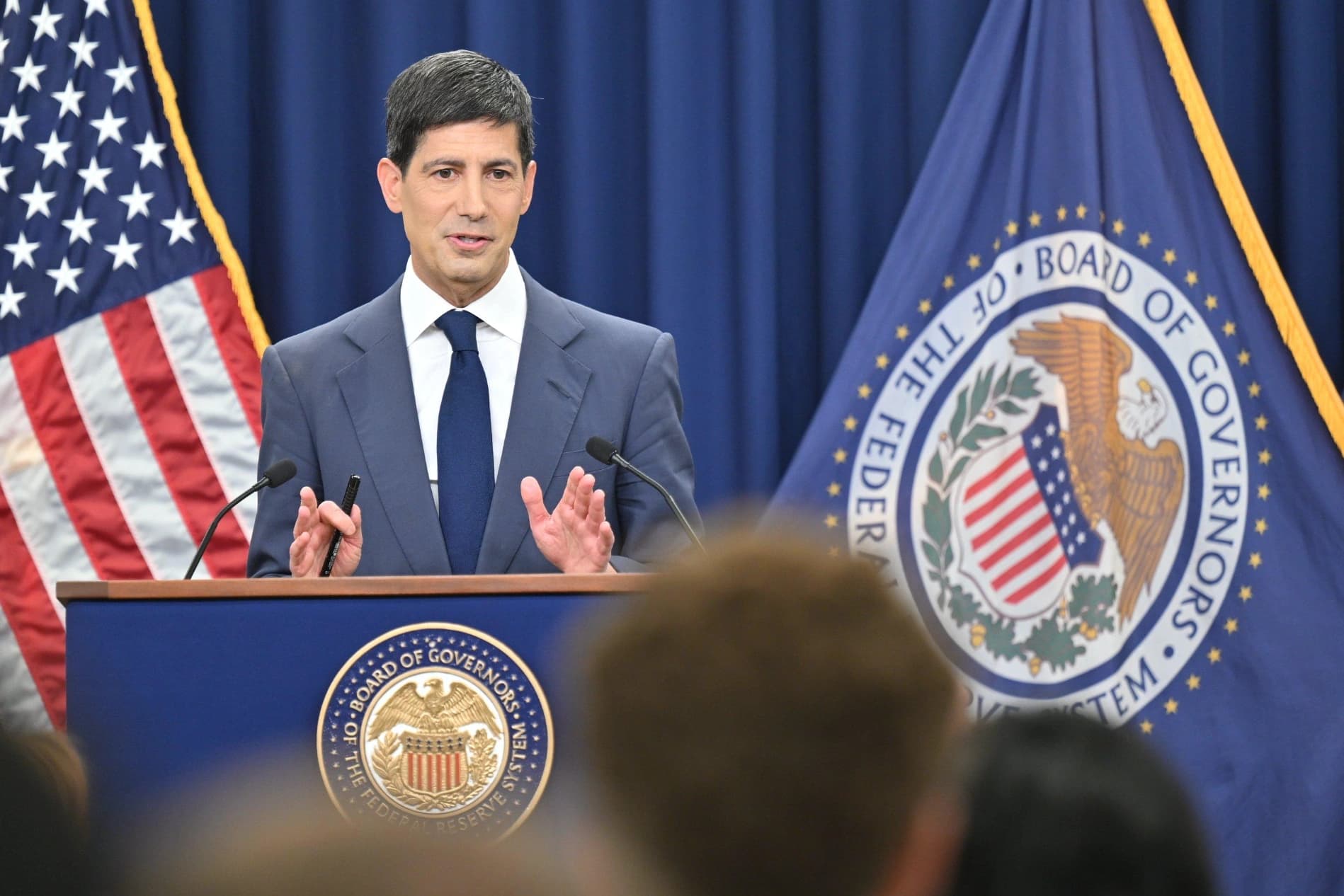
Fed Chair Kevin Warsh steps to the podium at 10:00 a.m. ET today in Moran, Wyoming for his first keynote address as the 17th Chair of the Federal Reserve — and he walks in carrying the most combustible combination of data any new Fed chief has faced at Jackson Hole in nearly two decades: headline CPI at 3.4%, core PCE at 3.3%, a 30-year Treasury yield that touched 5.31% eleven days ago, and three of his own committee members on record wanting to raise rates right now.
The Chair's Inheritance
Warsh was confirmed as Fed Chair on May 22, succeeding Jerome Powell, and has chaired exactly two FOMC meetings since. He held rates steady at both — the target range remains at 3.50% to 3.75%, with the effective federal funds rate printing at 3.63% as of Wednesday. Holding twice is not a policy statement in isolation, but the July 29 meeting made the internal picture undeniable: Beth M. Hammack, Neel Kashkari, and Lorie K. Logan all voted against the hold, each preferring an immediate 25-basis-point hike. A 9-to-3 dissent on an FOMC that only has 12 voting members is not a rounding error — it is a fault line.
The July statement language was carefully constructed to acknowledge reality without committing to a direction. The committee said economic activity was "expanding at a solid pace despite elevated uncertainty," pointed to productivity growth and capital investment as bright spots, and described inflation as "elevated relative to the 2% goal, in part reflecting supply shocks that have driven price increases in certain sectors, including energy." That last clause is doing heavy lifting: energy prices have been a core driver of the inflation overshoot since the Iran conflict escalated earlier this year, and WTI crude is currently sitting at $87.35 per barrel with Brent at $94.20. Neither level is a crisis, but neither gives the committee room to declare victory on supply-side pressures. The full July 29 statement is the clearest window into where the committee's center of gravity sat four weeks ago — before today's speech resets it.
What Warsh says in the next two hours will either ratify the hawkish drift embedded in that dissent count or push back against it. There is no neutral outcome at a speech this consequential. Markets have been pricing September at roughly one-in-three odds of a hike — a level that has been unusually sticky given the data, suggesting traders are genuinely uncertain which way Warsh leans on the medium-term path rather than just the next meeting.
The Data He Cannot Dismiss
The numbers Warsh has to address are not ambiguous. The Fed's preferred gauge, core PCE, came in at 3.3% for July — well above both the 2% target and the 2.8% reading from February, before the Iran conflict began injecting energy price volatility into the supply chain. Headline CPI is running at 3.4% year-over-year. The U.S. economy grew at just 1.5% annualized in Q2 2026, per the Bureau of Economic Analysis — a reading that gives the committee some cover for caution, but not nearly enough to offset inflation running 165 basis points above target on its preferred metric.
The bond market has already delivered its own verdict. The 30-year Treasury yield hit 5.31% on August 17 — the highest level since 2007 — and the move was severe enough that the Treasury Department took the unusual step of intervening in the market on August 19 to attempt to bring long-term borrowing costs down. That kind of executive-branch involvement in the bond market is rare and signals that the fiscal authorities see the long end as a genuine economic risk, not merely a pricing anomaly. The 10-year yield, as of Wednesday's close, was at 4.66%, with the 2-year at 4.19% — a positive spread of 47 basis points that reflects markets pricing in either further hikes or a prolonged hold, not a cut cycle.
SOFR at 3.64% is essentially locked to the funds rate, confirming that overnight money markets are fully aligned with the current policy stance and not anticipating imminent easing. The spread between where overnight rates sit and where the 30-year has traded this month is a direct measure of how much term premium — essentially, the compensation investors demand for holding long-duration risk — has expanded. That expansion is not a function of near-term rate expectations alone; it reflects uncertainty about the Fed's credibility in returning inflation to 2%, fiscal deficit concerns, and the geopolitical risk premium embedded in energy prices. Warsh inherits all of it simultaneously.
Before the speech, Senator Elizabeth Warren publicly challenged Warsh's pre-confirmation assertion that tariffs are not inflationary, noting that he has not updated or elaborated on that position since taking office. The criticism lands with practical weight: tariff policy has been a second-order driver of goods inflation throughout 2025 and 2026, and a Fed Chair who is perceived as underweighting that input faces a credibility problem with both the market and Capitol Hill. Warsh's comments on AI-driven productivity gains — which he has described as a potential disinflationary force — have been similarly scrutinized as aspirational rather than operationally useful for near-term monetary policy calibration.
What Traders Watch Next
The immediate market reaction will concentrate in the Treasury complex. If Warsh signals that the hiking cycle is genuinely paused — using language that emphasizes downside risks to growth or acknowledges that the current rate level is sufficiently restrictive — look for the 10-year to pull back from 4.66% and September hike odds to compress below 20%. That outcome would also be mildly supportive for equities and would put pressure on the dollar. The asymmetric tail risk, as Bloomberg noted this morning, is a surprise dovish tilt — the market is not positioned for it, which means the move would be larger in magnitude than a hawkish confirmation.
If Warsh instead validates the three dissenters — explicitly endorsing the possibility of a September hike or characterizing current policy as insufficiently restrictive — September futures will reprice sharply toward 50% or above, the 10-year will push back toward 4.80%, and the 30-year could retest the 5.31% level that triggered Treasury intervention eleven days ago. The dollar index would strengthen and rate-sensitive sectors — utilities, REITs, long-duration growth — would sell off into the close.
The second Fed event today runs at 12:45 p.m. ET: Vice Chair for Supervision Michelle Bowman holds a fireside chat at the 2026 CEO & Senior Management Summit. Bowman is not a confirmed hawk on the September decision, but her remarks will be parsed for any alignment with or divergence from whatever Warsh signals at 10 a.m. The next hard data point that can move the September calculus is CPI on Friday, September 11 — two weeks before the September 16 FOMC decision. That print is now the single most important scheduled data release between today and the next rate vote. If it comes in above 3.5% on headline with core PCE already at 3.3%, the three dissenters gain three more votes and September becomes live in a way that markets are not currently pricing.
The Weekly Investor
Daily market analysis for active traders. Free.