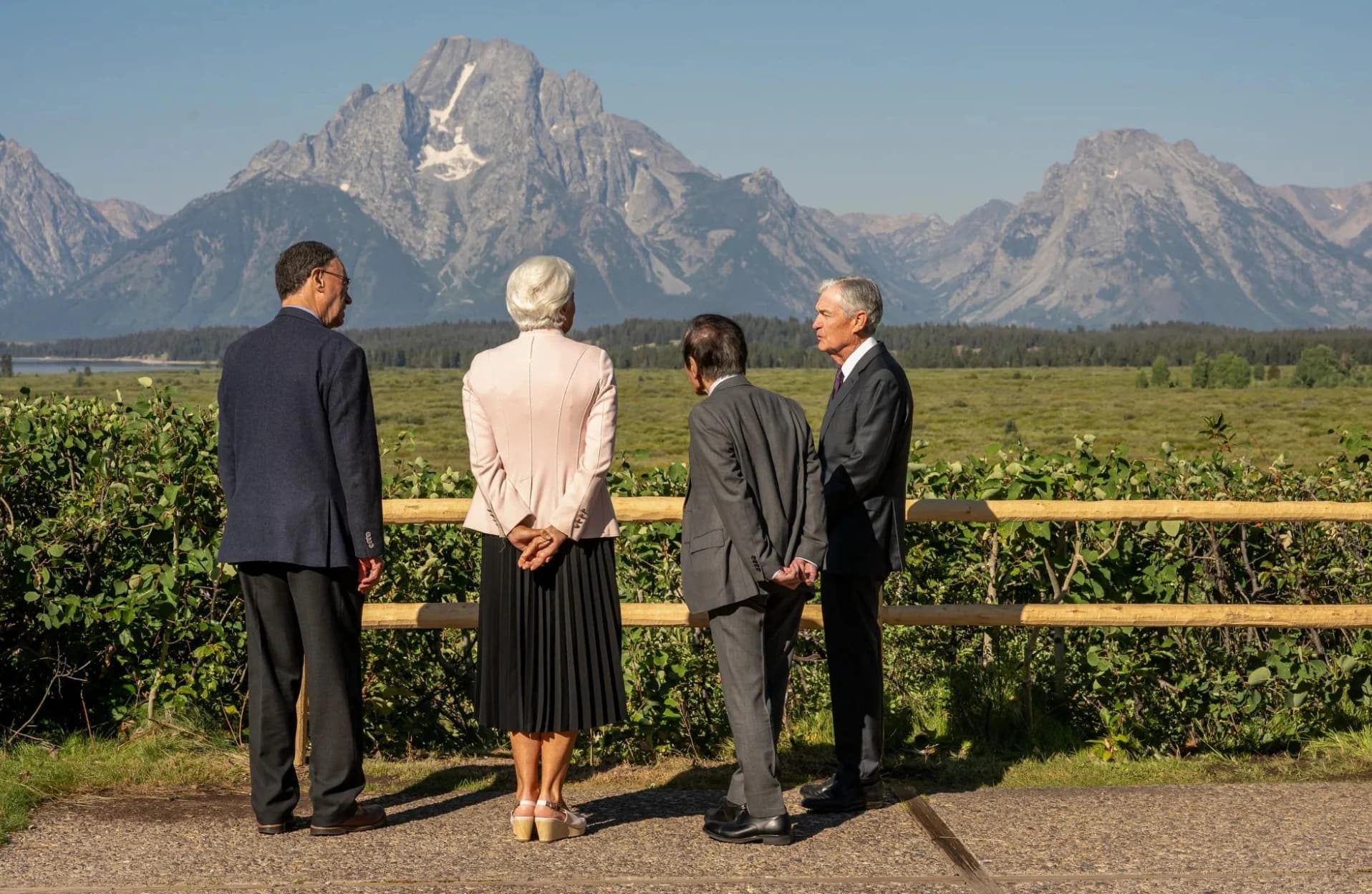
Warsh Faces Inflation Reckoning at Jackson Hole Friday
Fed Chair Warsh delivers his first Jackson Hole keynote Friday with three FOMC dissenters on record and core CPI stuck at 2.5%. What traders must watch.
Key Points
- Three FOMC voting members — Hammack, Kashkari, and Logan — dissented at the July meeting, each preferring a 25-basis-point hike over the current 3.50–3.75% hold.
- With core CPI at 2.5% YoY and core PCE forecasts pinned near 3.2% by year-end, the inflation fight is not over — and Warsh must say so publicly for the first time Friday.
- Watch the 2-year Treasury yield and September fed funds futures in the 90 minutes after Warsh begins speaking Friday morning; those are the real-time verdicts on whether markets read him as credibly hawkish.
The most consequential 30 minutes in markets this week happens Friday morning in Wyoming. Fed Chair Kevin Warsh delivers his first Jackson Hole keynote since taking office, and with three voting dissenters already on the record demanding a rate hike and core CPI sitting 50 basis points above the Fed's 2% target, this is not a ceremonial address — it is a policy inflection point with September 16 only three weeks away.
The Dissent That Changed Everything
The July FOMC decision to hold the federal funds rate at 3.50–3.75% was not clean. Beth Hammack, Neel Kashkari, and Lorie Logan all voted against the hold, each preferring an immediate 25-basis-point increase. Three dissenters on a single decision is not a rounding error — it is a committee in open disagreement about whether the current stance is restrictive enough, and it hands Warsh an uncomfortable inheritance as he takes the podium Friday.
The market's reaction to that July decision told the same story. The 10-year Treasury yield rose 5 basis points to 4.657% immediately after the announcement. The 30-year climbed more than 9 basis points to 5.193%. The 2-year slid 4 basis points to 4.236%, a move consistent with traders pricing a slightly longer hold rather than an imminent cut. Today, the 10-year sits at 4.69% and the 2-year at 4.19% — a 50-basis-point positive spread that reflects a curve still pricing in eventual tightening or persistent term premium, not the rate-cut narrative that dominated 2024.
What Warsh says Friday will either validate that repricing or reverse it. The FOMC's own language at the July meeting acknowledged that inflation "remains elevated relative to the Committee's 2% goal," attributing part of the persistence to energy-driven supply shocks — a direct reference to Middle East conflict premium in commodity prices. WTI crude is at $84.05 a barrel as of August 14; Brent is at $92.51. Those numbers are not disinflationary. They are feeding directly into headline CPI, which printed at 3.3% year-over-year in July, and they create a policy dilemma that is genuinely uncomfortable: tighten into a geopolitical shock, or hold and watch inflation expectations drift higher.
Wharton's Patrick Harker, the former Philadelphia Fed President, framed Warsh's challenge precisely in a recent interview with Barron's. "Warsh is going to have to address the elephant in the room, which is inflation," Harker said. "He must actually say more than 'we're in the fight.' That's not going to fly. If that's going to be his approach, it's going to really be a disappointment to the markets." That is a remarkably direct standard being set by a central banking insider — and it mirrors what fed funds futures are already pricing.
What the Data Actually Shows
The current SOFR rate of 3.63% and the effective federal funds rate of 3.63% confirm that markets are trading at the top of the existing policy range. There is no meaningful cushion between the policy rate and where overnight funding actually prices. That compression matters because it means the Fed's credibility rests almost entirely on forward guidance — exactly what Warsh will be providing Friday.
Core CPI at 2.5% year-over-year sounds close to the 2% target. It is not. The Fed's preferred gauge is core PCE, and the baseline forecast from multiple sell-side desks keeps year-end core PCE near 3.2%. That is a 120-basis-point gap from target, persisting into year-end. Meanwhile, unemployment sits at 4.1% — essentially at full employment by any historical measure — which removes the labor market safety valve that would otherwise argue for patience. The Fed is not facing a growth scare. It is facing an inflation problem against a solid economy, which is precisely the environment where a hold-forever posture becomes indefensible.
The week's most important pre-Warsh data point drops Wednesday: the July core PCE price index. If that print comes in at or above the June reading, Warsh walks into Jackson Hole with fresh evidence that the dissenters were right. If it softens, he has marginally more room to thread a hold with hawkish language. Either way, the Wednesday PCE number is the setup trade for Friday's speech — and it deserves more attention than it is currently getting from desks focused on the headline event.
The ECB is not standing still while the Fed deliberates. The European Central Bank raised its three key rates by 25 basis points at its most recent meeting, citing Middle East-driven inflation pressures directly — the same pressures the FOMC's July statement acknowledged. ECB baseline projections have eurozone headline inflation averaging 3.0% in 2026 before decelerating to 2.3% in 2027 and 2.0% in 2028. That is a central bank actively doing the work the three FOMC dissenters want to see replicated in Washington. The divergence is not sustainable indefinitely: a hiking ECB against a paused Fed puts additional downward pressure on the dollar and upward pressure on import prices, which feeds back into the U.S. inflation problem Warsh is trying to contain.
What Traders Watch Next
The immediate trade structure heading into Friday is straightforward. The 2-year Treasury yield is the most rate-sensitive instrument in the curve and the cleanest read on where the market prices the September 16 FOMC outcome. At 4.19% today, the 2-year is pricing a continued hold. A hawkish Warsh — one who validates the dissenters, signals openness to a September hike, and puts a specific inflation threshold on the table — should push the 2-year above 4.30% and compress the spread to the 10-year. A dovish or ambiguous Warsh, the outcome Harker warned against, should steepen the curve as long-end inflation risk premium rises while the short end rallies on hold expectations.
CNBC's live coverage of the July FOMC decision captured the immediate market whipsaw that followed the hold announcement — a preview of the volatility Friday carries. The RBA's August hold at 4.35%, with minutes dropping Tuesday, adds another central bank data point to the global picture: major economies are not cutting. They are holding or hiking. Warsh is the outlier if he delivers anything that sounds like a pivot.
The specific level to anchor: if the 2-year yield breaks convincingly above 4.35% in the 90 minutes after Warsh begins speaking Friday, the September hike is back on the table and rate-sensitive sectors — utilities, REITs, long-duration tech — face immediate pressure. If the 2-year drops toward 4.00%, the hold is confirmed and the curve steepens. The next FOMC decision is September 16 at 2:00 PM ET. Between now and then, Warsh owns the narrative. Friday is when it starts.
The Weekly Investor
Daily market analysis for active traders. Free.