VIX Spikes 5% as Nvidia and Jackson Hole Loom
VIX jumps to 15.94 as Nasdaq futures drop 0.5% Monday. Nvidia earnings Wednesday and Fed's Jackson Hole meeting Friday set up a pivotal week.
Key Points
- The VIX surged 5.36% to 15.94 Monday, reversing nearly 12% from its 2026 low of 14.2 hit just three sessions ago, as traders buy protection ahead of Nvidia's Wednesday print.
- A 10-year Treasury yield pinned near 4.74% — a 20-month high — combined with a CME FedWatch reading now showing a 36.9% probability of a September rate hike is repricing risk across high-multiple tech.
- All eyes shift to Wednesday's close, when Nvidia reports Q2 FY2027 results against a consensus of $2.09 EPS on $58.8 billion in revenue — a miss would likely break the S&P's 16% year-to-date gain narrative wide open.
The VIX is back above 15.90 — and it got there in a single session. Friday's complacency reading of 14.2, the lowest of 2026, has been replaced by a 5.36% one-day surge to 15.94 that tells you exactly what the options market thinks about the next 72 hours: this week breaks something, or confirms everything.
The Hostile Trifecta Forming Overhead
The setup entering Monday is as concentrated with risk as any week this year. Three forces are compressing simultaneously: a 10-year Treasury yield holding near 4.74% — within striking distance of a 20-month high — Nasdaq futures off 0.52% to 29,235.50 before the open, and a geopolitical backdrop where the Trump administration is actively pursuing what it has called "economic war" with Iran. Treasury Secretary Scott Bessent is expected to deliver specifics at a Monday afternoon press conference following weekend U.S. strikes that sent WTI 1-month implied volatility as high as 68% last week. It has since retreated to 51%, but WTI crude October futures opened Monday at $84.99, down $2.07 on the session — hardly a signal of resolution.
The bond market deserves special attention here. The spread between the 10-year at 4.71% and the 2-year at 4.22% has widened to 49 basis points — a steepening curve that, in isolation, would suggest improving growth expectations. But paired with a CME FedWatch tool now assigning a 36.9% probability to a September rate hike, this is not a curve that's steepening on growth optimism. It's steepening because the back end is selling off on fiscal and inflation concerns while the front end is anchored by the current Fed Funds Effective Rate of 3.63%. When you layer a 3.3% year-over-year CPI print — still running 130 basis points above target — onto a Fed that last cut rates months ago, the arithmetic for high-multiple growth stocks becomes punishing. The S&P 500 trades at a significant premium to historical averages, and every basis point the 10-year adds above 4.70% is a direct compression on those multiples.
Nvidia Is the Only Number That Matters Wednesday
Nvidia reports Q2 FY2027 results after the bell Wednesday, August 26. The consensus stands at $2.09 in earnings per share on $58.8 billion in revenue. For context, revenue at that level would represent roughly 100% year-over-year growth — a bar so high that "beats" and "misses" have taken on new meaning. Nvidia's market cap is near $5 trillion, making it the most consequential single earnings print of 2026. The stock is down 0.98% in premarket Monday at roughly $169 and change, a muted decline relative to how much heat it carries in index weighting.
What makes this print particularly treacherous for traders is the asymmetric setup. Marvell Technology — which jumped nearly 7% last week on an expanded custom AI-chip partnership with Google — is down 5.57% Monday in what appears to be straightforward profit-taking ahead of its own August 27 report. MRVL is up over 160% year-to-date, the best performer among major reporters this week, and its action is functioning as a sentiment proxy for the AI infrastructure trade broadly. When MRVL fades 5.5% on a day with no negative company-specific news, it signals that AI-adjacent positions are being trimmed in front of the Nvidia print — a classic reduce-before-confirm trade. Nvidia itself has reportedly been raising AI server prices by more than 15%, and invested $6 billion in Poolside to expand its open-weight model portfolio, both of which point to demand strength. But the market needs the numbers to validate what has become a $5 trillion thesis.
CrowdStrike also reports Wednesday. Together, Nvidia and CrowdStrike represent a combined gut-check for both AI infrastructure and cybersecurity spending — the two capex categories that have dominated enterprise IT budgets in 2025 and 2026. A stumble from either company would land in a market already nursing a VIX that moved 12% in three sessions.
Jackson Hole Friday — and What Warsh Won't Say
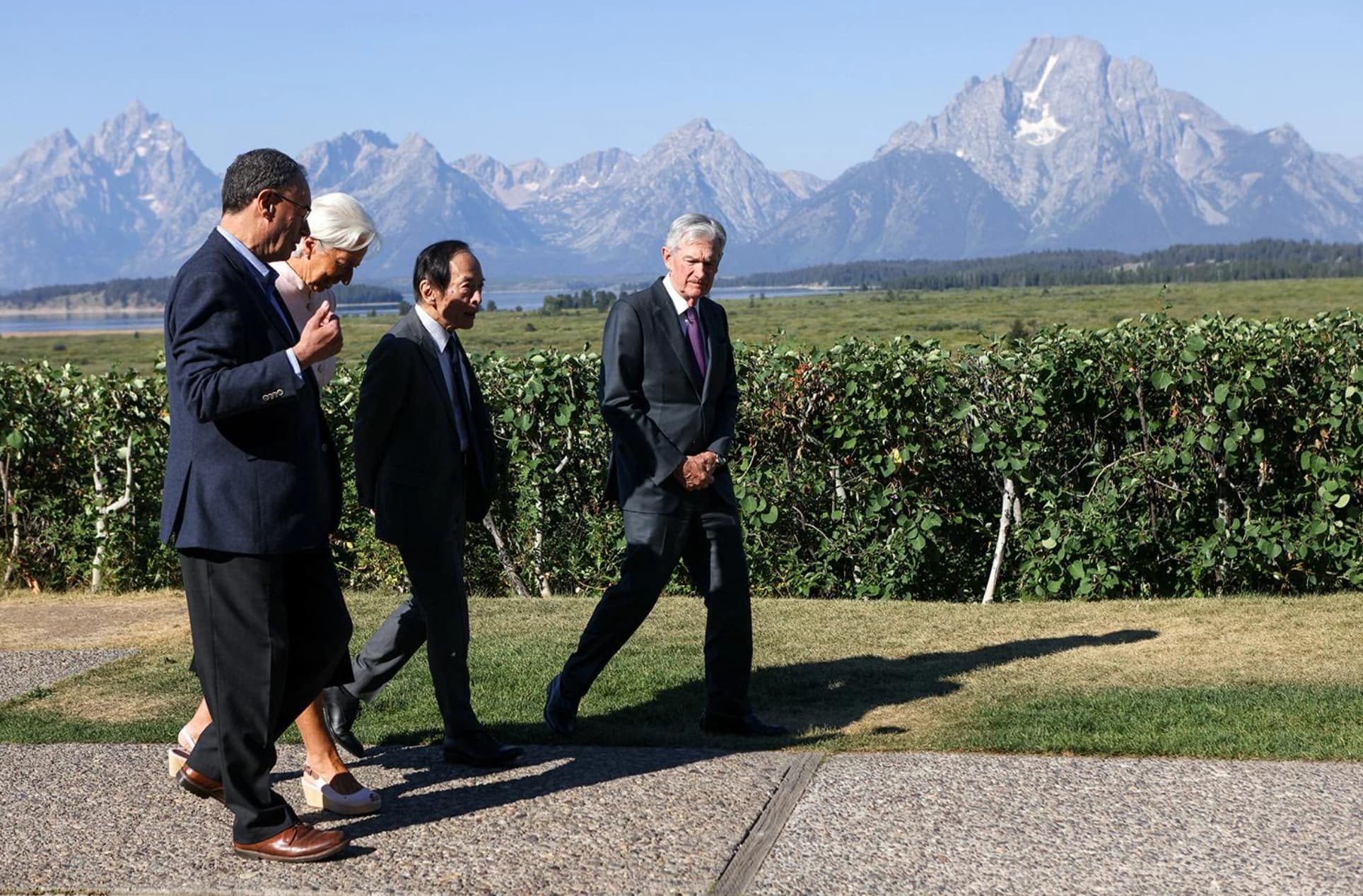
Even if Nvidia delivers, traders cannot exhale until Fed Chair Kevin Warsh speaks Friday at the Jackson Hole Symposium. Warsh replaced Jerome Powell earlier this year, and his policy posture remains less fully mapped than his predecessor's. Markets know what a Powell Jackson Hole speech looks like. They have significantly less data on how Warsh uses the venue and what signals he considers appropriate to transmit. That uncertainty is itself a volatility input.
The macro context he walks into Friday is genuinely complex. Core CPI is running at 2.5% year-over-year — closer to the Fed's 2% target than headline's 3.3% — but the yield curve is pricing something more uncomfortable. The 36.9% September hike probability on FedWatch is not noise; that number was effectively zero two months ago. If Warsh delivers a hawkish surprise — or even a carefully neutral statement that disappoints dovish expectations — the 10-year yield has a clear path toward 4.85% to 5.00%, a range that would force an immediate revaluation of everything from growth stocks to commercial real estate.
On the other side of the ledger, Bitcoin's 1.31% gain to $77,782 Monday is a minor but notable divergence. Crypto holding while equities fade is a pattern that has appeared during prior episodes of equity risk-off driven by rate anxiety rather than systemic credit concerns. It suggests the market is not pricing a hard landing — yet. Broader Monday equity market action confirms the character of today's selloff is orderly and concentrated in high-multiple tech, not broad-based panic. The Dow futures are barely negative at -0.04% while Nasdaq leads the decline at -0.52% — a momentum-tax selloff, not a flight-to-safety stampede.
The number to watch into Friday's close is the 10-year Treasury at 4.74%. If Nvidia beats big and Warsh sounds measured Thursday evening and Friday morning, expect that yield to pull back toward 4.55% — which would give the S&P room to reclaim last week's high near 7,700. If the yield pushes through 4.80% before Warsh speaks, the August 24 market setup will look prescient in hindsight: a VIX that knew what was coming before the headline risk arrived.
The Weekly Investor
Daily market analysis for active traders. Free.