TSMC's 44.7% Revenue Surge Masks One Critical Risk
TSMC's July revenue jumped 44.7% YoY to NT$467.58B, but the stock slid 3% ahead of NVIDIA earnings. Here's what the divergence tells traders.
Key Points
- TSMC reported July 2026 revenue of NT$467.58 billion, a 44.7% year-over-year surge, while simultaneously raising its full-year capital spending plan to $60–$64 billion — the largest single-year foundry capex commitment in history.
- Despite the operational strength, TSM shares slid 3% to $406.40 this week as traders reduced semiconductor exposure ahead of NVIDIA's Q2 FY2027 earnings print, illustrating how TSMC's stock has become a derivative bet on NVIDIA's forward guidance.
- The critical watch point is TSMC's 2nm yield ramp: if NVIDIA's Blackwell successor requires 2nm at scale in 2027 and TSMC fails to hit volume targets, the entire AI infrastructure capex cycle faces a physical throughput ceiling.
TSMC's July revenue print was, by any operational measure, extraordinary — NT$467.58 billion, up 44.7% year over year, driven by insatiable demand for advanced-node silicon from NVIDIA, Apple, AMD, and Broadcom. The market's response was to sell the stock 3% lower to $406.40. That disconnect is not irrational. It is the clearest signal available that TSMC's equity has stopped trading on its own fundamentals and started trading as a leveraged proxy on whatever Jensen Huang says after the bell tonight.
The Operational Case Is Nearly Unassailable
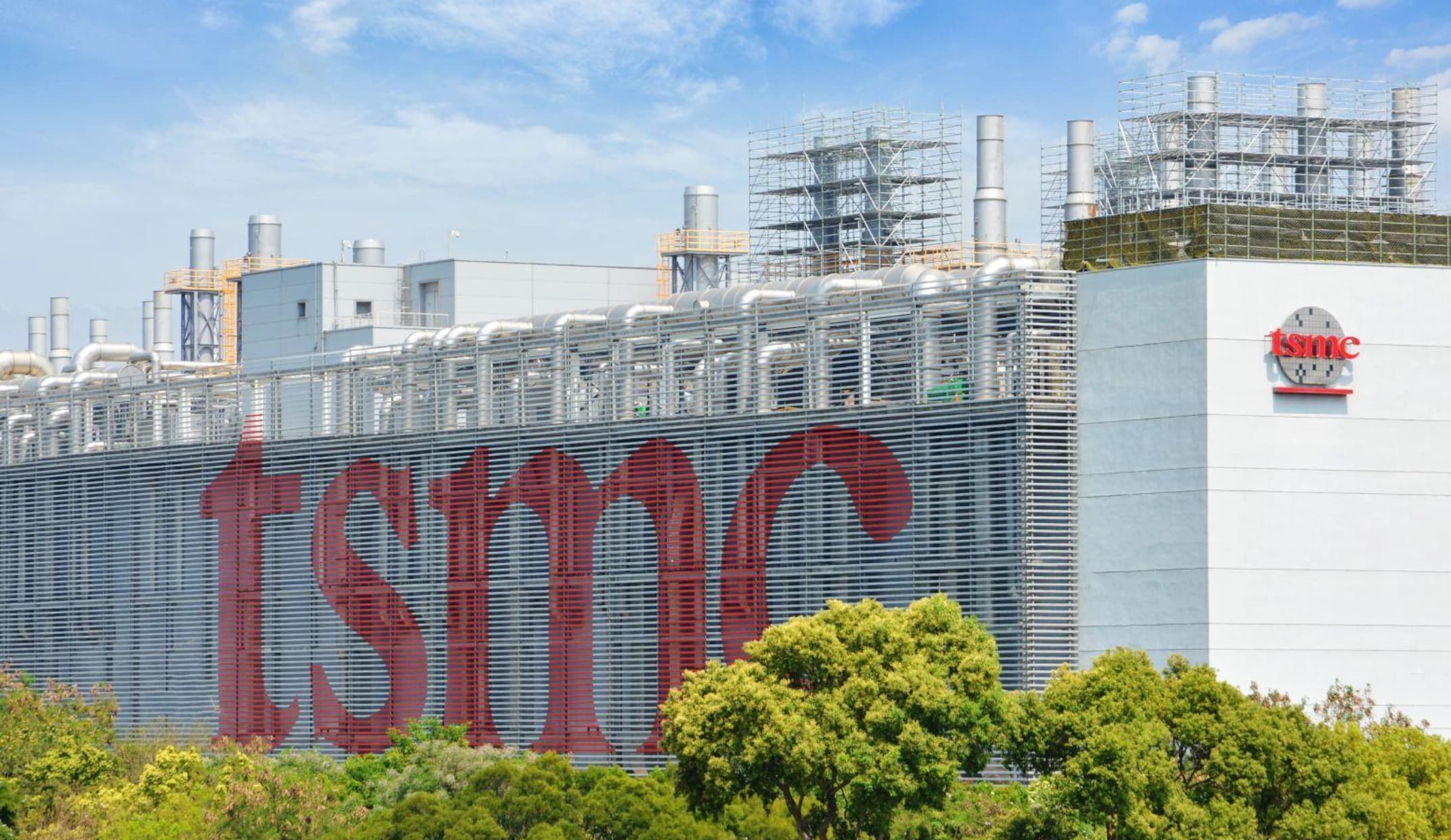
Start with the numbers that matter structurally. TSMC controls approximately 72% of the global contract chip foundry market — a figure that has actually increased over the past 18 months as Samsung Foundry has struggled with yield issues at advanced nodes and Intel Foundry Services has failed to attract major external customers at scale. Every AI GPU that ships at volume today — NVIDIA's Blackwell series, AMD's MI350, Broadcom's custom ASIC designs for Google and Meta — is manufactured in TSMC's fabs in Hsinchu and Taichung. That concentration of irreplaceable process capability is the foundational reason management felt confident enough to raise its 2026 capital-spending plan to between $60 billion and $64 billion, a figure that represents the single largest annual capex commitment any semiconductor company has ever made.
The 3nm node is now in full volume production, ramping ahead of where management guided at the start of 2026. The 2nm node is in early production, with volume ramp targeted for late 2026 and into 2027. Apple's A-series chips will be among the first 2nm customers at scale, but the AI inference and training workload market represents the longer-duration demand driver. If NVIDIA's next-generation GPU architecture — the successor to Blackwell — requires 2nm at meaningful volume, TSMC's pricing power on that node becomes the critical variable in the entire AI supply chain cost structure. TSMC does not negotiate on leading-edge node pricing; customers take the wafer price or wait. That dynamic alone justifies the foundry premium embedded in TSM's multiple.
The dividend announcement reinforces the confidence signal. TSMC declared a cash dividend of $1.114 per ADR share with an ex-date of September 16, 2026. At a stock price of $406.40, that represents a modest yield on an annualized basis, but the relevance is not income — it is what the dividend communicates about management's visibility into free cash flow generation over the next two to three quarters. Foundry companies do not raise capex to $64 billion and simultaneously return capital to shareholders unless order books are locked well into the next fiscal year.
Where the Valuation Becomes a Problem
TSMC's stock slid 3% to $406.40 this week alongside Intel's 5% drop to $85.98 and AMD's 4% decline to $454.36 — a synchronized sector de-risking event with no company-specific negative catalyst. That price action matters because it exposes the structural vulnerability in TSM's current valuation: at $406.40, the stock trades 15.47% above its GF Value estimate of $354.56. That premium is entirely justified as long as NVIDIA's forward guidance supports the prevailing assumption that hyperscaler AI infrastructure spending is accelerating, not plateauing. Remove that assumption — or even introduce doubt about its duration — and the 15.47% premium over intrinsic value compresses rapidly.
The 10-year Treasury yield sitting at 4.7% as of August 24 makes that valuation math more punishing than it would have been 18 months ago. At 4.7%, the discount rate applied to TSMC's 2027 and 2028 free cash flow projections is high enough that any downward revision to revenue growth assumptions — say, from 40% year-over-year to 25% — produces a meaningful reduction in fair value. The yield curve has also shifted: the 2-year at 4.24% against the 10-year at 4.7% represents a modestly positive spread, which signals that the bond market is not pricing in near-term rate cuts aggressive enough to provide multiple expansion relief for high-multiple technology names. TSMC is not a speculative growth stock, but it trades with enough of a growth premium that the rate environment is a real constraint on upside from current levels.
The China export control overhang adds a layer of geopolitical uncertainty that is genuinely difficult to model. Taiwanese prosecutors recently charged insiders over illegal AI server shipments to China — a development that signals enforcement intensity on export controls is rising, not stabilizing. TSMC's direct China revenue exposure has been sharply curtailed by U.S. restrictions, but the secondary risk is subtler: if Washington introduces additional restrictions on advanced-node foundry services for customers who then sell AI-adjacent products into restricted markets, TSMC faces compliance complexity that could slow customer qualification timelines and compress margins on affected product lines.
The 2nm Yield Question Is the Trade's Pressure Point
The forward-looking variable that sophisticated traders should track is TSMC's 2nm yield ramp, because it is the single physical constraint most capable of disrupting the AI infrastructure capex narrative in 2027. New process node ramps at TSMC follow a predictable but unforgiving pattern: initial production yields are low, wafer costs are correspondingly high, and customers face allocation constraints during the ramp-to-volume phase. For 3nm, that ramp lasted approximately four quarters from initial production to broad commercial availability. For 2nm, which involves a transition to gate-all-around transistor architecture — a more complex structural change than the FinFET-to-FinFET transition between 5nm and 3nm — the ramp timeline carries more execution risk.
NVIDIA's Blackwell successor, widely assumed to require 2nm process technology to sustain the performance-per-watt improvements that hyperscalers demand for dense GPU cluster deployments, would be the first true test of TSMC's 2nm at AI-workload scale. If yield rates at 2nm track below TSMC's internal targets through the first half of 2027, the supply of next-generation AI GPUs will be physically constrained regardless of how strong end-market demand is. That scenario is simultaneously bullish for TSMC pricing power on existing 3nm capacity and bearish for NVIDIA's ability to deliver Q1 and Q2 FY2028 revenue at the growth rates the current stock price implies.
The specific catalyst that resolves much of the near-term uncertainty arrives tonight. If NVIDIA's Q3 FY2027 guidance comes in at or above $100 billion — with data center revenue maintaining its position above 90% of total revenue — TSMC's 3% selloff this week looks like an entry point rather than a warning. The September 16 ex-dividend date provides a mechanical floor for income-oriented institutional holders. But if NVIDIA guides Q3 below $100 billion, or if management's commentary introduces any ambiguity about the pace of Blackwell shipments, TSM at $406.40 — trading 15.47% above intrinsic value in a 4.7% yield environment — has meaningful room to reprice toward the $370 to $380 range before fundamental buyers step back in at scale.
The Weekly Investor
Daily market analysis for active traders. Free.