TSMC's $40.2B Quarter Can't Stop the Chip Selloff
TSMC posted 77% profit growth and raised full-year guidance to 40%+, yet semiconductors shed $3.3 trillion in market cap since June 22.
Key Points
- TSMC posted Q2 2026 net profit of NT$706.56 billion (~$21.8B), up 77.4% year-over-year, on revenue of $40.2B — 36% higher than Q2 2025.
- Despite the blowout print, gross margin guidance for Q3 came in at 65–67%, with the midpoint down 1.7 percentage points as 2nm ramp-up costs absorb record capex.
- Watch TSMC's $44.6–$45.8B Q3 revenue guidance range and the SMH ETF's -17% July drawdown for confirmation that valuation, not fundamentals, is driving the sell-off.
TSMC printed the most profitable quarter in its history last week — NT$706.56 billion (~$21.8 billion) in net profit, up 77.4% year-over-year — then watched its stock fall nearly 7% in the days that followed. That divergence between earnings quality and price action is the most important signal in technology markets right now, and it tells traders something blunt: when $3.3 trillion in semiconductor market cap evaporates in less than four weeks, the problem isn't the fundamentals.
What the Numbers Actually Say
Revenue of $40.2 billion for the quarter ending June 30 came in 36% above the year-ago period and beat the high end of TSMC's own guidance range. Earnings per share of NT$27.25 cleared consensus by a margin that management hasn't delivered in several quarters. The company then did something unusual for a business running a $60–64 billion capital expenditure program: it raised its full-year USD revenue growth outlook to "slightly above 40%" and simultaneously hiked its annual dividend 33% to NT$24 per share — both funded entirely from operating cash flow. The dividend increase alone signals that management is not worried about the liquidity cost of the Arizona buildout.
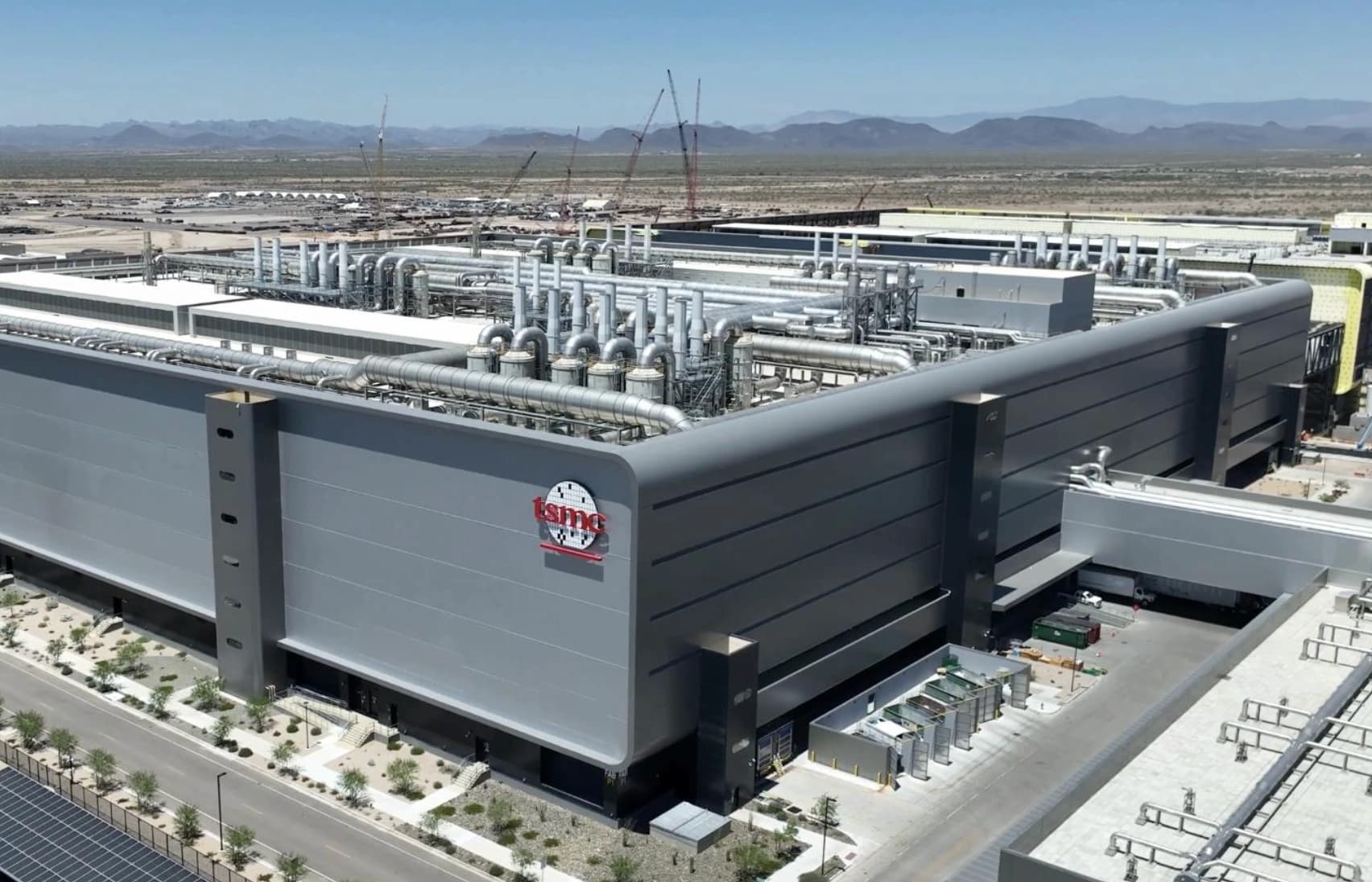
Q3 guidance of $44.6–$45.8 billion implies 37% year-over-year growth — actually accelerating from Q2's reported 33.7% rate. CEO C.C. Wei told analysts that AI-related demand "is strong all the way to probably 2029, 2030," and that advanced node supply remains constrained through at least 2027. These are not the words of a management team hedging into a slowdown. The incremental $100 billion Arizona commitment — covering sub-2nm fabrication and advanced packaging — locks TSMC into the U.S. onshoring narrative for the better part of a decade. That's not capex risk; that's a decade-long revenue anchor tied directly to hyperscaler and defense AI spend.
The one genuine flag in the print is gross margin. Q3 guidance of 65–67% puts the midpoint at 66%, down 1.7 percentage points from Q2's realized 67.7%. The culprit is 2nm ramp-up cost absorption — a well-understood, temporary dilution that every prior node transition has imposed. The market is pricing it as a structural deterioration. That's likely wrong, but it is the lever bears are pulling, and it has real short-term momentum behind it.
Why a Record Quarter Triggered a $3.3 Trillion Wipeout
The PHLX Semiconductor Index dropped more than 9% in the week ending July 17. The SMH ETF has lost more than 17% this month alone. Applied Materials, Lam Research, KLA Corp., and Arm Holdings each fell roughly 4% on Friday, July 18. Micron and NVIDIA dropped more than 2%. In Asia, SoftBank shed 9.2%, Tokyo Electron lost 9%, and Advantest slid 9.4% in a single session. Kioxia cratered more than 14% after a Texas federal jury ordered the firm to pay $229 million in damages for infringing a Viasat patent — unrelated to AI demand, but it landed in the middle of a tape already primed to sell.
None of this is a demand story. It is a valuation story with a catalyst. Semiconductor stocks entered July carrying multiples that priced in perfection, and TSMC's margin guidance — even at 66% gross margin, a level most companies in any industry will never see — gave the market a technical excuse to take profit. When the most profitable chip company on earth falls 3.64% the day after reporting 77% earnings growth, the message is that positioning, not fundamentals, is running price action.
The China dimension added another layer. Chinese startup Moonshot debuted a model it claims performs on par with OpenAI and Anthropic's flagship systems — amplifying the recurring fear that cheaper offshore AI alternatives reduce the urgency of the U.S. chip buildout. DeepSeek is simultaneously designing custom inference silicon, announced July 7, aimed at reducing Huawei and Nvidia dependence. Neither development has materially altered the hyperscaler capex commitments that fund TSMC's order book, but sentiment trades on narrative speed, not quarterly filings.
What Traders Watch Next
TSMC's position across NVIDIA's supply chain, custom silicon, edge AI, and physical AI makes it the single broadest proxy for AI infrastructure monetization available on a U.S. exchange. The question for traders entering this week is whether the 7% post-earnings drawdown has priced the margin headwind, or whether the broader SMH -17% July move has further to run before the valuation reset is complete.
The setup is asymmetric in one specific way. TSMC's $44.6–$45.8B Q3 revenue guide implies that the business is running at a pace that will make 2026 the company's first $170 billion revenue year — and it is doing that while 2nm ramp costs are at their most dilutive. By Q1 2027, 2nm gross margins will begin recovering toward the 68–70% corridor that management has telegraphed for mature-node operation. The $60–64B capex year is fully funded from cash flow with no dilution and no debt raise. That is a balance sheet the selloff is not reflecting.
South Korea's $880 billion, 10-year semiconductor and AI infrastructure commitment — with Samsung and SK Hynix alone pledging $518 billion in new fabrication capacity — sets the competitive landscape for the decade. But it also confirms that every major economy is now treating chip manufacturing as strategic infrastructure. That's a tailwind TSMC's Arizona expansion is built to capture on the demand side of U.S. policy.
The specific level to track: SMH's July low and whether the index can hold the -17% drawdown as a floor heading into NVIDIA's next earnings cycle. If SMH stabilizes above that level while TSMC's Q3 revenue prints at or above the $44.6B floor in October, the thesis is intact. If Moonshot and DeepSeek's model releases begin showing up as reduced inference spend at the hyperscaler level — watch Microsoft, Google, and Amazon capex commentary on their Q2 calls — that's the signal that demand assumptions need revision. Until then, the record books belong to TSMC.
The Weekly Investor
Daily market analysis for active traders. Free.