TSMC Beats Big: $40.2B Revenue, 40%+ Guide
TSMC posts $40.2B Q2 revenue, beats EPS by $0.37, and raises full-year growth guide to 40%+. Here's what it means for NVDA, AMD, and AVGO.
Key Points
- TSMC reported Q2 revenue of $40.2 billion — up 33.7% year over year — and raised its full-year USD revenue growth target to exceed 40%, up from the prior "over 30%" guide.
- High Performance Computing now constitutes 66% of total revenue, up from 61% last quarter, confirming that hyperscaler AI infrastructure spend is still accelerating, not plateauing.
- Watch how NVDA, AMD, and AVGO trade off the open today — then watch TSMC's Arizona capex ramp and the CoWoS bottleneck as the next physical constraint on Nvidia Blackwell supply into Q3.
TSMC just printed the most important number in technology this quarter: $40.2 billion in Q2 revenue, up 33.7% year over year, with gross margin of 67.7% — above its own guided ceiling of 67.5% — and a full-year growth target raised to over 40%. The EPS of $4.31 beat consensus by $0.37. Every number that matters came in hot, and the guidance revision is not incremental — it's a structural signal about where AI infrastructure spending sits right now.
What the Print Actually Says About AI Demand
The headline revenue figure is clean, but the margin story is where the thesis lives. TSMC's gross margin of 67.7% cleared the top of its own 65.5%–67.5% guidance band, and operating margin hit 60.3% on net profit margin of 55.6%. Those are not the numbers of a company absorbing pricing pressure or managing demand softness. They are the numbers of a fab running at or near optimal utilization on its most advanced nodes, with customers willing to pay for priority allocation.
The revenue mix tells the same story. High Performance Computing — the category that captures AI accelerators, custom silicon from Apple and others, and data center GPUs — now represents 66% of total revenue, up from 61% in Q1 2026. That five-percentage-point shift in a single quarter is not noise. It means AI-driven silicon demand is consuming an incrementally larger share of TSMC's most constrained and highest-margin capacity. Advanced technologies — defined as 7nm and below — accounted for 77% of total wafer revenue, which implies the mix shift toward leading-edge nodes is also continuing.
The capex raise confirms management's conviction. TSMC increased its full-year capital expenditure guidance to $60–$64 billion, up from $52–$56 billion — a roughly 14% lift that sets a new annual record. CFO Wendell Huang went further, stating on the earnings call that capex over the next three years will be significantly higher than the current level. For context: that is a deliberate signal to every hyperscaler on the planet — and every investor in the chip stack — that TSMC is not managing for a demand air pocket. It is building for a sustained supercycle.
The Read-Through for NVDA, AMD, and the Rest of the Stack
TSMC does not sell chips. It manufactures them for the companies that do. That makes today's print a demand proxy for every name downstream — Nvidia, AMD, Apple, Qualcomm, and Broadcom — because what TSMC's HPC revenue actually represents is the aggregated order flow from those customers. A 66% HPC revenue share at $40.2 billion total implies roughly $26.5 billion of AI-and-compute-focused wafer revenue in a single quarter. That's the floor under every bull thesis in semiconductors heading into the back half of 2026.
Nvidia is the clearest beneficiary. The company reported Q1 FY2027 non-GAAP EPS of $1.87, beating $1.77 estimates, on revenue of $81.61 billion — up 85.2% year over year. Morgan Stanley has an Overweight with a $288 price target, citing four distinct demand vectors: AI labs, hyperscalers, sovereign AI programs, and neoclouds. Internal Nvidia guidance now targets $91 billion in revenue for the current quarter, reflecting unrelenting Blackwell demand. The TSMC print validates that supply — specifically CoWoS advanced packaging capacity — is scaling to meet it. TSMC's CoWoS output has grown roughly 80% annually, from approximately 35,000 wafers per month at end of 2024 toward a target of 125,000–130,000 by end of 2026. That packaging ramp is the physical gating factor on how many Blackwell systems reach hyperscalers per quarter.
AMD is a secondary but material beneficiary. Q1 2026 non-GAAP EPS came in at $1.37 versus $1.29 expected, on revenue of $10.25 billion, with data center revenue up 57% year over year. Multi-gigawatt compute commitments from OpenAI and Meta underpin the MI450 accelerator roadmap. AMD shares are up 160.5% year to date and 286.99% over the past year — a run that has repriced the market's view of what competitive GPU supply does to Nvidia's monopoly in inference and training workloads. TSMC's guidance raise is, structurally, AMD fuel: it means foundry capacity for leading-edge nodes is being actively expanded, not rationed.
There is a pricing dimension to watch carefully. TSMC has informed major customers — Apple, Nvidia, Qualcomm, and AMD — to prepare for wafer price hikes of 5%–10%. Earlier reports had flagged only 3nm nodes, but the increases now extend to 5nm and 7nm. For fabless chip designers, this is a margin headwind that will flow through to gross margins in Q3 and Q4 filings. It is not existential — demand at current levels absorbs pricing — but it is a number that needs to sit inside every model for NVDA and AMD heading into their own prints in late July and August.
What Traders Watch Next
The TSMC print clears the first gate in what is now a gauntlet of AI-infrastructure earnings. Microsoft, Meta, and Alphabet all report in the final week of July, and collectively their capex commitments determine whether the demand signal TSMC just confirmed translates into sustained order flow through 2027. Any single hyperscaler that guides capex lower — even modestly — will be treated by the market as a discontinuity, regardless of what TSMC's order book implies.
ASML, the equipment layer above the foundry layer, added independent confirmation today. CFO Roger Dassen said the current market environment provides a "favorable opportunity" for equipment price hikes and that the company is actively in pricing discussions with customers. ASML's willingness to raise prices is only rational if they see their own order book as constrained and demand as durable — a second-order validation of the TSMC thesis.
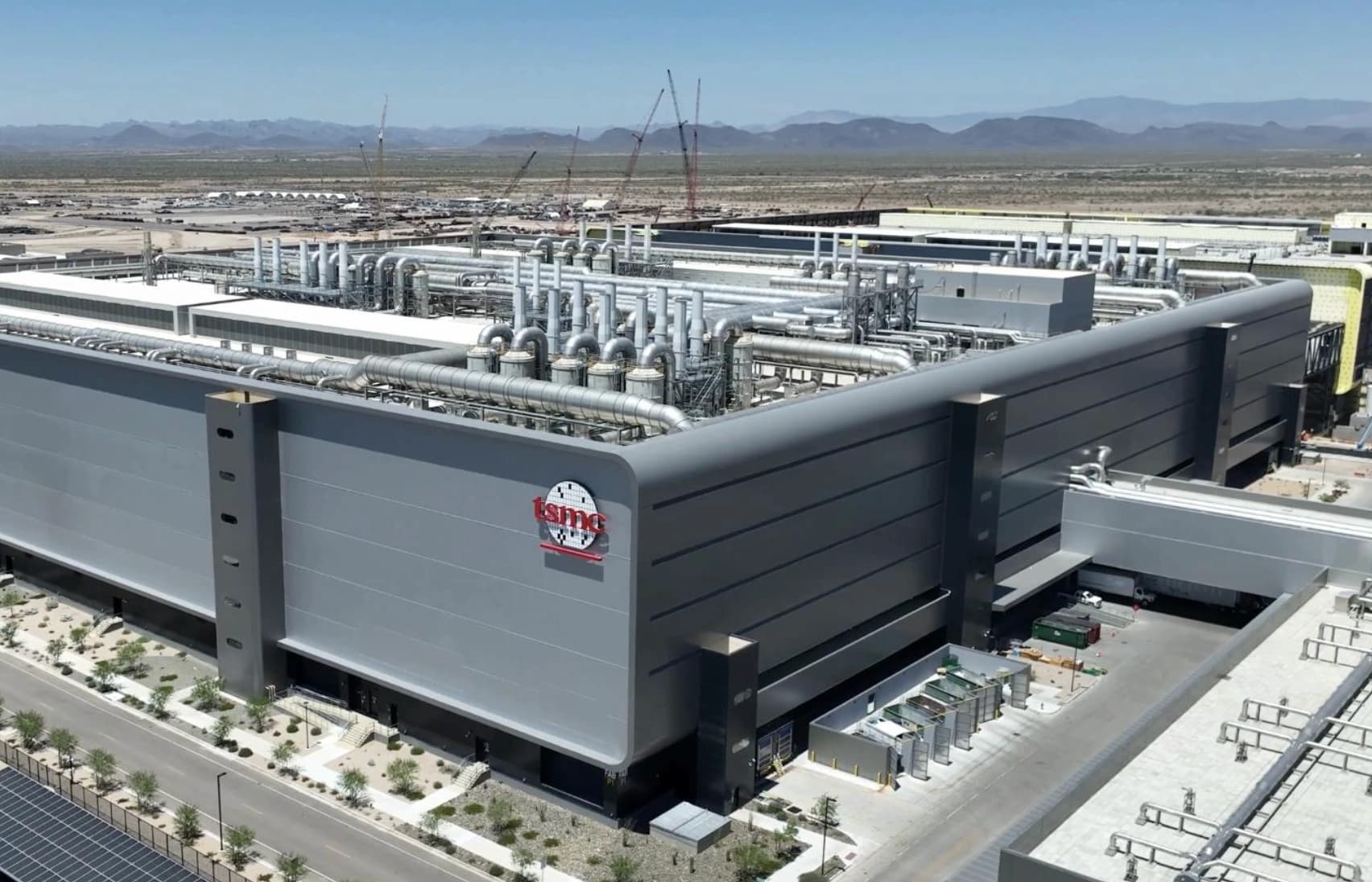
Geopolitically, TSMC's Arizona expansion from a $12 billion two-fab plan to a $165 billion six-fab commitment — the largest foreign direct investment in a greenfield U.S. project in history — creates a long-dated supply story that reduces but does not eliminate Taiwan concentration risk. Micron's first concrete pour at its New York fab on July 9, combined with a $3 billion strategic U.S. investment announcement, adds a memory-layer dimension to the domestic buildout. The Intel wildcard — KeyBanc raised its target to $155 on July 14 following Intel's adoption of ASML's High-NA EUV machine and the Nova Lake production pivot — introduces a potential third domestic logic player, though Intel's execution risk remains the single largest discount in the sector.
The specific level to watch on TSM is how the stock handles the region above $250 into the close today. The guidance raise to 40%+ growth should be a re-rating catalyst, but the stock has already moved significantly on AI infrastructure optimism year to date. If TSM fails to hold a post-earnings premium by the close, it signals the market is front-running the remaining hyperscaler prints — and positioning for a "sell the confirmation" dynamic before Microsoft and Meta report. The date that matters most after today is the final week of July, when three of the five largest AI capex spenders on the planet open their books.
The Weekly Investor
Daily market analysis for active traders. Free.