PepsiCo Q2 2026: Three Numbers That Matter
PepsiCo reports Q2 2026 earnings before the open. EPS consensus sits at $2.21, but the real story is Frito-Lay volume and second-half guidance.
Key Points
- Wall Street expects PepsiCo to report Q2 EPS of $2.21 on revenue of $23.96B, but the headline growth rate of 140% is a mirage created by a $1.86B impairment charge in Q2 2025 — true core growth is closer to 4.2%.
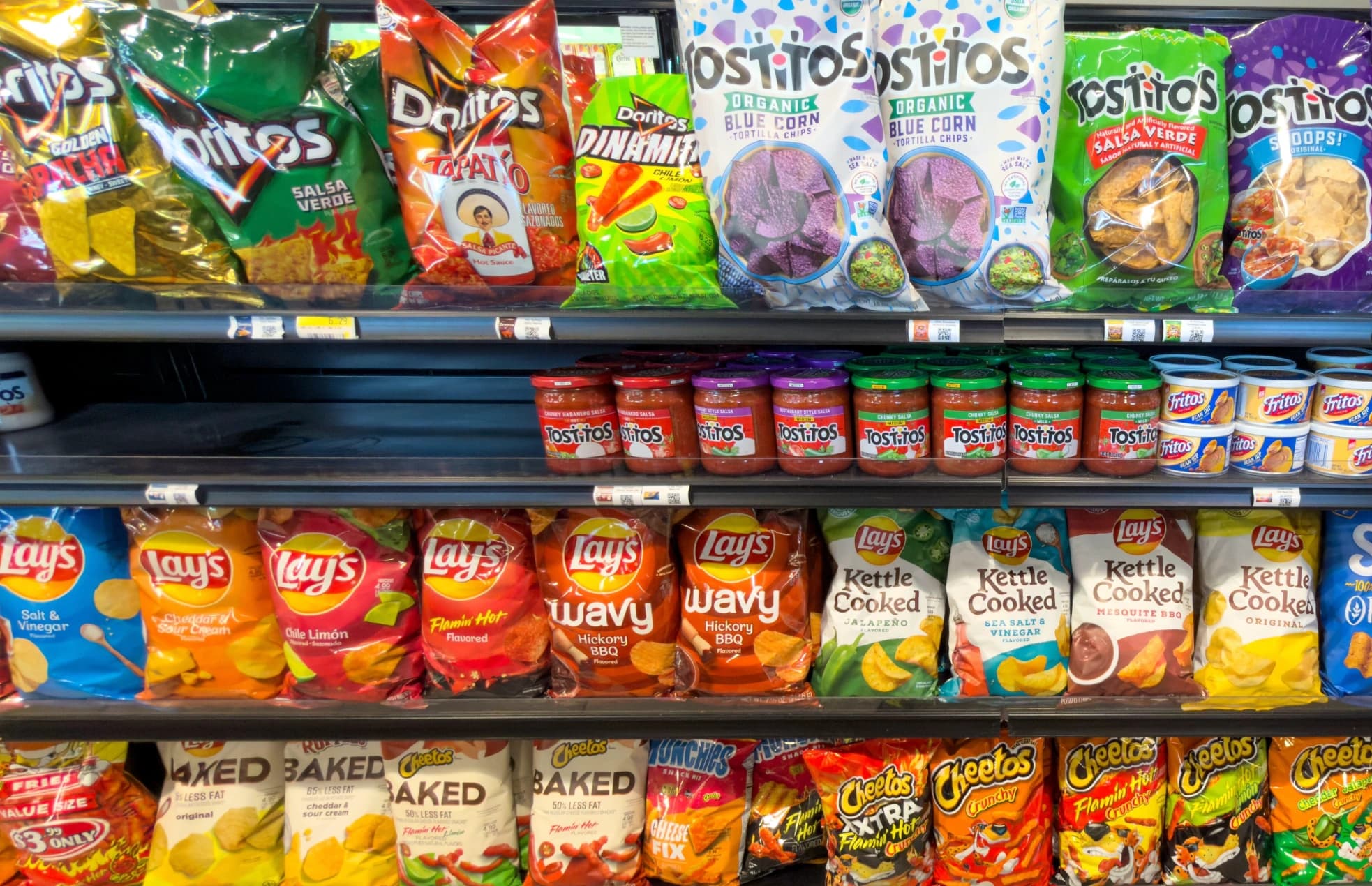
- Elliott Investment Management's pressure campaign forced price cuts of up to 15% on Doritos, Lay's, and Cheetos, making North American snack volume the single most watched line item in today's release.
- If management fails to push organic revenue guidance toward the top of its 2%–4% range, PEP risks extending its slide near 52-week lows with no near-term catalyst to reverse institutional selling.
PepsiCo hit the tape before Wednesday's open with Q2 2026 results that Wall Street had spent three months quietly dreading. The consensus sat at $2.21 EPS on $23.96B in revenue — numbers that look explosive on a year-over-year basis only because Q2 2025 was wrecked by a $1.86B non-cash impairment charge that dragged GAAP EPS down to $0.92. Strip that distortion out and the real story is a company grinding out roughly 4.2% core earnings growth while fighting a volume war in its most important business.
The Impairment Distortion Traders Must Ignore
The 140.2% headline EPS growth figure will appear in every screener and algorithmic feed the moment the print crosses the wire. Ignore it. The comparison is useless as a signal of business momentum because Q2 2025's $0.92 GAAP EPS was not a real operating result — it was an accounting event. The $1.86B impairment charge PepsiCo booked last year reflected write-downs against specific brand or asset values, not a collapse in cash generation. Treating the year-over-year delta as a growth story would be like praising a patient for running a mile when the prior week's benchmark was taken while they had a broken leg.
What actually matters is the trajectory of non-GAAP operating performance, and that trajectory has been under pressure. Analyst EPS estimates drifted down 1.3% over the 30 days heading into the print — from $2.24 to $2.21 — and had fallen 2.6% over the prior 90 days from a starting point of $2.27. That's a consistent, methodical bleed in expectations, not a one-day revision driven by a single data point. When the sell-side systematically shaves numbers over a multi-month window, it typically reflects ongoing channel checks showing weakness, not model-tweaking on macro assumptions. The compression also stands in contrast to PepsiCo's four-quarter streak of beating EPS consensus — a streak that provided cover for bulls but may be harder to extend now that the pricing lever has been partially surrendered.
The price target landscape reflects the same ambivalence. UBS sits at $172, JPMorgan at $170, but Barclays is at $144, Bernstein at $142, and TD Cowen at $150. That's a $30 spread between the most and least optimistic major-house targets — unusually wide for a large-cap consumer staples name with a predictable cash flow profile. Options traders priced in a 4.46% move in either direction into the release, which is elevated for PEP and signals that institutional positioning was not firmly anchored in either direction heading into this morning.
Frito-Lay Is the Only Number That Actually Moves the Stock
Elliott Investment Management made PepsiCo's snack division the center of its activist campaign earlier this year, and the company responded by cutting prices by up to 15% on Doritos, Lay's, and Cheetos. That decision was simultaneously a capitulation to shelf-price pressure and a bet that volume recovery would more than offset the per-unit revenue hit. Today's Q2 print is the first clean read on whether that bet is working.
The mechanics are straightforward: if Frito-Lay North America volume turns positive — or narrows its prior decline materially — management can argue the price cuts are stimulating demand and the brand is healthy. If volume remains flat or negative despite the discounting, PepsiCo has effectively taken a revenue-per-unit hit without getting the unit-movement payoff, which is the worst possible outcome. It would signal that the segment's struggles are structural rather than price-elastic, meaning the consumer has genuinely shifted preferences toward private label or competing snack formats rather than simply waiting for a deal.
This is not an abstract concern. Private label penetration in salty snacks has been climbing for six consecutive quarters across major grocery chains. Competitors including Utz Brands and Shearer's have been gaining shelf facings at regional retailers where PepsiCo's pricing premium had already been eroding. Elliott's public pressure was a symptom of an underlying problem that pricing alone cannot fully solve. Management's language around Frito-Lay specifically — not the consolidated organic revenue number, but the segment-level volume commentary — is the single most diagnostic data point in today's release for traders trying to underwrite the next 12 months of PEP.
What the Guidance Range Actually Tells You
PepsiCo entered Q2 with a full-year organic revenue growth outlook of 2% to 4%. That range is deliberately wide for a company of PepsiCo's analytical sophistication and global data infrastructure. When a company with $91B in annual revenue and real-time point-of-sale visibility across 200 markets gives itself a 200 basis point guidance window, it's telling you something: management itself does not have conviction in the demand recovery trajectory. A tight guidance range signals confidence. A wide one signals uncertainty, and the 2%–4% band is about as wide as PepsiCo has run in recent memory outside of COVID-era disruption.
The critical question traders need to answer from today's call is whether management nudges that range. A reaffirmation of the midpoint — approximately 3% — is already baked into current consensus and would likely produce a muted reaction, potentially even a mild sell-on-the-news move given how much negative sentiment has built up in the stock. A narrowing of the range toward the upper half, specifically any language anchoring the second-half outlook closer to 3.5%–4%, would be a genuine positive surprise given the systematic estimate cuts of the past quarter. A reduction of the top end, or any suggestion that 2% is now the more probable outcome, would likely accelerate the stock's slide toward fresh 52-week lows.
The macro setup does not help. CPI inflation running at 4.2% year-over-year as of May means real consumer purchasing power is being squeezed, even as the Fed funds rate sits at 3.63% and the 10-year Treasury yield holds at 4.55%. That rate environment keeps PepsiCo's dividend yield — historically a key support for the stock's valuation floor — less attractive relative to risk-free alternatives than it was during the zero-rate era. Consumer staples multiples have compressed across the sector, and PEP has not been immune. The stock needs a fundamental catalyst, not just a cheap valuation argument, to break the institutional selling pressure.
The specific level traders should watch is whatever price corresponds to a clean break above the 50-day moving average on above-average volume. Until PEP reclaims that level on meaningful buying interest, the path of least resistance remains lower regardless of whether today's print comes in at or above the $2.21 consensus. The next major event after today's release will be the Q3 preliminary volume data, expected sometime in October 2026, which will be the first quarter fully reflecting the Frito-Lay pricing reset without any base-period distortion. That print — not today's — is when traders will know definitively whether Elliott's prescription was medicine or a placebo.
The Weekly Investor
Daily market analysis for active traders. Free.