Micron Trades 22% Off Peak: Buy the Dip or Falling Knife?
Micron stock sits 22% below post-earnings highs despite a 346% revenue surge and $50B Q4 guidance. Is the SK Hynix IPO the real threat?
Key Points
- Micron reported $41.46B in Q3 revenue — a 346% YoY surge — and guided Q4 to $50B with ~86% gross margins, yet the stock has given back 22% from its post-earnings peak.
- SK Hynix's $28B Nasdaq debut under ticker SKHY today is the most immediate catalyst for MU's underperformance, introducing the first NVIDIA-qualified HBM supplier as a direct public-market competitor.
- Watch $984 as the critical support level; a close below it on heavy volume would open a technical pathway to the 200-day moving average near $920, while the RSI at 38.25 suggests the dip is becoming technically extended.
Micron Technology is sitting at $991.64 this morning, up 4.52% on the session but still 22% below the $1,199.52 it hit in after-hours trading when Q3 results landed — a quarter where the company posted $41.46 billion in revenue against a $35.69 billion consensus and printed adjusted EPS of $25.11, blowing past the $20.49 estimate by 22.6%. The question for traders today is brutally simple: does the gap between those fundamental numbers and this stock price represent the best AI memory entry of 2026, or is the market correctly pricing in a competitive shift?
The Earnings Case Is Overwhelming
The Q3 print was not a beat driven by accounting adjustments or one-time items — it was a structural revenue explosion across every business unit Micron operates. Data center gross margin hit 87%, up roughly 12 points sequentially, and the Cloud Memory Business Unit alone generated $13.77 billion at an 83% gross margin and 78% operating margin. For comparison, that single business unit pulled in $3.39 billion one year ago. That is a 306% year-over-year increase from one division.
Q4 guidance of $50 billion in revenue with approximately 86% gross margins and EPS near $31 is not a management team sandbagging — it is a company telling the market it expects sequential acceleration on an already-historic base. The $22 billion in locked long-term AI supply contracts provides visibility that most semiconductor companies can only describe in aspirational terms. Yesterday's first concrete pour at Micron's New York fab — paired with a separate announcement of up to $3 billion in strategic U.S. semiconductor ecosystem investment — signals a management team spending like demand is structural, not cyclical.
The stock is up approximately 700% over the trailing twelve months, pushing market cap past $1 trillion. The YTD gain still leads most large-cap semiconductor peers outside of the PHLX Semiconductor Sector index's front-runners. Analysts who track the HBM memory market note that Micron's ramp to HBM3E production has been faster than most expected even six months ago, and the company's roadmap to HBM4 puts it on a timeline competitive with Samsung — though not yet SK Hynix.
The SK Hynix Threat Is Real, Not Theoretical
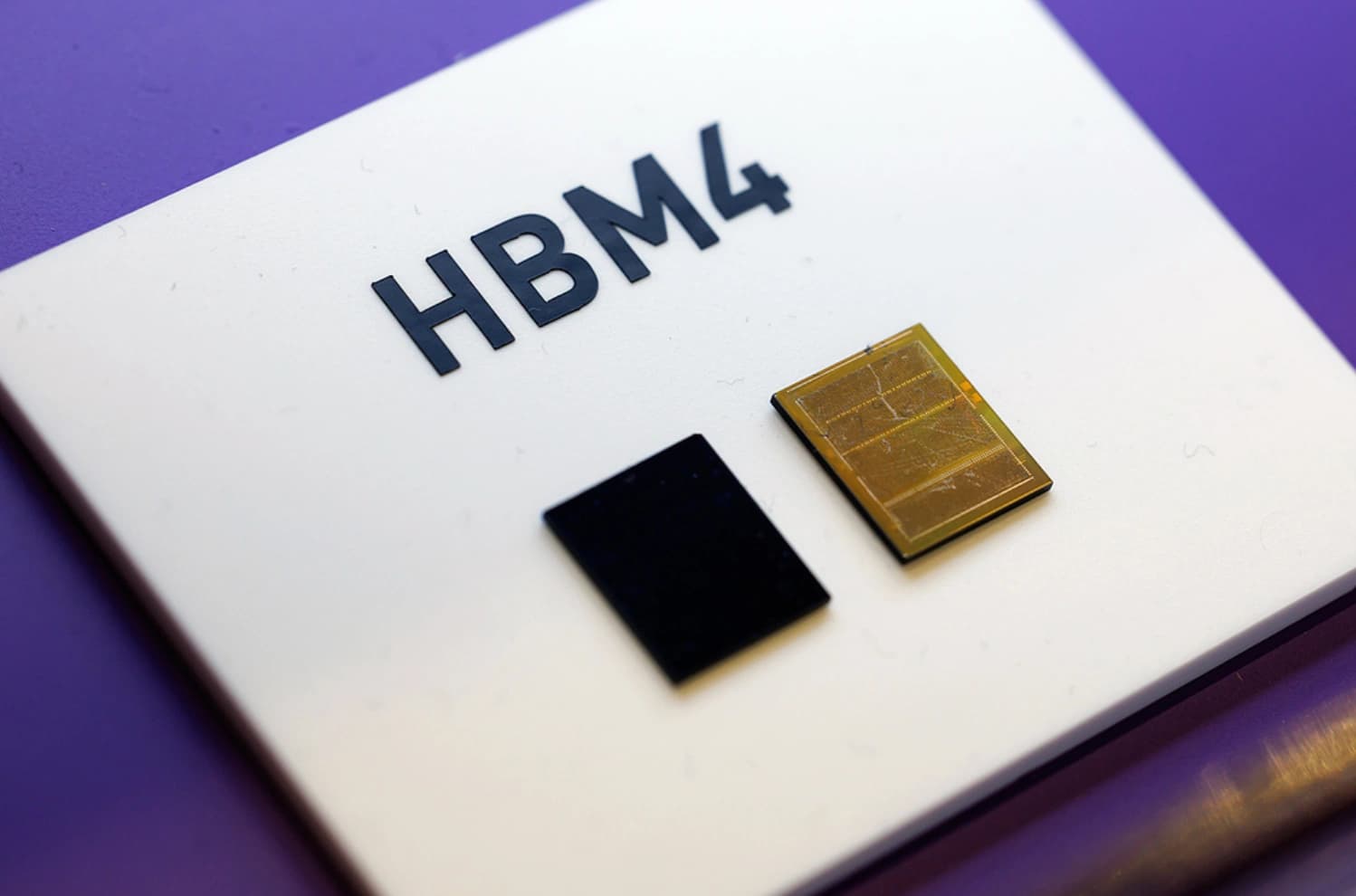
The single most important development pressuring MU today is not macro or rates — it is the $28 billion Nasdaq listing of SK Hynix under ticker SKHY, which began trading this morning. SK Hynix is currently the only HBM supplier qualified by NVIDIA for its H100, H200, and Blackwell-series accelerators, and it holds an estimated 50%-plus share of the HBM market. That competitive position is exactly what Micron's valuation is implicitly betting will erode.
Investors who want HBM exposure now have a direct, liquid, U.S.-listed alternative. That is a new dynamic. Prior to today, playing the HBM trade through public markets meant either owning MU or taking Korean market risk through ADRs. SKHY changes the calculus. Any institutional rotation from MU to SKHY in the coming weeks — even partial — creates mechanical selling pressure that has nothing to do with Micron's fundamentals.
South Korea's announced $880 billion, ten-year investment plan in semiconductors, AI infrastructure, and robotics — with Samsung and SK Hynix committing $518 billion toward new fabrication — means the competitive landscape Micron is operating in will be better capitalized on the Korean side than at any point in the past decade. That is the structural risk the market is attempting to price, and why the 22% post-earnings drawdown is not simply noise.
What Traders Are Watching Next
The RSI at 38.25 is the most actionable technical signal on the board for MU right now. Oversold does not mean bottomed, but it does mean the easy selling has likely occurred. The $984 level — roughly where the stock opened this week — is the line in the sand. A confirmed close below $984 on volume above the 20-day average would technically open a path toward $920, which corresponds to the approximate 200-day moving average. A hold above $984 into the close today, combined with SKHY's first-day price action stabilizing, would be the bullish scenario for a near-term recovery attempt.
The forward calendar matters as much as technicals here. Microsoft reports Q2 results on July 29, and Azure's AI infrastructure commentary will serve as a direct proxy for whether the hyperscaler capex cycle — which underpins Micron's entire demand thesis — is accelerating, decelerating, or holding. Goldman Sachs projects four hyperscalers will collectively spend $725 billion on AI infrastructure this year, a 77% year-over-year increase. If Microsoft's Azure numbers support that projection, MU's $50 billion Q4 guide looks conservative. If Azure disappoints, the guide gets questioned regardless of how strong Micron's own execution has been.
NVIDIA's Q2 FY2027 guidance targets $91 billion in revenue. NVIDIA's accelerator demand is Micron's demand — HBM is not optional in modern GPU architecture, and every Blackwell chip that ships needs Micron or a competitor's memory stacked on it. DeepSeek's reported effort to build its own AI chip to cut Nvidia ties deserves monitoring, but the timeline for that to materially impact HBM volumes is measured in years, not quarters. The more immediate watch: TSMC reports Q2 on July 16, and any commentary on advanced packaging demand — where HBM is assembled — will give traders an independent read on whether the volume ramp Micron described is tracking. TSMC is hiking prices on advanced nodes by 5% to 10%, a move that signals demand is outpacing capacity, which is bullish for the memory supply chain broadly. MU's next formal catalyst after TSMC's print is its own Q4 earnings release, expected in late September — but by then, the July hyperscaler reports will have already set the narrative.
The Weekly Investor
Daily market analysis for active traders. Free.