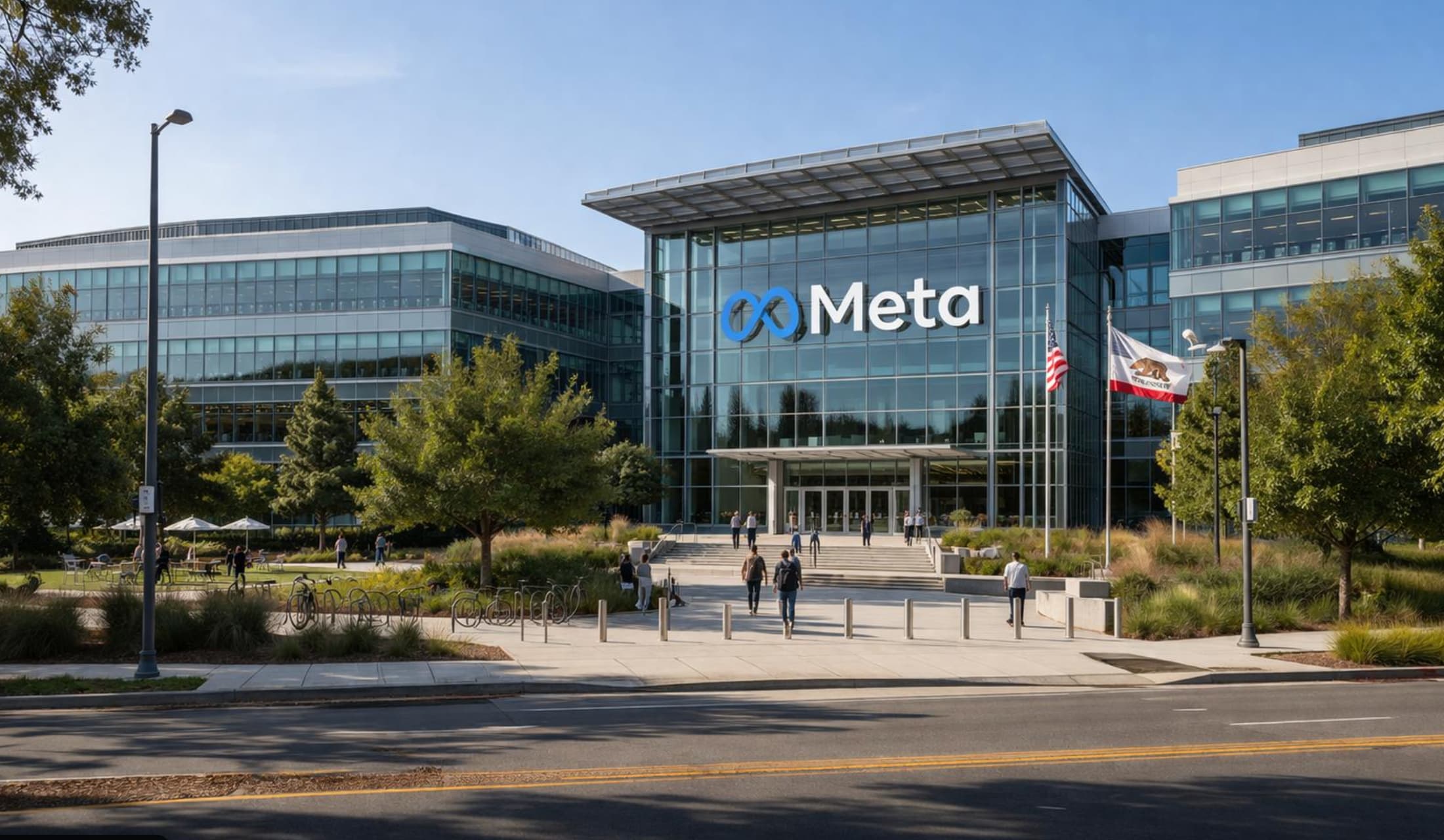

Meta Surges 8% on Cloud Launch: What Traders Need to Know
Meta jumps 8.1% after announcing a cloud business to monetize excess AI compute. Here's what the move means for margins and the ad-tech stack.
Key Points
- Meta rose 8.1% in early trading July 6 after announcing it will sell excess AI computing capacity as a cloud service, opening an entirely new revenue vertical.
- The move repositions Meta from pure ad-revenue dependency into infrastructure monetization, directly competing with AWS, Azure, and Google Cloud at a moment when enterprise AI compute demand is structurally undersupplied.
- Watch META's next analyst day and Q2 earnings on July 29 for the first quantified revenue guidance tied to the cloud unit — that print will set the price ceiling for the next leg.
Meta Platforms surged 8.1% to lead large-cap gainers on Monday, July 6, after the company announced it will launch a cloud business and sell excess computing capacity to enterprise customers — a structural pivot that, if executed, adds a high-margin revenue stream to a business that already generates roughly $50 billion in annual operating income from advertising alone.
The Strategic Logic Is Airtight
Meta has spent aggressively on AI infrastructure for three years, and its capex commitments have been a persistent point of friction with investors focused on near-term margins. The company guided for $60–65 billion in 2026 capital expenditures — a figure that spooked analysts earlier this year and contributed to multiple rounds of multiple compression across the ad-tech sector. The cloud announcement flips the narrative entirely: the infrastructure build that looked like a margin drain is now positioned as an asset that generates third-party revenue. That reframe is exactly what the stock needed entering Q2 earnings on July 29.
The business logic mirrors what Amazon did with AWS in the mid-2000s and what Microsoft has spent the last five years engineering with Azure OpenAI. Both companies discovered that internal compute infrastructure, built to serve proprietary products, could be monetized externally at margins far exceeding their core businesses. AWS now generates roughly 17% of Amazon's total revenue but accounts for the majority of operating profit. Meta is making the same calculated bet: that the moat it built to serve Reels, WhatsApp, and its ad targeting engine is wide enough to rent to competitors and enterprise customers who can't afford to build it themselves.
The Ripple Effect Through AI and Ad-Tech
AppLovin climbed 7.6% in early trading Monday in direct sympathy, a move that underscores how tightly the ad-tech and AI infrastructure ecosystems are currently correlated. Any signal that Meta's AI investments are inflecting toward profitability reduces the overhang on the entire sector. AppLovin, which uses AI-driven ad optimization as its core product, benefits from a market that increasingly values AI infrastructure ownership rather than penalizing the capex required to build it. That sentiment shift is not trivial — the PHLX Semiconductor Index lost 6.7% in the prior session after roughly doubling during Q2, and sector-wide confidence in AI monetization timelines needed a catalyst.
The broader macro backdrop gives the cloud announcement added weight. With S&P 500 Q2 2026 earnings growth now estimated at 23.3%, up from 18.8% at the start of the quarter, investors are aggressively rewarding companies that can demonstrate tangible pathways to margin expansion. The CY 2026 bottom-up EPS estimate has risen 6.3% since March 31 to $340.52. Meta, reporting July 29, sits at the center of a Q2 earnings season where the bar is already elevated — the cloud announcement is a pre-earnings positioning move that resets buy-side expectations before the print.
The competitive risk is real but asymmetric. AWS, Azure, and Google Cloud have entrenched enterprise relationships, compliance certifications, and years of operational trust that Meta cannot replicate overnight. Google Cloud itself has been under pressure recently — Alphabet was downgraded Monday amid concerns over capital expenditure intensity, margin compression, and depreciation risks from aggressive AI infrastructure spending. That downgrade, combined with Meta's announcement, suggests the market is beginning to differentiate between AI infrastructure spenders who have a clear monetization path and those who don't. Meta just put itself firmly in the first category, at least in the market's near-term judgment.
What Traders Watch Next — July 29 Is the Line in the Sand
The 8.1% single-session gain on July 6 is meaningful, but it is a sentiment move, not a fundamentals move. No revenue from the cloud unit has been reported, no pricing structure has been disclosed, and no customer contracts have been announced. The trade now becomes whether the stock can hold this new price level through the July 29 earnings release or whether profit-taking erases the gap before Meta delivers hard numbers.
S&P 500 forward P/E sits at 20.4x — above the 5-year average of 19.9x and the 10-year average of 19.0x. At that valuation, markets are already priced for execution, and any shortfall on Q2 ad revenue, monthly active user growth, or initial cloud commentary will be punished more severely than the multiple would suggest. Meta's Reality Labs unit continues to lose money at scale, and the company has not yet provided a timeline for when cloud operations would reach breakeven, let alone profitability.
The June payrolls shock — 57,000 jobs added versus 110,000–115,000 expected — adds another layer of complexity. Advertising revenue, which still constitutes the overwhelming majority of Meta's top line, is cyclically sensitive to consumer spending confidence and corporate marketing budgets. A weakening labor market that forces Fed rethinking on rates could compress ad pricing in H2 2026 precisely as the cloud business is ramping. CNBC reported the premarket move and framed it as the most significant single-stock catalyst of the Monday session, and that framing is accurate — but traders should treat the gap as an entry-pricing problem, not a free pass. The July 29 print is where the cloud story either gets a foundation or becomes a rumor that was sold into. Watch for any analyst hosting events or advertiser conference presentations in the next three weeks that might offer early channel checks on Q2 ad demand — those will be the leading indicator before the official number lands.
The Weekly Investor
Daily market analysis for active traders. Free.