Jackson Hole 2026: Warsh's Podium, Fed's Hike Signal
Fed Chair Warsh speaks Friday at Jackson Hole as three FOMC dissenters push for hikes. September 16 decision is live. Here's what to watch.
Key Points
- Fed Chair Kevin Warsh delivers his first-ever Jackson Hole keynote Friday, August 28 at approximately 10:00 AM ET, with three FOMC members already on record voting for an immediate rate hike.
- The September 16-17 FOMC meeting is 21 days out, making this the last major communication window before the Fed enters its pre-meeting blackout period.
- A hawkish lean from Warsh pushes the dollar index higher and the 2-year Treasury yield toward 4.50%; a dovish tilt extends risk-on but raises inflation credibility questions given core PCE at 3.3%.
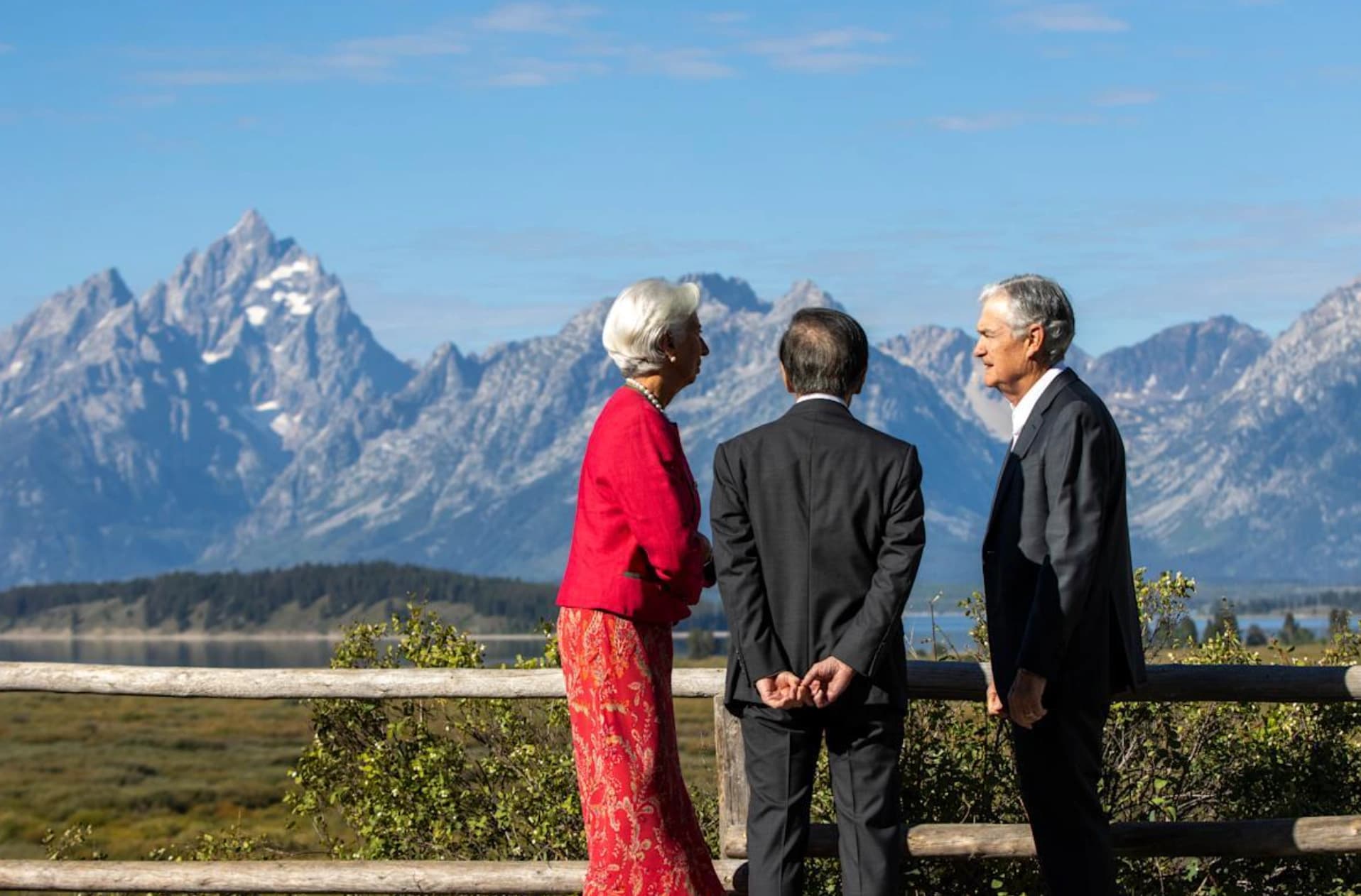
Fed Chair Kevin Warsh steps to the Jackson Hole podium Friday morning for the first time in his tenure, and the most consequential question he'll answer — whether he says it explicitly or not — is whether September 16 is a live hike meeting. Three of his colleagues already voted yes at July's FOMC. Today's PCE and GDP data will tell him how much political and economic cover he has to agree with them.
The Most Watched Podium in Finance
The Kansas City Fed's annual Economic Policy Symposium in Jackson Hole, Wyoming has functioned for decades as the Fed's preferred venue for pre-committing to policy pivots — Bernanke used it to signal QE2 in 2010, Powell used it in 2022 to deliver the most hawkish statement in a generation, and Warsh now inherits that tradition at a moment of genuine uncertainty. The 2026 symposium theme, "Financial Innovation: Implications for Payments and Policy," is nominally about fintech and digital payment architecture, but no one in the market is attending for the panel discussions. Warsh's keynote at approximately 10:00 AM ET on Friday, August 28 is the event, and every word will be parsed for its implications on the September 16-17 FOMC decision.
The backdrop Warsh faces is not ambiguous. The Fed held the funds rate at 3.50% to 3.75% at the July 28-29 meeting, but three voting members — Beth Hammack, Neel Kashkari, and Lorie Logan — dissented in favor of an immediate 25-basis-point hike. That is not a fringe view inside the Committee. These are three regionally diverse presidents with distinct economic mandates, and they read the same data as the majority and drew a different conclusion. The conclusion: core PCE at 3.3% year-over-year with unemployment at 4.1% and job growth still running does not require the Fed to wait. Wells Fargo's post-meeting assessment flagged that absent improvement in core inflation, rate hikes later in 2026 remain the central case — not a tail risk. The funds rate at 3.63% effective against CPI at 3.4% and core PCE at 3.3% leaves real rates barely positive. That is not a restrictive stance by historical standards, and the hawks know it.
Reading Warsh's Signals
Warsh has not yet established a clear public identity on the hawkish-dovish spectrum in the same way his predecessors did, which makes Friday's speech doubly important. His first Jackson Hole keynote is effectively a policy introduction under live-fire conditions. Markets will listen not just for what he says about September but for how he characterizes the inflation problem. If he describes the current inflation overshoot as supply-driven and time-bound — leaning on the Fed's July language about "supply shocks in certain sectors including energy," with WTI at $84.05 and Brent at $92.51 — the market will read that as a patient majority holding the line against the dissenters. The dollar softens, the 2-year yield retreats from 4.24%, and rate-sensitive equities get a brief reprieve.
If, however, Warsh acknowledges that 3.3% core PCE is no longer explicable by energy passthrough alone — that services inflation and wages are sustaining price pressure independent of the Middle East shock — the signal shifts decisively. Vice Chair for Supervision Michelle Bowman is also participating in a symposium discussion, and Governor Lisa Cook is delivering a separate speech. If Bowman, who has previously demonstrated hawkish sympathies, reinforces a tightening lean in her remarks, it compounds Warsh's message. The combination of three dissenting votes in July, a core PCE print holding at 3.3%, and coordinated hawkish messaging from Jackson Hole would push September 16 into full live-hike status. The 2-year Treasury yield, which settled at 4.24% on Monday, would be the first and fastest mover — watch for a push toward 4.40% to 4.50% intraday Friday if the tone tilts hawkish.
The global central bank context matters here because it shapes how far the dollar can run. The ECB held rates unchanged at its July 23 meeting, citing elevated uncertainty from the Middle East energy shock and cautioning that the full inflationary impact has not yet played out. The ECB's next decision is September 24, one week after the Fed's. The Bank of England is expected to hold at 3.75% at its September 24 meeting as well, having guided toward a "gradual downward path" for rates — a posture that directly diverges from where three Fed officials already want to be. If Warsh signals a September hike and both the ECB and BoE stay on hold, the dollar index (DXY) gets a structural bid from rate differential widening. That cross-currency pressure also matters for emerging market central banks: the Bank of Korea decides tonight at 9:00 PM ET with the prior rate at 2.75%, and any surprise cut out of Seoul in a dollar-strengthening environment creates immediate capital flow stress for Korean assets.
What Traders Watch Next
The pre-Jackson Hole checklist for traders runs as follows: today's 8:30 AM PCE and GDP data establishes the inflation and growth baseline; Thursday's session digests that baseline and prices in Warsh's likely posture; Friday's keynote at 10:00 AM ET delivers the signal. After Friday, the next major data input before the September 16-17 FOMC is the August jobs report, due in early September. If payrolls remain solid — consistent with July's 4.1% unemployment rate — the hawks' case closes. A weak jobs number is the only realistic circuit breaker that prevents September from becoming a genuine coin-flip on a 25-basis-point hike.
The specific levels that define the trade: DXY above 104.50 after Friday's speech signals a full hawkish reprice. The 10-year Treasury breaking and holding above 4.80% confirms bond market capitulation to the hike scenario. For equities, the rate-sensitive sectors — REITs, utilities, and long-duration growth — are the first casualties if Warsh leans hawkish. The Russell 2000, heavily weighted toward floating-rate debt, faces amplified pressure in a rising short-rate environment. Conversely, financials — particularly regional banks that benefit from a steepening yield curve — stand to outperform if the 2-year rises faster than the 10-year spread can compress. The setup from now through the September 17 announcement is as binary and time-compressed as any in this cycle. Warsh has 19 days to tell markets what he thinks. Friday, he begins.
The Weekly Investor
Daily market analysis for active traders. Free.