GPT-5.6 Broad Release Hinges on July 7 White House Call
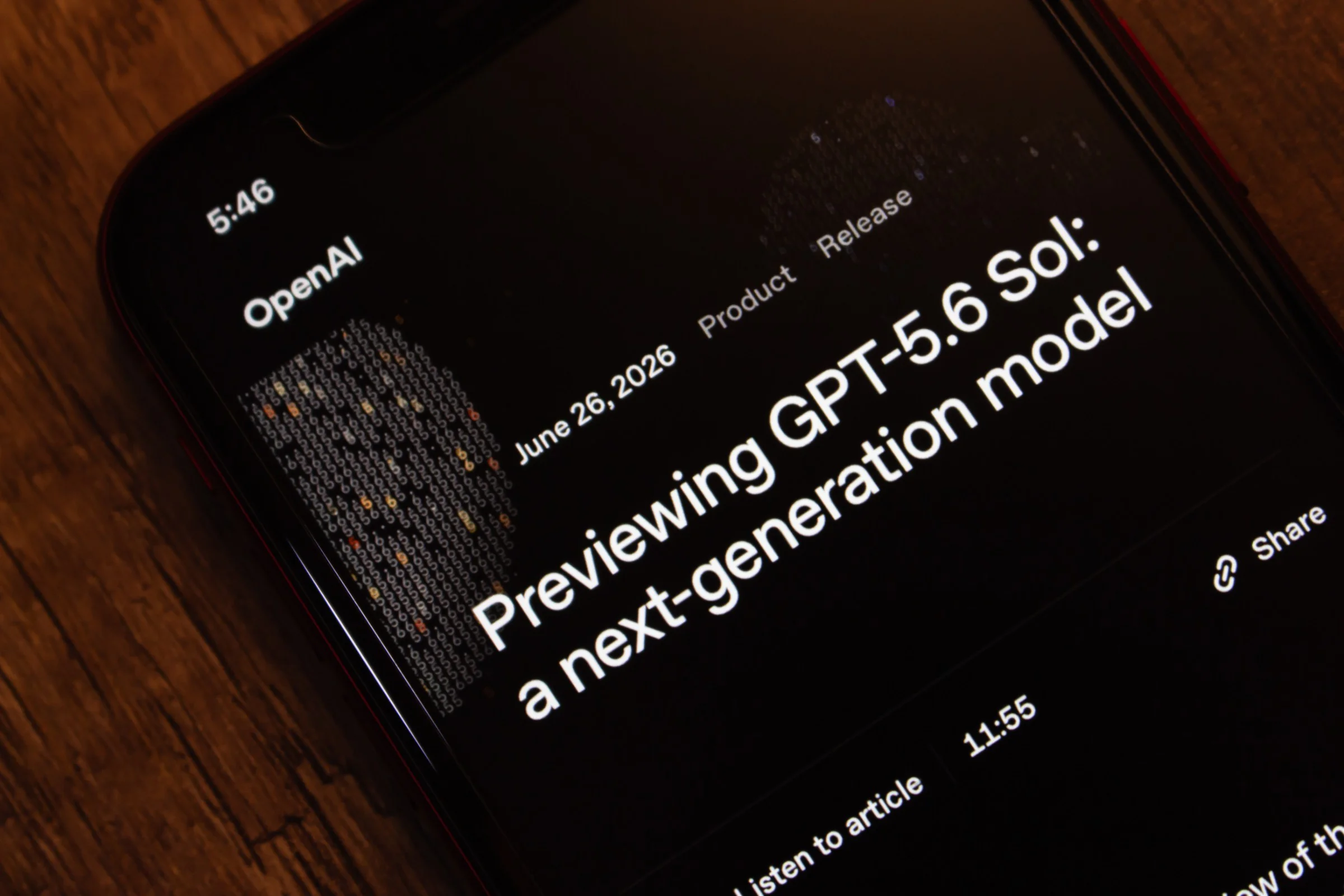
OpenAI's GPT-5.6 is live for 20 government partners. A White House AI framework expected July 7 is the trigger for broad commercial access and IPO pricing.
Key Points
- GPT-5.6 Sol, Terra, and Luna remain restricted to approximately 20 government-vetted organizations; analyst consensus places broad commercial access in mid-to-late July, contingent on a White House voluntary standards framework expected around July 7.
- The three-tier token pricing structure — Sol at $5/$30, Terra at $2.50/$15, Luna at $1/$6 per million tokens — positions Terra as the likely volume leader at commercial launch, directly pressuring Google and Anthropic on enterprise market share.
- Traders should watch the July 7 White House announcement as the trigger that unlocks GPT-5.6 revenue, resets IPO timeline expectations for both OpenAI and Anthropic, and forces a competitive response from Google on the still-unscheduled Gemini 3.5 Pro.
OpenAI's GPT-5.6 is commercially functional and already deployed — but only for roughly 20 government-vetted organizations. The White House voluntary AI standards framework expected around July 7 is not a policy footnote. It is the unlock condition for what could be the most significant model launch since GPT-4, and it arrives with two companies valued near $1 trillion each sitting on confidential S-1 filings at the SEC.
The Gate Keeping $1 Trillion Valuations Locked
OpenAI has been explicit that the current government-access-only restriction is not its preferred long-term model. The company stated it "does not believe this kind of government access process should become the long-term default" — a rare instance of a company publicly lobbying against its own gatekeeping arrangement. The framework under discussion involves benchmarks, release timelines, and rules governing who can access advanced models both inside and outside the United States. That last clause is the one with the largest commercial consequences: international access restrictions on GPT-5.6 would directly constrain OpenAI's addressable market in the quarters between now and an IPO roadshow.
The three-tier pricing structure telegraphs where the volume is expected to land. Sol, the flagship tier, is priced at $5 per million input tokens and $30 per million output tokens — premium positioning aimed at government, defense, and enterprise deployments where accuracy and capability justify the cost. Terra, the mid-tier, runs at $2.50 and $15 respectively, making it roughly half the cost of Sol and the obvious target for the largest population of commercial API customers: mid-market SaaS companies, developer platforms, and enterprise software teams currently paying for GPT-4 class models. Luna, the efficiency tier, at $1 and $6 per million tokens, competes directly with Anthropic's Haiku and Google's Flash models on cost-sensitive, high-throughput workloads. Analyst consensus already identifies Terra as the likely widest early adopter, which means the revenue ramp from broad access is faster than the Sol headline pricing suggests.
The IPO calculus makes the July 7 date operationally significant beyond the model launch itself. Both OpenAI and Anthropic have confidentially filed S-1 forms with the SEC, with both companies valued near $1 trillion following their most recent fundraising rounds. Every week of restricted GPT-5.6 access is a week of revenue that does not appear in the trailing metrics that underpin IPO pricing. Investment banks building the comparable-company analysis for these offerings will want to see at least one full quarter of broad-access GPT-5.6 revenue before setting a price range. The July 7 framework announcement, if it confirms mid-July broad release, potentially puts that quarter in the books before year-end — which is exactly the window that analysts have been modeling for the roadshows.
Anthropic and Google Are Not Waiting
Anthropic is not sitting still while OpenAI manages its government access process. Claude Science — targeting pharmaceutical research teams, academic biology labs, and biotech startups — is a direct challenge to OpenAI's GPT-Rosalind, which launched in April 2026 with Amgen, Moderna, and Thermo Fisher as anchor partners. Anthropic's structural advantages in the science vertical are real: the company acquired Coefficient Bio, hired Nobel laureate John Jumper from Google DeepMind, and is positioning Claude Science against Google's Isomorphic Labs on the most defensible and highest-margin segment of the AI application market. Drug discovery and molecular biology are industries where customers will pay for accuracy over cost, making them natural Sol-equivalent margin territory regardless of which company wins the account.
The SpaceX GPU arrangement underscores how serious Anthropic's infrastructure position has become. SpaceX agreed to rent all of Colossus 1's GPU capacity — more than 220,000 NVIDIA chips — to Anthropic, while simultaneously negotiating the Google deal for 110,000 GPUs at $920 million per month beginning October 2026. Anthropic's compute access, effectively secured through SpaceX as an intermediary, gives it the training capacity to close the capability gap with GPT-5.6 without owning the underlying hardware. That is a capital-efficient structure that will appear favorably in Anthropic's S-1 relative to OpenAI's direct infrastructure ownership model.
Google, meanwhile, is handing its competitors a gift. Gemini 3.5 Pro has no confirmed launch date, delayed into July 2026 after failing to meet internal quality thresholds on token efficiency and long-horizon agentic performance. The expected specification — a 2-million-token context window, Deep Think reasoning mode gated to the $250 per month Ultra tier, and frontier multimodal capability — would be competitive with GPT-5.6 Sol if it were available. It is not. Every week Google's delay extends is market share that OpenAI and Anthropic can lock up with enterprise customers who are making annual contract decisions right now. The cost of customer acquisition in enterprise AI is front-loaded; once a company has standardized its workflow on a specific model API, switching costs are meaningful.
What the July 7 Announcement Actually Unlocks
Together AI's $800 million raise at an $8.3 billion valuation — for a platform that helps enterprises run open-source models including DeepSeek, MiniMax, and Kimi — is a signal that the enterprise AI market is splitting into two distinct spending tracks. Premium frontier models from OpenAI and Anthropic on one side; lower-cost open-source infrastructure on the other. The bifurcation matters for anyone trying to price the OpenAI IPO, because it defines the competitive ceiling on GPT-5.6 Terra pricing. If Together AI can deliver 80% of the capability at 20% of the cost for workloads that do not require frontier performance, the addressable market for Terra is smaller than the total enterprise AI budget.
The SCOTUS ruling on FTC independence, which landed this week, adds a layer of regulatory uncertainty that will appear in both IPO risk factor disclosures. As OpenAI's Ben Rossen noted, the decision makes independent assessment of frontier models with binding consequences "a lot harder, if not impossible." That cuts both ways: less structural regulatory risk for OpenAI and Anthropic in the near term, but more exposure to politically-directed enforcement actions that are harder to predict or price. The Microsoft FTC antitrust probe, advanced under the current administration, is the live example of what that uncertainty looks like in practice.
The specific calendar sequence traders should track: July 7 for the White House framework announcement, mid-July for GPT-5.6 broad commercial access, late July for hyperscaler Q2 earnings that will include the first AI revenue disclosures benchmarked against the new model tier, and year-end for the IPO roadshow window. If the July 7 framework is delayed or weakened, the entire sequence shifts right — and with 4.2% CPI still running above the Fed's target against a 3.63% Fed Funds Rate, the rate environment for a trillion-dollar growth IPO is not getting easier with time.
The Weekly Investor
Daily market analysis for active traders. Free.