FTC AI Probe: The Risk Big Tech Isn't Pricing In
The FTC's AI accuracy policy statement closes July 31 — and its enforcement teeth under Section 5 directly threaten how Microsoft and Google sell AI.
Key Points
- The FTC's public comment period on its AI accuracy policy statement closes July 31, 2026 — the same week Microsoft and Alphabet report Q2 earnings — with real enforcement teeth under Section 5 of the FTC Act targeting how AI companies represent model neutrality and behavior.
- The Trump administration's FTC has simultaneously advanced a broad antitrust probe into Microsoft's cloud, AI, and software businesses, while DOJ Antitrust Division leadership instability — two senior departures since February 2026 — creates unpredictable enforcement timelines.
- Traders pricing Microsoft and Alphabet at 30x+ forward earnings on cloud and AI revenue growth need to model a scenario where FTC enforcement materially constrains how those products are marketed and sold.
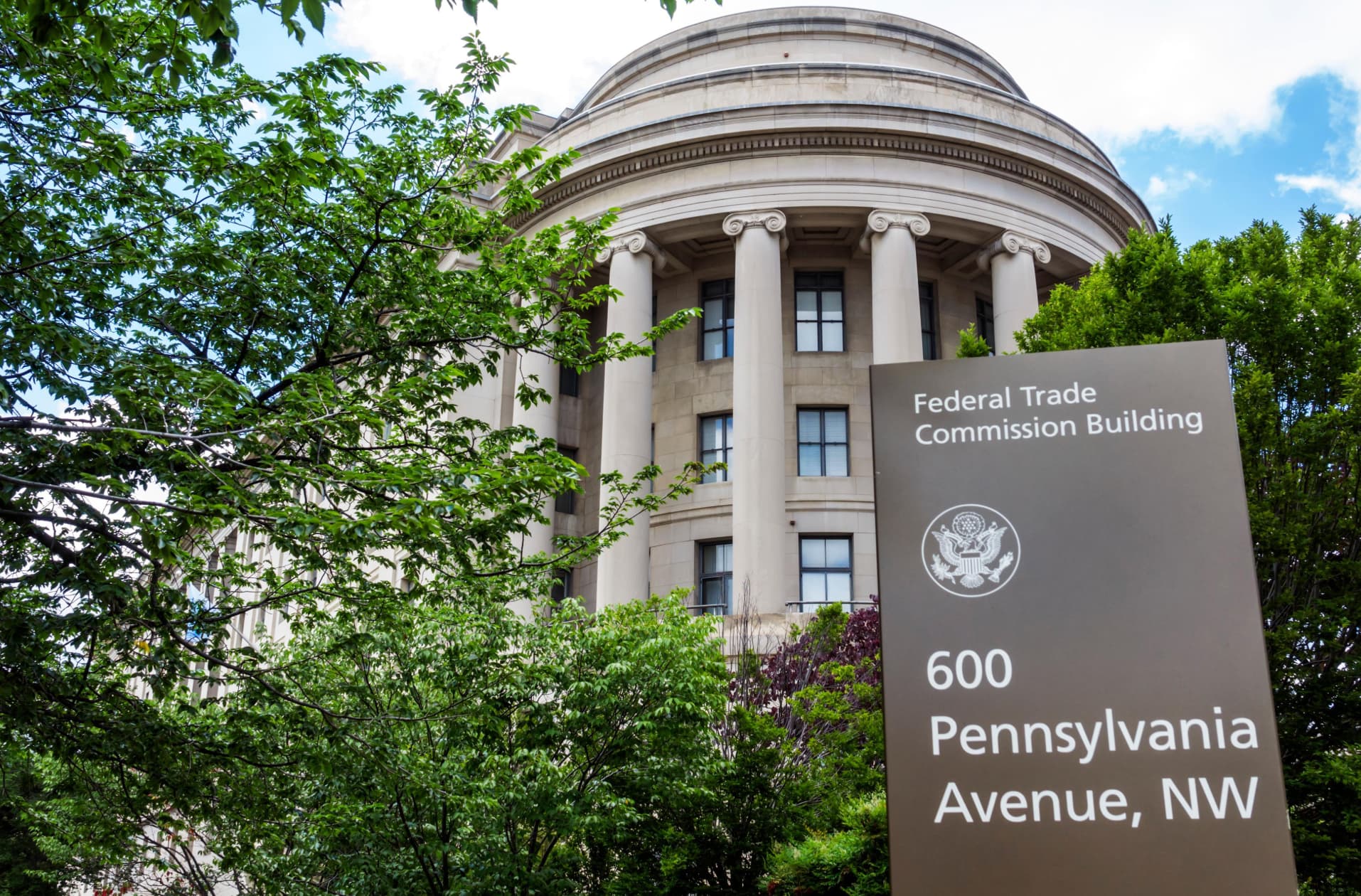
The FTC's comment period on its AI accuracy policy statement closes July 31, 2026 — the same week Microsoft and Alphabet sit down to report Q2 earnings — and the timing is not incidental. The Commission's proposed statement, targeting AI companies that may be manipulating model behavior contrary to reasonable consumer expectations, carries enforcement authority under Section 5 of the FTC Act, the same statutory hook the agency has used to extract billion-dollar settlements from legacy tech platforms. This risk is not in the price.
What the FTC Is Actually Targeting
The policy statement is narrow in its language but broad in its potential application. The FTC is specifically concerned that AI companies may be representing their models as neutral, accurate, or objective while engineering outputs that serve commercial interests — a practice the Commission frames as a deceptive trade act under its Section 5 authority. Public comment closes July 31, after which the FTC can finalize the policy and begin using it as an enforcement template.
The practical reach is significant. OpenAI, Google DeepMind, and Anthropic all market their models with explicit or implicit claims about accuracy, helpfulness, and objectivity. Microsoft's Copilot suite — embedded across its $28-per-seat-per-month Microsoft 365 Commercial plans and deeply integrated into Azure AI services — relies on precisely these kinds of representations to justify enterprise adoption. If the FTC determines that model outputs are being shaped by commercial incentives in ways that contradict those representations, it has a clear path to enforcement action without needing new legislation.
The FTC has not limited its AI scrutiny to accuracy. The Commission has separately launched an inquiry into AI chatbots acting as companions — a signal that the agency is building an oversight framework across multiple vectors simultaneously. That parallel inquiry covers a different set of companies, including startups in the social AI space, but it establishes a pattern: the FTC is not treating AI as a single monolithic issue to be addressed with a single rule. It is building enforcement infrastructure across product categories. For traders, the implication is that AI-related regulatory risk for the major platforms is not a one-time event — it is a recurring, expanding pressure that compounds over multiple quarters.
The Microsoft Probe and the DOJ Vacuum
The Trump administration's FTC has reportedly advanced the broad antitrust probe into Microsoft that originated under the Biden administration, covering the company's cloud, AI, and software businesses. The probe's specific focus — how Microsoft bundles AI capabilities into Azure and Microsoft 365, and whether those bundling practices foreclose competition — maps directly onto the business lines that Wall Street is paying the highest multiples to own. Microsoft's Azure segment has been growing at roughly 30%+ annually, with AI services cited as a primary driver in recent earnings calls. Any enforcement action or consent decree that constrains bundling would put those growth rates at direct risk.
The DOJ dimension adds a layer of uncertainty that markets are systematically underpricing. Assistant Attorney General Gail Slater departed as head of the DOJ Antitrust Division on February 12, 2026 — less than a year into her tenure — following the earlier exit of a senior deputy amid reported friction between the Division and the broader administration. Leadership vacuums in federal enforcement agencies do not simply pause activity; they create conditions where individual career staff make enforcement decisions without clear policy direction, producing outcomes that are harder to predict than either aggressive or permissive regimes. For Microsoft, that uncertainty is arguably worse than a clearly hostile regulator, because it makes legal strategy planning nearly impossible.
The broader enforcement posture in 2026 reflects a genuine tension within the administration. The first half of the year brought a more permissive merger review environment — several AI-adjacent acquisitions cleared that would likely have faced challenges under Biden-era guidelines — while Europe advanced assertive digital regulation under the Digital Markets Act framework. The Trump administration has simultaneously dismantled many Biden-era AI executive orders while retaining the flexibility to use established antitrust tools with sensitivity to AI market dynamics. The result is an enforcement environment where the rules are unclear, which historically has a chilling effect on the most aggressive forms of AI product integration — the exact integrations Microsoft and Google are betting their next five years on.
What Traders Watch Next
The convergence of the July 31 FTC comment deadline with Microsoft and Alphabet's Q2 earnings reports creates a specific risk window. Microsoft reports July 29; Alphabet reports the same day. Both companies will face analyst questions about the regulatory environment, and both management teams will be speaking into a live FTC process — which constrains what they can say about forward product strategy without creating additional legal exposure. That constraint on forward guidance specificity is itself a risk for stocks that trade on AI narrative momentum as much as on reported numbers.
Microsoft currently trades at roughly 32x forward earnings, with analysts at Goldman Sachs modeling Azure AI revenue growth as the primary justification for that multiple. Goldman's estimate that the four hyperscalers will collectively spend $725 billion on AI infrastructure in 2026 — a 77% YoY increase — creates a circular dynamic: Microsoft spends aggressively to build AI capability, markets that capability aggressively to justify the spend, and the FTC is now specifically scrutinizing whether the marketing claims hold up. If the FTC finalizes its policy statement in the form currently proposed and begins even preliminary enforcement inquiries against major AI vendors before year-end, the multiple compression risk on MSFT and GOOG is material.
Nvidia's projection that AI hyperscaler capex will rise from $650 billion in 2026 to $1 trillion in 2027 is the number the semiconductor sector is trading on as its north star. But that $1 trillion figure assumes the commercial and regulatory environment for AI deployment remains broadly permissive — that enterprises continue buying AI products at current rates, that hyperscalers face no enforcement-driven constraints on how they bundle and sell AI services, and that the FTC's current posture does not harden into something that slows the enterprise adoption curve. None of those assumptions are guaranteed. Watch the FTC's docket after July 31 — specifically, whether the Commission issues requests for information to named AI vendors as a follow-on step — as the clearest signal of whether this probe is moving from policy statement to active enforcement. That escalation, if it comes, will hit MSFT first and GOOG second, and neither stock has priced it in at current levels.
The Weekly Investor
Daily market analysis for active traders. Free.