FOMC Minutes Tomorrow: Three Hawkish Dissents Raise Stakes
Three Fed officials voted to hike at the July 29 meeting. Tomorrow's FOMC Minutes reveal how close the committee came to raising rates above 3.75%.
Key Points
- Three FOMC members — Hammack, Kashkari, and Logan — voted to raise the federal funds rate at the July 29 meeting, the most hawkish dissent configuration since the 2022–2023 tightening cycle.
- The Middle East conflict is driving energy-linked supply shocks that the majority of the committee is treating as transitory, while three members clearly disagree — and the minutes will expose exactly how heated that debate became.
- With Jackson Hole opening Thursday and the next FOMC decision on September 16, tomorrow's minutes are the last primary source document traders will have before Fed Chair Powell addresses the global central banking community.
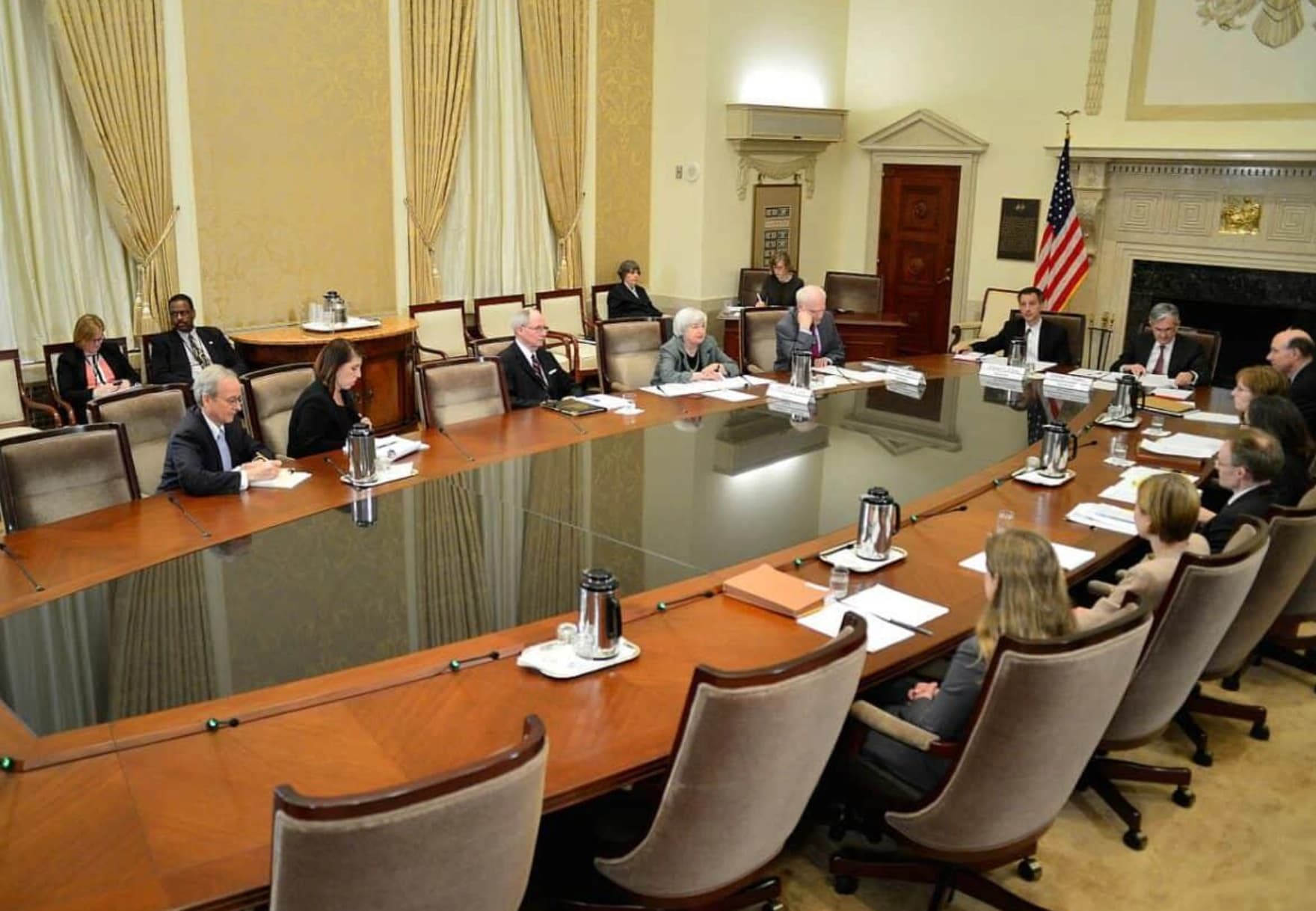
Three Federal Reserve officials voted to raise the federal funds rate at the July 29 FOMC meeting — and tomorrow at 2:00 PM ET, the minutes from that meeting drop, giving markets their clearest window yet into how fractured the committee has become. The effective fed funds rate sits at 3.63%, the 10-year Treasury yield closed Monday at 4.72%, and the curve is now 53 basis points steep at the 2s10s spread — a configuration that historically signals the market is pricing in either sustained inflation or a coming rate shock. With Jackson Hole beginning Thursday, tomorrow's minutes are not background reading. They are the trade setup.
The Dissent That Changes Everything
Three dissents in favor of a rate hike at a single FOMC meeting is not a rounding error — it is a structural signal about where the committee's internal center of gravity is drifting. Beth Hammack, Neel Kashkari, and Lorie Logan all voted to raise the target range for the federal funds rate by 25 basis points at the July 29 meeting. That would have moved the target range to 3.75%–4.00%, reversing the easing that began in late 2025. For context: three dissents favoring a hike while the majority holds is the kind of internal tension that tends to resolve in one direction within one or two meetings. The minutes will show whether the dissenters made any headway persuading colleagues, or whether they were categorically outvoted on the inflation-as-transitory argument.
The policy statement from July 29 acknowledged that "inflation remains elevated relative to the Committee's 2 percent goal, in part reflecting supply shocks that have driven price increases in certain sectors, including energy." That language is deliberately ambiguous. It lets the majority hold rates while nodding to the hawks' concern. But the minutes will contain the actual deliberations — the specific inflation projections members cited, the debate over whether Middle East-driven energy costs are passing through into core services, and whether any swing-vote members moved closer to the dissenters' camp between June and July. That is where the actionable information lives.
The Inflation Math Doesn't Favor the Doves
The case for the three dissenters is straightforward when you run the numbers. Headline CPI is running at 3.3% year-over-year as of the July 1 reading. Core CPI — the Fed's preferred signal for underlying demand pressure — is at 2.5%, a full 50 basis points above target. The fed funds rate, in effective terms, sits at 3.63%. That puts the real policy rate at roughly 1.13% on a headline basis and just over 1.1% on core — positive real rates, yes, but not dramatically restrictive given an unemployment rate that has held at 4.1% and an economy that expanded at 1.5% annualized in Q2 2026. The labor market has not broken. Demand has not cratered. The conventional justification for holding or easing — that restrictive policy is doing its job and the economy is cooling — is only weakly supported by the current data configuration.
The energy overlay makes the picture more complicated, not simpler. WTI crude is trading at $78.94 per barrel as of the August 7 reading, and Brent at $87.86 — levels that are not catastrophic but are materially elevated compared to the sub-$70 prints seen in early 2025. Henry Hub natural gas at $2.66 per MMBtu is relatively contained, but oil's pass-through into transportation, logistics, and petrochemical-linked goods takes three to six months to fully appear in core CPI. The hawks' argument is that the committee is looking at June and July core readings that do not yet reflect the full commodity pass-through from a conflict that escalated in May and June. If they are right, the September 11 CPI print — released five days before the next FOMC decision on September 16 — could arrive at a level that forces the committee's hand.
What Traders Must Watch Before September 16
The sequence of events over the next 72 hours is unusually compressed for a macro calendar. Tomorrow's FOMC minutes at 2:00 PM ET set the analytical baseline. Then, starting Thursday at Jackson Hole, Fed Chair Powell addresses a room that contains every major central bank governor on the planet — against a backdrop of the ECB holding at 2.25% after hiking in June, and the Bank of England projecting UK CPI to peak at 3.2% in Q4 2026. Powell's tone at Jackson Hole has historically served as a forward-guidance vehicle. In 2022, his eight-minute speech torched equity markets. In 2024, he signaled the pivot. This year, with three dissents on the table and CPI at 3.3%, the risk asymmetry is heavily skewed toward a hawkish surprise.
For rates traders specifically, the 10-year at 4.72% is the number to anchor on. A hawkish set of minutes tomorrow — meaning the internal debate shows more members moving toward the dissenters' view, or that inflation projection revisions were more significant than the statement implied — could push the 10-year through 4.80% before Thursday's open. The 2-year at 4.19% is more directly policy-sensitive; any repricing of September 16 hike odds from near-zero to even 20–25% probability would move the 2-year faster and sharper than the long end. Conversely, if the minutes reveal that the three dissenters were isolated and the majority firmly views energy inflation as transitory, the curve could steepen further as the long end sells off on fiscal and duration concerns while the short end rallies on rate-hold confidence.
The January 2026 FOMC statement established the committee's earlier posture of data-dependence amid uncertainty — a posture that has now been tested by six months of above-target inflation and a geopolitical shock with no clear resolution. The September 11 CPI print is the next binary event after Jackson Hole, and it arrives with just five days of buffer before the September 16 decision. If tomorrow's minutes show a committee that is more divided than the statement let on, and Powell strikes even a mildly hawkish tone Thursday, the bond market will not wait for September 11 to reprice. Watch the 4.80% level on the 10-year and 4.30% on the 2-year as the near-term triggers.
The Weekly Investor
Daily market analysis for active traders. Free.