Fed's Three Dissenters: The FOMC Split Reshaping Rate Bets
Three FOMC members voted for a hike at the July 29 meeting — the most hawkish internal split this cycle. Here's what it means for September 16.
Key Points
- Three FOMC members voted for an immediate rate hike at the July 29 meeting — the largest hawkish dissent count in this tightening cycle — against a 9–3 vote to hold at 3½–3¾%.
- Chair Warsh's deliberate absence of forward guidance has left markets pricing a 60.1% probability of a September hike, with Governor Cook explicitly stating she is "prepared to act."
- The September 16 decision hinges on two sequential releases: the August labor report on September 4 and CPI on September 11 — both of which must show progress for the hold bloc to maintain its majority.
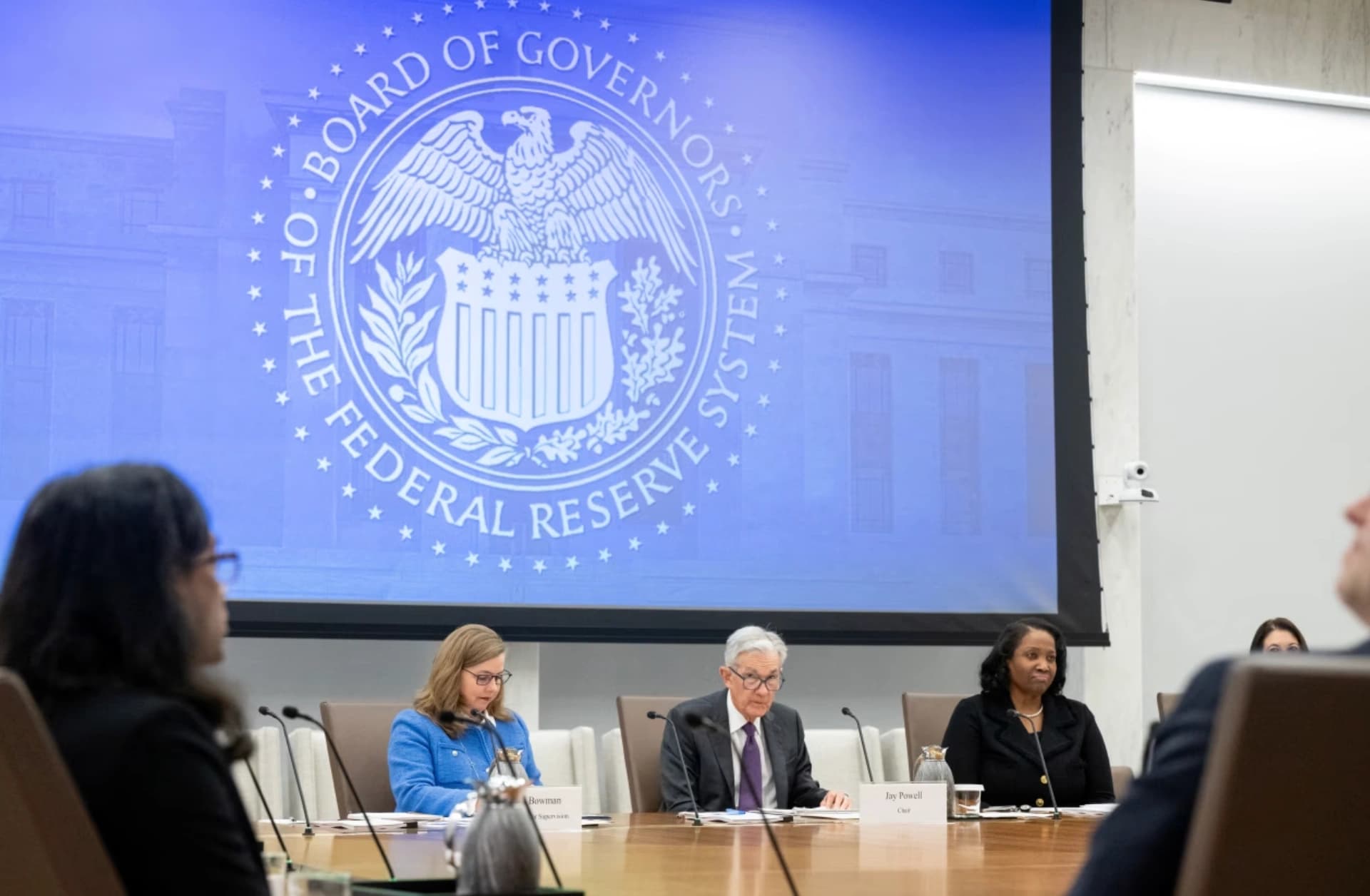
Three voting FOMC members wanted to hike rates at the July 29 meeting. They lost — but the 9–3 vote to hold the federal funds rate at 3½–3¾% is the most hawkish internal split of this entire tightening cycle, and it has turned the September 16 decision into one of the most genuinely uncertain FOMC outcomes in years. Today's ISM and JOLTS releases at 10:00 AM ET are the first live inputs into that decision — and neither the hawks nor the doves can afford to dismiss them.
The Dissent That Changed Everything
Three dissenting votes at a single FOMC meeting is not a procedural footnote. It is a signal that the committee's consensus — nine members voting to hold — is thinner than the headline suggests and more vulnerable to incoming data than any recent Fed communication has let on. In the prior tightening cycle under Chair Powell, dissents of this magnitude were vanishingly rare; the committee moved by consensus almost reflexively. Under Warsh, the gloves are off.
The June dot plot mapped the battlefield explicitly. Nine members projected at least one rate hike in 2026. Eight projected rates unchanged for the year. One dot still projected a cut — an outlier who has, at this point, no live constituency inside the building. That 9-8-1 distribution means the hold majority is a single defection away from being tested, and every data print between now and September 15 is an opportunity for a fence-sitter to move. Governor Cook, who sits on the Board of Governors with a permanent vote, said she is "prepared to act" on a rate hike to address inflation — language that does not leave much interpretive room.
Warsh's decision to strip forward guidance from the July meeting was calculated, not accidental. By refusing to signal what comes next, he preserved maximum optionality for himself and for the committee — but he also created exactly the uncertainty that TD Securities warned about: an erosion of market confidence in the Fed's inflation-fighting resolve. When a central bank chair deliberately does not tell you what he is going to do, the market fills that vacuum with its own projections, and right now those projections sit at a 60.1% probability of a September hike. That is not a comfortable place for risk assets to operate from — it is a coin-flip with a 25 basis point penalty on one side.
The Inflation Math That Keeps Hawks Credible
The July 29 statement acknowledged inflation "remains elevated relative to the Committee's 2 percent goal" — the kind of plain language that gives dissenters their factual anchor. The most recent CPI reading confirmed it: July CPI came in at 3.4% year-over-year, down from 3.5% in June, but still 140 basis points above target. The trend is moving in the right direction, but at a pace that, if maintained, does not get the Fed to 2% before mid-2027. That gap is the hawks' argument: waiting is not a cost-free decision when inflation is still running at 3.4%.
Wells Fargo's framing is the clearest distillation of the hold bloc's conditional position — absent improvement in core inflation, the Fed may be inclined to raise rates later this year. That word "absent" is doing enormous work. It means the hold vote is not a conviction call; it is a conditional reprieve tied to the September 11 CPI print. Goldman Sachs flagged the August CPI specifically as one of two inflation reads that could directly trigger the September hike decision. The July CPI at 3.4% did not resolve that trigger — it deferred it.
The macro backdrop complicates the picture further. Q2 GDP printed 1.5% annualized — below trend but positive — while Personal Consumption Expenditures came in at 3.4% annualized, above the 3.2% consensus. Strong consumer spending alongside sticky inflation is precisely the combination that makes the hawkish case coherent: the economy is not so weak that a hike would cause visible damage, and inflation is not falling fast enough to justify patience. The July 29 FOMC statement described economic activity expanding "at a solid pace despite elevated uncertainty tied to Middle East conflict" — language that does not give doves much structural cover to argue for restraint.
What Has to Happen Before September 16
The sequencing of data between now and the September 15 start of the FOMC meeting is nearly as important as the data itself. ISM Manufacturing and JOLTS land at 10:00 AM ET today. The August labor report — the most watched employment print of the cycle — drops September 4. CPI for August follows September 11. The Fed enters its blackout period before all of that fully digests, which means committee members have a narrow window this week to speak publicly and shape expectations before going dark. No Fed speak is scheduled today, which makes this morning's data releases the dominant market-moving variable in an otherwise quiet session.
The labor market is the swing factor. The July 29 statement said job gains have "kept pace with the workforce" — a neutral characterization that neither validates the hawks nor gives the doves a deflationary signal to point to. If the August NFP print on September 4 comes in below 150,000 — roughly the threshold where the labor market is merely treading water — the hold bloc gets a second data point alongside any CPI softness to argue that tightening is working and patience is warranted. Above 200,000 with wage growth above 4%, and Cook's "prepared to act" language starts looking like foreshadowing rather than posturing. Follow the BLS release schedule for the exact September 4 timing.
The global rate context adds one more layer of pressure. The Federal Reserve sits at 3.75%, the highest among major developed-market central banks, above the Bank of England at 3.75% on a matched basis, well above the ECB at 2.25%, and dramatically above the Bank of Canada at 2.25% and the RBNZ at 2.50%. The Bank of Japan is expected to hike to 1.25% on September 18 — two days after the FOMC decision — which adds yen-carry and dollar-strength dynamics to a September already crowded with event risk. As CNBC's Federal Reserve coverage has tracked, the dollar's trajectory into September 16 will be partly a function of whether traders price a Fed hike alongside a BoJ hike in the same 48-hour window — a combination that historically produces outsized volatility in cross-currency positioning.
The specific date to circle is September 11: if August CPI prints below 3.2% year-over-year, the three dissenters lose their most powerful argument and a hold becomes the path of least resistance. Above 3.3%, and the nine-vote majority starts fracturing. That single number, five trading days before the FOMC decision, is the most important data point between now and September 16 — and everything released between today and then is pre-positioning for the moment that print hits the tape.
The Weekly Investor
Daily market analysis for active traders. Free.