
Defense ETFs Surge $713M as Semis Bleed $728M
Defense ETFs pulled in $712.6M in a single session while SOXX shed $727.8M on Sept. 28 — the sharpest sector rotation in the ETF market this quarter.
Key Points
- Defense ETFs absorbed $712.6 million in a single Monday session while the iShares Semiconductor ETF (SOXX) shed $727.8 million on September 28, marking the most violent single-day sector rotation in the ETF market this quarter.
- Gulf conflict geopolitical risk is driving institutional money out of rate-sensitive, export-dependent semiconductor names and into defense contractors, compounding existing pressure from a stronger dollar and elevated Treasury yields on growth-heavy tech.
- Watch SOXX's $46 billion AUM floor and XLK's $120 billion base for confirmation of whether this rotation has institutional staying power or reverts once quarter-end positioning clears.
Defense ETFs pulled in $712.6 million in a single session Monday while the iShares Semiconductor ETF bled $727.8 million the following day — a near-perfect mirror trade that signals institutional money is not leaving equities but aggressively reallocating within them. This is the cleanest sector rotation signal in the ETF market since Q1, and it is happening at exactly the moment when the macro environment is most hostile to growth-dependent, rate-sensitive technology names.
The Defense Bid Is Institutional, Not Retail
A $712.6 million single-day inflow into defense ETFs is not retail money chasing a headline. Retail flows aggregate slowly and rarely move that volume in one session without an underlying institutional catalyst. The driver here is the ongoing Gulf conflict, which has materially elevated geopolitical risk premiums across energy and defense assets simultaneously — a combination that explains why Energy (XLE) is the best-performing S&P 500 sector year-to-date at +38.9% while growth-heavy Consumer Discretionary (XLY) sits at -8.7%. Defense contractors sit at the intersection of government spending visibility, geopolitical tailwinds, and relative insulation from the dollar-strengthening and yield-rising dynamics that are hammering technology exporters.
The institutional rotation into defense reflects a calculated risk-adjusted positioning decision, not panic. Defense companies carry long-duration government contracts that provide earnings visibility regardless of the rate environment, making them one of the few growth categories that actually benefits from elevated geopolitical uncertainty without requiring a Fed pivot. That structural argument has been building since early 2026, but the single-day $712.6 million print suggests a concentrated institutional decision — likely from a small number of large funds — rather than broad market consensus. If defense ETF inflows repeat above $300 million in Thursday's session, the trade has broadened beyond the initial catalyst.
Semiconductors: Structure Meets Macro Headwind
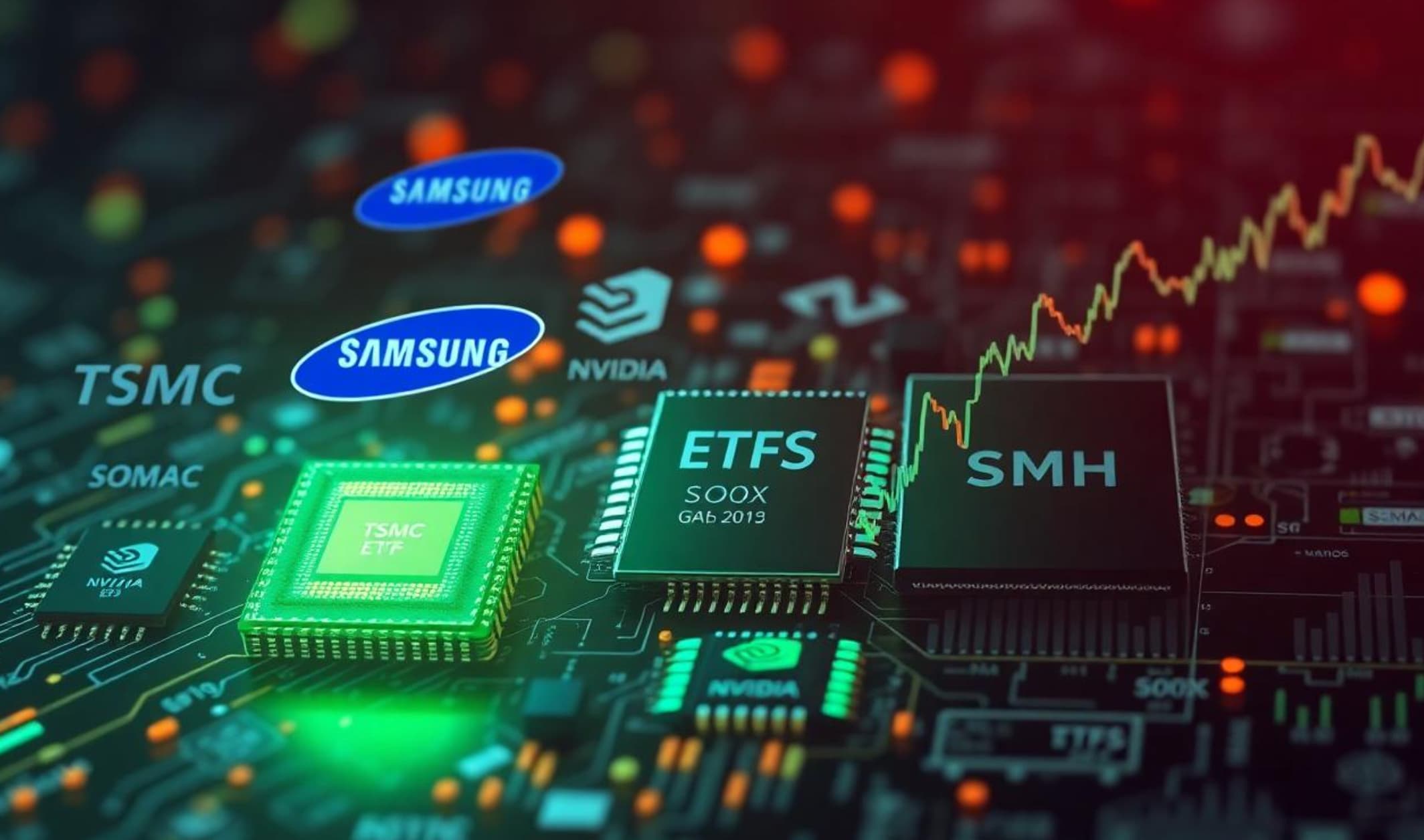
The $727.8 million single-day outflow from SOXX on September 28 is the number that should concern anyone holding semiconductor exposure into Q4. SOXX ended September with $46 billion in assets; SMH, the VanEck equivalent, sat at $70 billion. Together, the two flagship semiconductor ETFs represent roughly $116 billion in indexed and active semiconductor exposure, and both have been under sustained pressure — SMH shed $7.8 billion in the most recent weekly flow data, a 10.61% AUM decline that ranks as one of the steepest in the sector ETF universe this week. XLK, the broad technology sector ETF, lost $9.2 billion in the same period, a 7.69% AUM drop from a $120 billion base.
The semiconductor outflow story has multiple layers. First, the dollar's recent strength directly compresses earnings expectations for the chip companies with the largest overseas revenue exposure — names like NVIDIA, TSMC's ADR, and Broadcom that dominate SOXX and SMH weightings. Second, elevated Treasury yields raise the discount rate on future earnings, hitting high-multiple semiconductor names harder than any other sub-sector in technology. Third, export control risks tied to the Gulf conflict and ongoing U.S.-China technology tensions create a policy overhang that institutional risk managers have been reducing into quarter-end. The combination of macro headwinds and geopolitical risk in a single sector is rare and creates a feedback loop: as large funds reduce SOXX and SMH exposure, the price pressure forces risk-model-driven funds to cut further.
What Traders Watch Next
The sector performance table as of September 29 frames the stakes clearly. Technology (XLK) is still up 35.1% year-to-date despite recent pressure, which means the sector retains enormous unrealized gains that remain vulnerable to continued institutional trimming. The one-month performance of XLK at +4.8% masks the fact that the three-month return of +7.4% is decelerating sharply relative to the first-half pace. Materials (XLB) at -7.0% over one month and Industrials (XLI) at -4.7% over one month show that the selling is not confined to semiconductors — any sector with significant dollar revenue exposure or import cost sensitivity is being repriced. Real Estate (XLRE) lost 6.28% over one month as the yield-sensitive sectors absorb rising rate pressure across the board.
The clearest near-term trade structure sits at the intersection of the outflow data and price levels. The surge in total ETF inflows — $91.9 billion last week alone, pushing 2026 totals to $1.47 trillion — confirms that the semiconductor and tech outflows are rotation, not redemption. The money is not leaving equities; it is leaving growth-at-a-high-multiple for defense, energy, and value. IWD, the iShares Russell 1000 Value ETF, posted $11.2 billion in net inflows this past week, a 12.56% AUM gain that is the strongest proportional move among the large-cap equity ETFs in the data set. DRAM, the Roundhill Memory ETF, added $3.8 billion — a 14.52% AUM jump that suggests not all semiconductor sub-sectors are being abandoned, with memory chip exposure attracting targeted buyers even as broad semi ETFs bleed.
For traders, the specific levels that define the Q4 setup are SOXX at $46 billion in AUM — a breach below that threshold on continued outflows would signal that passive index rebalancing is amplifying the institutional selling into a structural trend — and XLK's $120 billion AUM base, which has already been tested by the $9.2 billion outflow. The October 15 earnings season kickoff for major semiconductor names will serve as the first hard catalyst to either validate the rotation trade or snap it back. If NVIDIA, Broadcom, and TSMC guide down on dollar headwinds and export control costs, the SOXX and SMH outflow trade becomes a multi-quarter thesis rather than a quarter-end positioning story.
The Weekly Investor
Daily market analysis for active traders. Free.